EasyManua.ls Logo

HP 3468A - Page 30

HP 3468A
114 pages
Print Icon
To Next Page IconTo Next Page
To Previous Page IconTo Previous Page
Loading...
=
g-EMENTS
(Cont'd)
ESISTANCE
ME,
MELO
P-L
.
iL
|
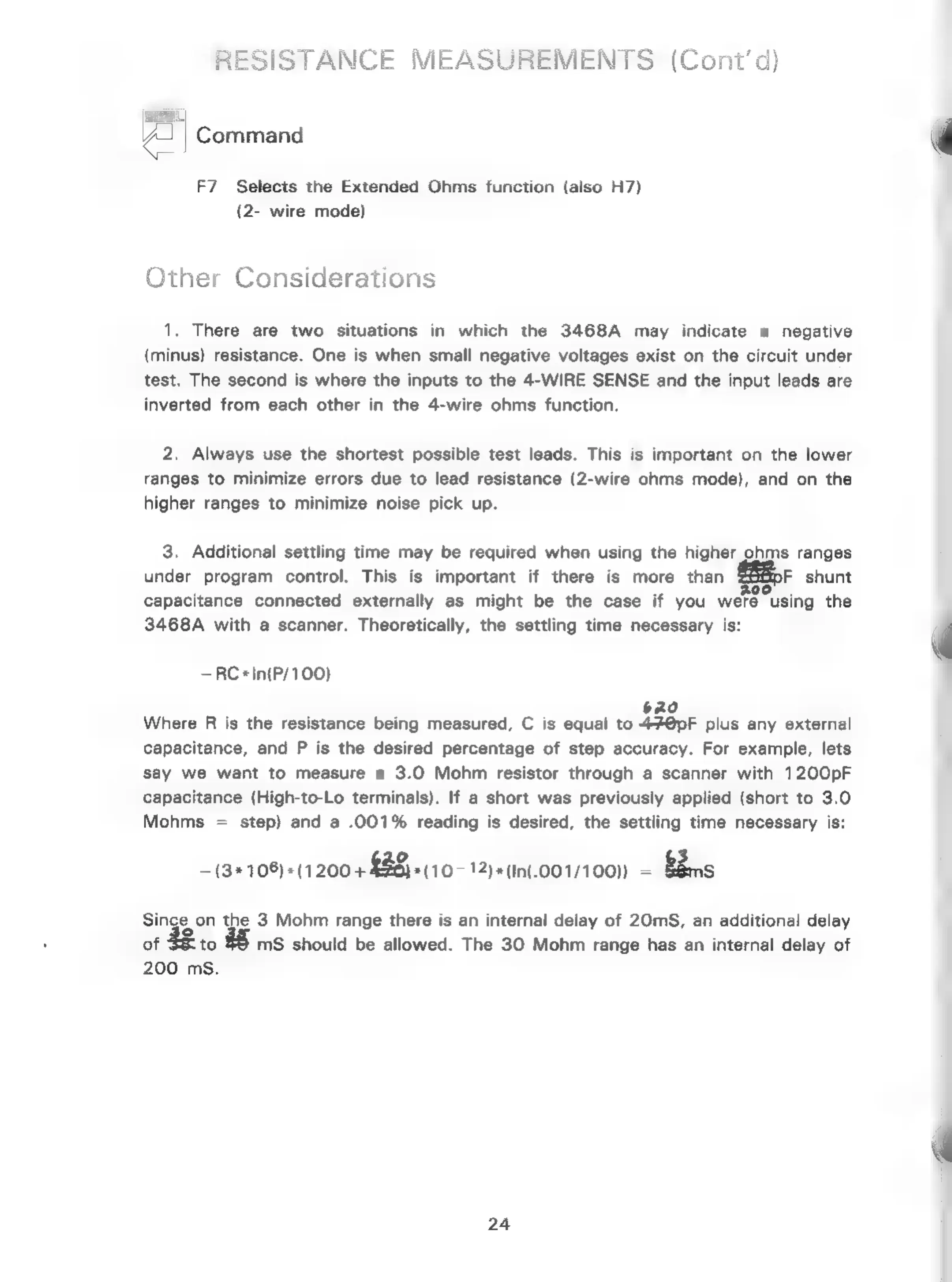
Command
F7
Selects
the
Extended
Ohms
function
(also
H7)
{2-
wire
mode)
Other
Considerations
1.
There
are
two
situations
in
which
the
3468A
may
indicate
a
negative
(minus)
resistance.
One
is
when
small
negative
voltages
exist
on
the
circuit
under
test.
The
second
is
where
the
inputs
to
the
4-WIRE
SENSE
and
the
input
leads
are
inverted
from each
other
in
the
4-wire
ohms
function.
2.
Always
use
the
shortest
possible
test
leads.
This
is
important
on the
lower
ranges
to
minimize
errors
due
to
lead
resistance
(2-wire
ohms
mode),
and
on
the
higher
ranges
to
minimize
noise
pick
up.
3.
Additional
settling
time
may
be
required
when
using
the
higher
ohms
ranges
under
program
control.
This
is
important
if
there
is
more
than
F
shunt
capacitance
connected
externally
as
might
be
the
case
if
you
were
using
the
3468A
with
a
scanner.
Theoretically,
the
settling
time
necessary
is:
—RC*In(P/100)
Where
R
is
the
resistance
being
measured,
C
is
equal
to
$56pr
plus
any
external
Capacitance,
and
P
is
the
desired
percentage
of
step
accuracy.
For
example,
lets
say
we want
to
measure
a
3.0
Mohm
resistor
through
a
scanner
with
1200pF
capacitance
(High-to-Lo
terminals).
If
a
short
was
previously
applied
(short
to
3.0
Mohms
=
step)
and
a
.001%
reading
is
desired,
the
settling
time
necessary
is:
o
~
(3108)
+(1
200
+
$88}
«(10-12)«{In(.001/100))
=
£3mns
Singe
on
the
3
Mohm
range
there
is
an
internal
delay
of
20mS,
an
additional
delay
of
to
a8
mS
should
be
allowed.
The
30
Mohm
range
has
an
internal
delay
of
200
mS.
24
.

Related product manuals