EasyManua.ls Logo

HP 3468A - Receiving Data via HP-IL

HP 3468A
114 pages
Print Icon
To Next Page IconTo Next Page
To Previous Page IconTo Previous Page
Loading...
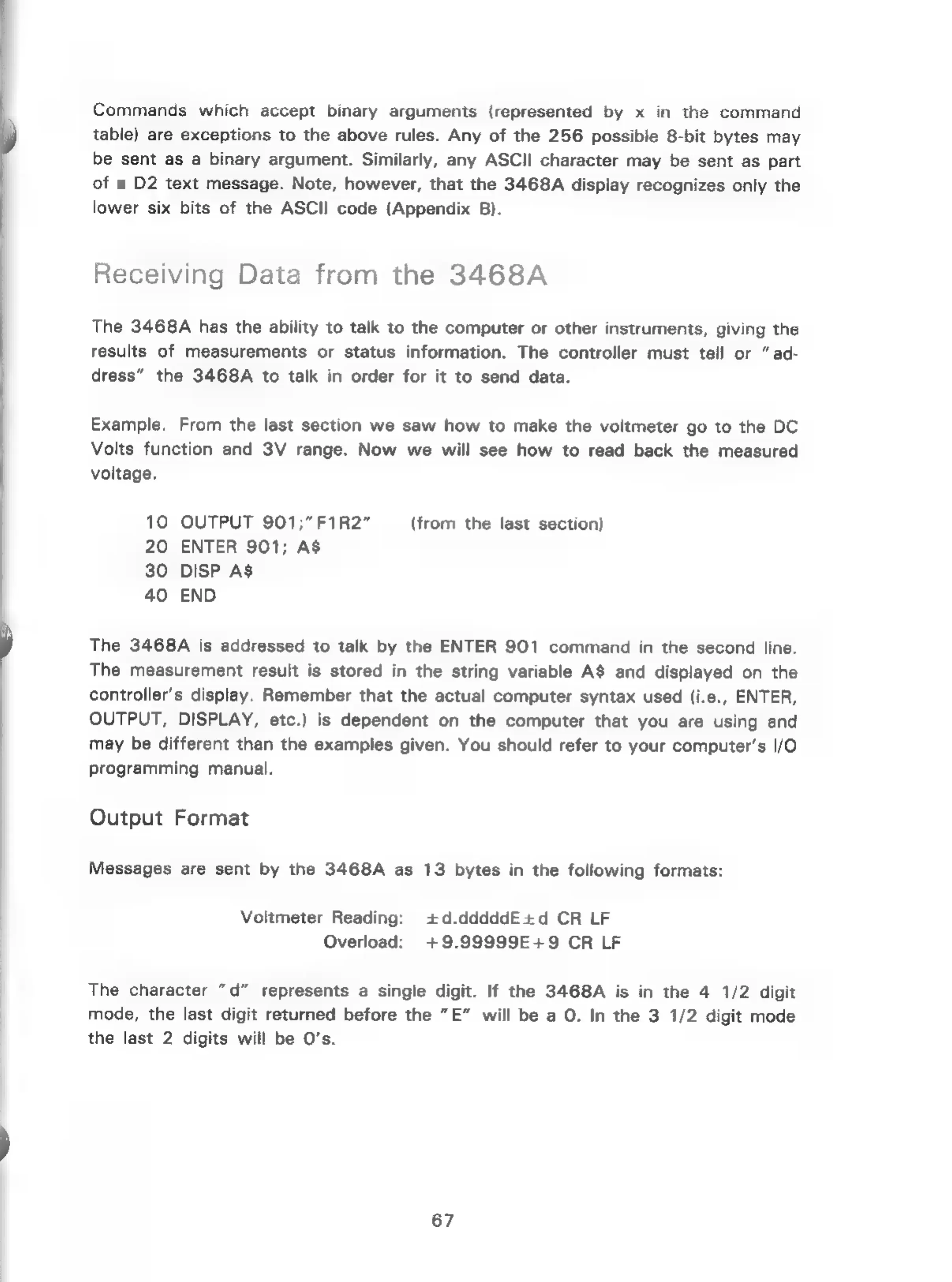
Commands
which
accept
binary
arguments
(represented
by
x
in
the
command
table)
are
exceptions
to
the
above
rules.
Any
of
the
256
possible
8-bit
bytes
may
be
sent
as
a
binary
argument.
Similarly,
any
ASCII
character
may
be
sent
as
part
of
a
D2
text
message.
Note,
however,
that
the
3468A
display
recognizes
only
the
lower
six
bits
of
the
ASCII
code
(Appendix
B).
Receiving
Data
from
the
3468A
The
3468A
has
the
ability
to
talk
to
the
computer
or
other
instruments,
giving
the
results
of
measurements
or
status
information.
The
controller
must
tell
or
”ad-
dress”
the
3468A
to
talk
in
order
for
it
to
send
data.
Example.
From
the
last
section
we
saw
how
to
make
the
voltmeter
go
to
the
DC
Volts
function
and
3V
range.
Now
we
will
see
how
to
read
back
the
measured
voltage.
10
OUTPUT
901;”F1R2”
(from
the
last
section)
20
ENTER
901;
A$
30
DISP
A$
40
END
The
3468A
is
addressed
to
talk
by
the
ENTER
901
command
in
the
second
line.
The
measurement
result
is
stored
in
the
string
variable
A$
and
displayed
on
the
controller's
display.
Remember
that
the
actual
computer
syntax
used
{i.e.,
ENTER,
OUTPUT,
DISPLAY,
etc.)
is
dependent
on
the
computer
that
you
are
using
and
may
be
different
than
the
examples
given.
You
should
refer
to
your
computer's
|/O
programming
manual.
Output
Format
Messages
are
sent
by
the
3468A
as
13
bytes
in
the
following
formats:
Voltmeter
Reading:
+d.dddddE+d
CR
LF
Overload:
+9.99999E+9
CR
LF
The
character
“d”
represents
a
single
digit.
If
the
3468A
is
in
the
4
1/2
digit
mode,
the
last
digit
returned
before
the
”E”
will
be
a
O.
In
the
3
1/2
digit
mode
the
last
2
digits
will
be
O’s.
67

Related product manuals