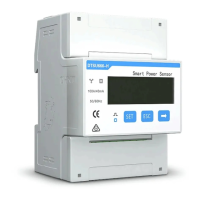
The DDSU666-H Smart Power Sensor is a device specifically designed for distributed photovoltaic systems, serving as a new smart power sensor that integrates measurement and communication capabilities. Its primary application is the measurement of various electrical quantities within an electrical circuit, including voltage, current, power, frequency, power factor, and active energy. The sensor is capable of networking with external devices through its RS485 communication interface. Featuring a standard DIN35mm DIN rail mounting and a structural module design, it is characterized by its small volume, ease of installation, and networking capabilities.
The core function of the DDSU666-H Smart Power Sensor is metering. It accurately measures positive and reverse active energy, as well as combined active energy. A key feature of its metering function is that it ensures no storage data loss even after a power interruption, providing reliable data retention. Beyond energy metering, the sensor also offers a comprehensive measurement function for various electrical parameters. It can precisely measure power, voltage, current, frequency, and power factor, offering a detailed overview of the electrical circuit's performance.
The device incorporates a user-friendly display function. It utilizes a field LCD design to present electrical parameters and energy data. The LCD display is capable of showing energy measurement values with six bits, covering a display range from 0 to 999999 kWh. This allows for clear and immediate access to critical information. The sensor also features a cyclic display function, where items are shifted every 5 seconds, providing a continuous update of various parameters. The cyclic displayed items include current positive active energy (Imp), current reverse active energy (Exp), active power (P), voltage (U), current (I), and frequency (F).
In addition to the cyclic display, the DDSU666-H Smart Power Sensor offers a button display and backlight function. This allows users to manually navigate through different displayed items. The button-displayed items include current combined active energy, current positive active energy (Imp), current reverse active energy (Exp), data format settings (n.1, indicating eight bits, no parity bit, and one stop bit, with baud rates of 9600bps or 4800bps), communication address (Comm.Add), and voltage (U). The backlight automatically closes after sixty seconds of no button operation. By default, the combined active energy is set to be equal to the positive active energy from the factory.
The sensor also includes a parameter setting function, enabling users to configure the communication address and baud rate via buttons. To access the setting interface, a long press of the button for 3 seconds is required. Once in the interface, the sensor will cyclically display options for baud rate and communication address settings. Users can press the button to select the desired setting. If there is no button operation for twenty seconds, the sensor will automatically exit the communication address and baud rate settings.
For communication, the DDSU666-H Smart Power Sensor is equipped with a single RS485 communication interface. The baud rate can be adjusted between 4800bps and 9600bps, with a default baud rate of 9600bps. The communication settings include a check bit and stop bit set to n.1. The communication address is determined by the factory number or the LCD display. The sensor supports the ModBus-RTU protocol, facilitating integration with various external devices for real-time data query and control.
In application scenarios, the sensor plays a crucial role in power restriction for the power grid, coupled with charge and discharge control for energy storage in household inverter schemes. It acts as a core component for household energy management, utilizing RS485 communication to measure electrical quantities and energy, and to respond to real-time data queries from an upper host.
Maintenance features include troubleshooting guidelines for common issues. If there is no display after the instrument is powered on, potential causes are incorrect wiring or abnormal voltage supply. The recommended solutions involve correcting the wiring according to the diagram or supplying the specified voltage. For abnormal RS485 communication, the issues could be a disconnected, short-circuited, or reversely connected communication cable, or a mismatch in address, baud rate, data bit, and parity bit between the instrument and the host computer. The solutions include reconnecting or changing the cable, and setting the communication parameters to match those of the host computer using the buttons. If energy metering is inaccurate, it could be due to incorrect wiring, such as an incorrect phase sequence of voltage and current, or a reversely connected high and low end of the current transformer inlet. Users are advised to check the power of Pa, Pb, Pc for any negative values, which indicate an issue. The elimination method involves connecting based on the correct wiring mode. If all troubleshooting steps are completed and the fault persists, users are advised to contact the installation vendor.
The installation mode involves directly sticking the sensor onto a DIN rail and then installing it in the power distribution box. For installation, one side of the card slot should be stuck first, followed by forcibly sticking the sensor onto the DIN rail. For disassembly, a screwdriver should be used to forcibly hold the flexible card, and then the sensor can be taken out.
The DDSU666-H Smart Power Sensor is designed with safety in mind. Users are advised to follow all precautions and special safety instructions provided by Huawei. Personnel involved in installation or maintenance must be thoroughly trained, understand all safety precautions, and be capable of performing operations correctly. The document emphasizes that Huawei is not liable for consequences arising from violations of safety regulations or device usage standards. Before any operation, it is crucial to read the manual and adhere to all precautions. Operation personnel must comply with local laws and regulations, which are supplemented by the safety instructions in the document. Important safety measures include not operating the product or handling cables during thunderstorms, removing conductors like jewelry or watches before operation, using insulated tools, and tightening bolts with a torque wrench and marking them. Specified procedures must be followed during installation and maintenance, and no alterations should be made without prior consent. The product must be installed strictly according to the quick guide.
Disclaimer information highlights that Huawei is not liable for consequences caused by transportation damage, storage conditions not meeting requirements, incorrect installation or use, installation or use by unqualified personnel, or failure to obey operation instructions and safety precautions. The device should not be operated in extreme environments not covered in the document or beyond specified ranges. Unauthorized modifications, device damage due to force majeure (like lightning, fire, storm), expired warranty, or installation/use in non-specified environments can also void liability.
Personnel requirements state that only certified electricians are allowed to install, connect cables for, maintain, troubleshoot, and replace the DDSU666-H. These personnel must receive professional training, read and follow all precautions in the document, be familiar with electrical system safety specifications, understand the composition and working principles of grid-tied PV power systems and local regulations, and wear proper personal protective equipment (PPE).
Protecting labels is also important; users should not scrawl on or damage warning labels or the nameplate, as they contain critical safety and product information. During installation, it is essential to ensure the DDSU666-H is not connected to a power supply or powered on before completion. Adequate clearances must be maintained for proper heat dissipation and installation.
Electrical connections must comply with local electrical standards, and cables used in a grid-tied PV system must be properly connected, insulated, and meet all specification requirements. A danger warning emphasizes that the DDSU666-H must not be damaged before connecting cables, as this could lead to electric shocks or fire.
During operation, a danger warning highlights the risk of electric shock, serious injury, death, or property damage from the energized DDSU666-H. Users must strictly comply with safety precautions. It is advised not to touch an energized DDSU666-H due to high temperatures and to follow local laws and regulations. For maintenance and replacement, another danger warning reiterates the risk of electric shock from high voltage. Before maintenance, the DDSU666-H must be powered off, and safety precautions must be strictly followed. Maintenance personnel should have sufficient knowledge, proper tools, and testing devices. Temporary warning signs or fences must be placed to prevent unauthorized access. The DDSU666-H should only be powered on after all faults are rectified to prevent escalation of faults or device damage. ESD precautions and ESD gloves must be observed during maintenance.



 To Next Page

 General