
 Need help?
Do you have a question about the Huntleigh SD2 and is the answer not in the manual?
Key safety warnings and precautions for operating the device.
Information on acoustic safety and the ALARA principle for ultrasound use.
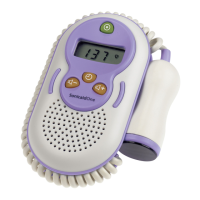
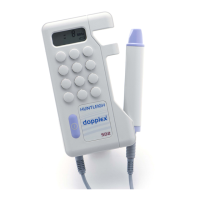
Identification and description of all controls and features on the unit.
How to use the Doppler in vascular mode, including probe selection and clinical application.
Guidelines and considerations for using the Doppler in obstetric mode.
Procedures for cleaning and disinfecting the ultrasound probes based on risk.
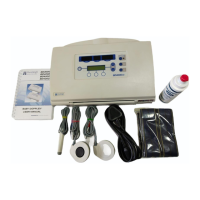
The Huntleigh MD2/SD2 is a high-sensitivity pocket Doppler designed to aid healthcare professionals in vascular and obstetric examinations. This device is a screening tool and should not replace normal vascular or fetal monitoring. Users should familiarize themselves with the controls, display features, and operation to ensure safe and effective use, adhering to ALARA guidelines (As Low As Reasonably Achievable) for ultrasound exposure.
The MD2/SD2 operates in two primary modes: Vascular Mode and Obstetric Mode, automatically selected based on the connected probe.
In Vascular Mode, the device provides bi-directional blood flow rate and direction, indicated on bar graphs with four levels in each direction. Blood flow sounds are audible through the loudspeaker. The probe frequency is also displayed alongside the bar graphs. This mode is suitable for examining various vessels, including jugular, subclavian, femoral, great saphenous, small saphenous, posterior tibial, popliteal, vertebral, carotid, brachial, ulnar, radial, digital, penis, metatarsal, and dorsalis pedis arteries and veins.
For Obstetric Mode, the MD2 provides a Fetal Heart Rate (FHR) display with three operating modes and outputs FHR for printing. The SD2 in obstetric mode provides audio only. The device can calculate fetal pulse signals as early as the 9th or 10th week of pregnancy, though accurate rate computation may not be stable until after the first trimester. It is suitable for intermittent auscultation during the intrapartum period but not for long-term monitoring, which requires cardiotocographic equipment.
Probe Connection: To connect a probe, align the arrow on the connector with the slot on the probe and push firmly. To disconnect, pull the connector sharply, avoiding pulling the cable.
Coupling Gel: Only water-based ultrasound gel should be used with the device.
Vascular Mode Clinical Use: Apply a liberal amount of gel to the examination site. Position the probe at a 45° angle to the skin surface over the vessel. Adjust the probe's position to achieve the loudest audio signal. Arteries produce high-pitched pulsatile sounds, while veins emit a non-pulsatile sound resembling rushing wind. For optimal results, keep the probe as still as possible once the best position is found and adjust the audio volume as needed.
Obstetric Mode Clinical Use: Apply a liberal amount of gel to the abdomen. Place the probe's faceplate flat against the abdomen above the symphysis pubis. Angle the probe to obtain an optimum audio signal, avoiding sliding it over the skin. In early pregnancy, a full bladder may enhance sound detection. In later pregnancy, signals are typically found higher on the abdomen. Fetal heart sounds resemble a galloping horse at approximately twice the maternal rate, while the placenta produces a wind-like sound.
Gain Control: A gain control allows optimization of the bar-graph display and increases waveform height. On the MD2, gain is adjusted using the Mode button (x1, x2, x4, x8); on the SD2, it's the Gain button.
Waveform Recording (MD2 Only): The MD2 provides separated waveform outputs in analogue and digital formats. Analogue signals can connect to a single-channel chart recorder for a combined bi-directional waveform or a dual-channel recorder for separate forward and reverse flow waveforms. Digital signals are transmitted via the RS232 port for printing on a Dopplex Printa II or for communication with Dopplex Reporter software.
Cal Function (MD2 Only): This function sets the baseline and sensitivity for chart recorders, generating a zero-velocity baseline and a sequence of bi-directional pulses.
Automatic Shut-off: If the unit is not manually switched off, it will automatically shut off after 3 minutes of no signal or 10 minutes unconditionally.
General Care: All Huntleigh products are designed for normal clinical use, but delicate components like the probe tip require careful handling. Periodically, or if system integrity is in doubt, perform a check of all functions as described in the manual. Any defects to the housing should be reported to Huntleigh or a distributor for repair or replacement.
Storage: If not for immediate use, re-seal the unit in its original packing after inspection. Store under covered conditions at temperatures between +14°F to +104°F (-10°C to +40°C) and relative humidity of 10% to 93% non-condensing. Remove the battery if the unit will not be used for an extended period. Store the unit, probe, and accessories in the provided soft carry case after use and cleaning.
Maintenance and Repair: There are no user-serviceable parts inside the control unit or probe. Regular inspection is recommended, paying attention to the probe tip for cracks and the cable/connector. Any crackling or intermittent behavior should be investigated. The product does not require periodic maintenance. For service, contact the Service Department at ArjoHuntleigh Inc.
End of Life Disposal: The product, including accessories and consumables, is subject to WEEE regulations and should be disposed of responsibly according to local procedures.
 General
| Category | Fetal Doppler |
|---|---|
| Frequency | 2 MHz |
| Display | LCD |
| Fetal Heart Rate Range | 50 - 210 bpm |
| Type | Doppler |
| Audio Output | Built-in Speaker |
| Weight | 300g (including battery) |



 To Next Page