FUEL & COOLING
20
8
ATTENTION:
Service more frequently when
riding under hard conditions
Carburettor setting:
To ensure an easy start of the engine, a high
level of performance and a reduction of any risk
of engine damages, the carburettor has to be
correctly set and adjusted.
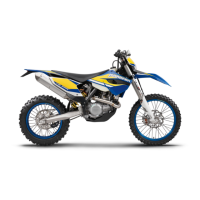
The carburettor has an idling screw (Fig. 8C-1)
and a mixture screw (Fig. 8C-2) that have to be
properly adjusted. In order to carry out a proper
adjustment of these, the engine has to be warm.
With the twistgrip fully closed, turn the idling
screw to a position that makes the engine run
smoothly at idling speed (approximately 1600-
1800 rpm).
Adjust the mixture screw to a position of a
maximum idling speed.
If the engine now runs in a too high idling speed
unscrew the idling screw until a satisfying idling
speed is established.
A guideline regarding the mixture screw is 1½-
2½ turns from the bottom position of the screw.
Depending on the altitude and the humidity, the
adjustment may have to be changed whenever
riding under various conditions.
CARBURETTOR:
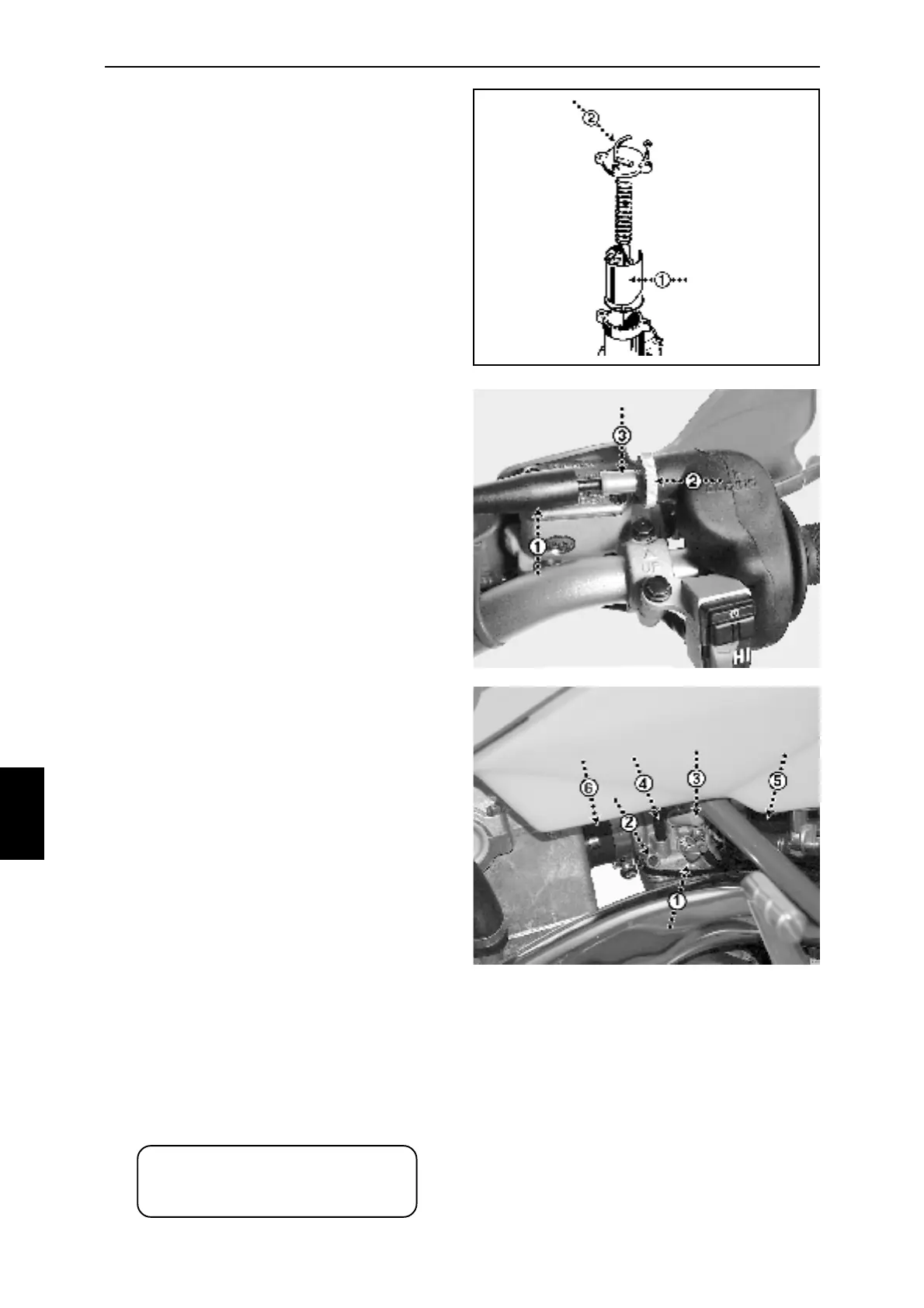
Always make sure that the throttle (Fig. 8A-1)
returns to a fully closed position.
Always make sure that the twistgrip and cable
move easily.
Always keep the twistgrip and cable well cleaned
and lubricated. The tube on top of the carburettor
(Fig. 8A-2) is a point of deterioration to the cable
and thus a vital part of the cable to be inspected.
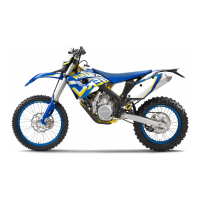
Always make sure of a 1-2 mm clearance in the
twistgrip. Adjustment is done by removing the
dust protection (Fig. 8B-1), releasing the lock nut
(Fig. 8B-2) and adjusting the adjustment screw
(Fig. 8B-3).
Fig.
8A
Fig.
8B
Fig.
8C
8 A
Always check the intake manifold (Fig. 8C-6) and
the airfilter tube (Fig. 8C-5) for any cracks and/
or leakages and replace if necessary.
Always keep the shaft of the choke lever (Fig.
8C-3) well lubricated.
Always check that the overflow tubes (Fig. 8C-4)
on each side of the carburettor are positioned in
a vertical position straight from the outlets and
not crossed nor hanging over the carburettor.
Always ensure that an appropriate fuel is used
(minimum 98 octane) in order to get the most
out of the motorcycle and to ensure a proper
function of the engine.



 To Next Page