Proper use of the Sludge Judge in
Hydro-Action Industries Systems
A Sludge Judge is a device used to discover tankage sludge levels. Proper use in our
systems is as follows:
1. Let the Sludge Judge down into the tank to be tested, being sure to keep the Sludge
Judge as close to vertical as possible, until it contacts the bottom of the tank. (As
sludge in the ATU tends to assume a dished shape due to mixing currents, two
readings should be taken: against the tank wall and the center of the clarifier.)
2. Pull the Sludge Judge vertically out of the tank and inspect.
3. You should find a sludge level indicated in the barrel of the Sludge Judge. Note that the
barrel of the Sludge Judge is marked in 1 foot intervals. Using these marks, estimate the
depth of sludge indicated to the nearest inch (i.e. halfway between marks would be 6”,
etc.)
4. Make a note of the sludge levels on your inspection report.
System Tankage Sludge Level Suggestions
Tankage Level Logic
The primary problem with sludge build-up in the pre-
Treatment (or ‘trash’) tank is one of obstructed volume. An
important role played by this tank is the dilution of
chemicals harmful to the bacterial colony. As sludge builds
up in this tank, the volume of liquid influent is reduced,
thereby reducing the total volume available for dilution.
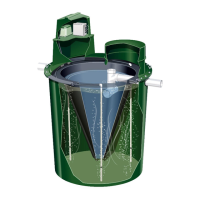
The clarifying cone in the center of the ATU extends to
within 8” of the bottom of the tank. If the opening at the
bottom of this cone is obstructed, cleaned mixed liquor
cannot enter the clarifier, leading to poor quality effluent.
Sludge build-up is almost never a problem in the pump tank,
due to the extremely pure effluent produced in the ATU.
We use a mid-suction pump in the pump tank, and the
intake on that pump is 12” from the bottom of the tank. If
sludge is allowed to enter this intake, effluent pump life will
at least be greatly shortened, and the pump could possibly
fail immediately. Such a failure is not warrantied.


 To Next Page