Need help?
Do you have a question about the Hyster J019 and is the answer not in the manual?
Provides general manual information and describes electrical schematic layout and description.
Covers schematic location numbering, component representation, and wire identification.
Details wire color coding and the purpose/identification of wire harnesses.
Describes how wire harnesses are connected and indicated on schematics.
Explains connector types, identification, pins, and descriptions.
Details the location and function of fuses in the electrical system.
Describes the relay panel and individual relays for system functionality.
Covers flyback diode function and the CAN bus communication system.
Describes the instrument panel components, indicators, and testing.
Covers CAN bus diagnostics and general fault finding procedures.
Provides a guideline for finding electrical faults in the system.
Guides on identifying wire harnesses and locating specific connectors.
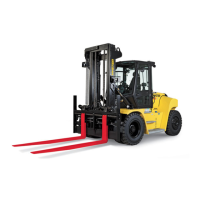
This document is a service and repair manual for Hyster J019 (H300HD2, H330HD2, H360HD2, H360HD2-EC) forklift models, as well as H8.0-12.0XM-6 (H190-280HD2) [K007], H13.0-14.0XM-6 (H300-330HD2) [J019], H16.0XM-6 (H360HD₂) [J019], H10.0-12.0XM-12EC (H360HD2-EC) [J019], H16XM-9, H16XM-12, H18XM-7.5, H18XM-9 (H360-36HD, H360-48HD) [A238] forklifts, specifically focusing on the electrical system.
The manual provides comprehensive information on the electrical system of the specified Hyster forklift models. It details the electrical schematic and system description, including the identification of electrical components, wires, harnesses, and connectors. The electrical schematic is organized by function, with each sheet representing a specific function or area of the forklift's electrical system. This modular approach allows for easier troubleshooting and maintenance. The system incorporates a CAN (Controller Area Network) bus for communication between various controllers, such as the transmission controller, hydraulic controller, instrument cluster, and engine control module. This network enables efficient data exchange and coordinated operation of different forklift functions. The manual also covers diagnostic procedures, including general fault finding, and provides detailed information on the instrument panel, which displays critical operational data and warning lights.
The electrical system relies on a structured wire identification system. Each electrical wire is identified by a solid line, an identification number, and a color code for its insulation. Wire identification numbers range from 1 to 999, with specific ranges assigned to different function ID groups. For instance, grounds are numbered 101-149, switched B+ are 200-239, and communication wires (CAN) are 900-909. Electrical wire colors are standardized to indicate circuit levels: Red for Battery Level Power Circuits, Black for Heavy Current Grounds, Green for Signal Grounds, Pink for 12 Volt, Orange for 5 Volt Supply, White for Other Circuits, Yellow (Twisted Pair) for CAN Hi, and Green (Twisted Pair) for CAN Lo.
The system includes various fuses and relays for circuit protection and control. The grid heater and alternator have separate fuses located in the engine compartment, while other electrical circuits are protected by fuses in four panels behind the instrument panel cover. Relays, except for the grid heater and starter relay, are located on a dedicated relay panel. The manual lists specific fuse values and their locations, such as a 5A fuse for the OPS Switch (F10), 30A for Flood Lights (F11), and 15A for Mast/Attachment Lights (F16). Relays are also detailed, including their functions (e.g., Flood Lights, Main Power, Ignition, AC Fan) and their corresponding connectors and locations.
Flyback diodes are integrated into connectors to prevent current surges when components are switched off, thereby protecting mechanical contacts in switches and relays from premature erosion. The CAN bus system uses twisted pair wires (900 green for data inverse and 901 yellow for data) to reduce sensitivity to electromagnetic interference. Termination resistors (120 Ohm) are present at the extreme ends of the controller string to ensure proper CAN bus functionality.
The electrical system supports various operational features of the forklift:
The manual emphasizes several maintenance and repair guidelines:


 To Next Page
 General