440 01 4300 00 23
Specifications subject to change without notice.
Roll−Out Protection
Provide a minimum 12−in. x 22−in. (305 x 559 mm) piece of
sheet metal for flame roll−out protection in front of burner area
for furnaces closer than 12−in. (305 mm) above the
combustible deck or suspended furnaces closer than 12−in.
(305mm) to joists. The sheet metal MUST extend underneath
the furnace casing by 1−in. (25mm) with the door removed.
The bottom closure panel may be used for flame roll−out
protection when bottom of furnace is used for return air
connection. See Figure 26 for proper orientation of roll−out
shield.
Supply Air Connections
For a furnace not equipped with a cooling coil, the outlet duct
shall be provided with a removable access panel. This opening
shall be accessible when the furnace is installed and shall be of
such a size that the heat exchanger can be viewed for possible
openings using light assistance or a probe can be inserted for
sampling the air stream. The cover attachment shall prevent
leaks.
Connect supply−air duct to flanges on furnace supply−air
outlet. Bend flange upward to 90 with wide duct pliers. (See
Figure 22) The supply−air duct must be connected to ONLY
the furnace supply−outlet−air duct flanges or air conditioning
coil casing (when used). DO NOT cut main furnace casing side
to attach supply air duct, humidifier, or other accessories. All
supply−side accessories MUST be connected to duct external
to furnace main casing.
Return Air Connections
The return−air duct may be connected to bottom of the furnace.
The side of casing that faces downward may also be used for
return air connection. A combination of the bottom and
downward facing side may also be used. The upward facing
side of the casing cannot be used as a return air connection.
(See Figure 29)
Bottom Return Air Inlet
These furnaces are shipped with bottom closure panel installed
in bottom return−air opening. Remove this panel when bottom
return air is used. This panel may be used for rollout protection
or discarded. To remove bottom closure panel, perform the
following:
1. Tilt or raise furnace and remove four (4) screws holding
bottom plate. (See Figure 19)
2. Remove bottom plate.
3. Remove bottom closure panel.
4. Reinstall bottom plate and screws.
Side Return Air Inlet
These furnaces are shipped with bottom closure panel installed
in bottom return−air opening. This panel MUST be in place
when side return air inlet(s) are used without a bottom return air
inlet.
Not all horizontal furnaces are approved for side return air
connections (See Figure 29)
Filter Arrangement
! WARNING
FIRE, CARBON MONOXIDE AND POISONING HAZARD
Failure to follow this warning could result in personal injury, or
death.
Never operate a furnace without a filter or filtration device
installed. Never operate a furnace with filter or filtration device
access doors removed.
Furnaces shipped without a filter rack:
There are no provisions for an internal filter in these furnaces.
An external filter rack is required and is purchased separately.
A field supplied accessory air cleaner may also be used in
place of the filter rack.
For upflow applications, the filter can be installed on either side
of the furnace, the bottom of the furnace or any combination of
side and bottom of the furnace. (See Figure 28, Figure 30, and
Figure 31)
For downflow applications, the filter rack (or field supplied
accessory air cleaner) must only be connected to the bottom
opening on the furnace (See Figure 27 and Figure 31 and
Table 9).
For horizontal applications, the filter rack (or field supplied
accessory air cleaner) can be connected to the bottom opening
on the furnace. For side return use in the horizontal position,
refer to Figure 29. If both side and bottom openings are used in
Figure 29, each opening used will require a filter.
A filter rack or any field supplied accessory air cleaner can also
be installed in the common return duct prior to entering the
return air opening in any orientation.
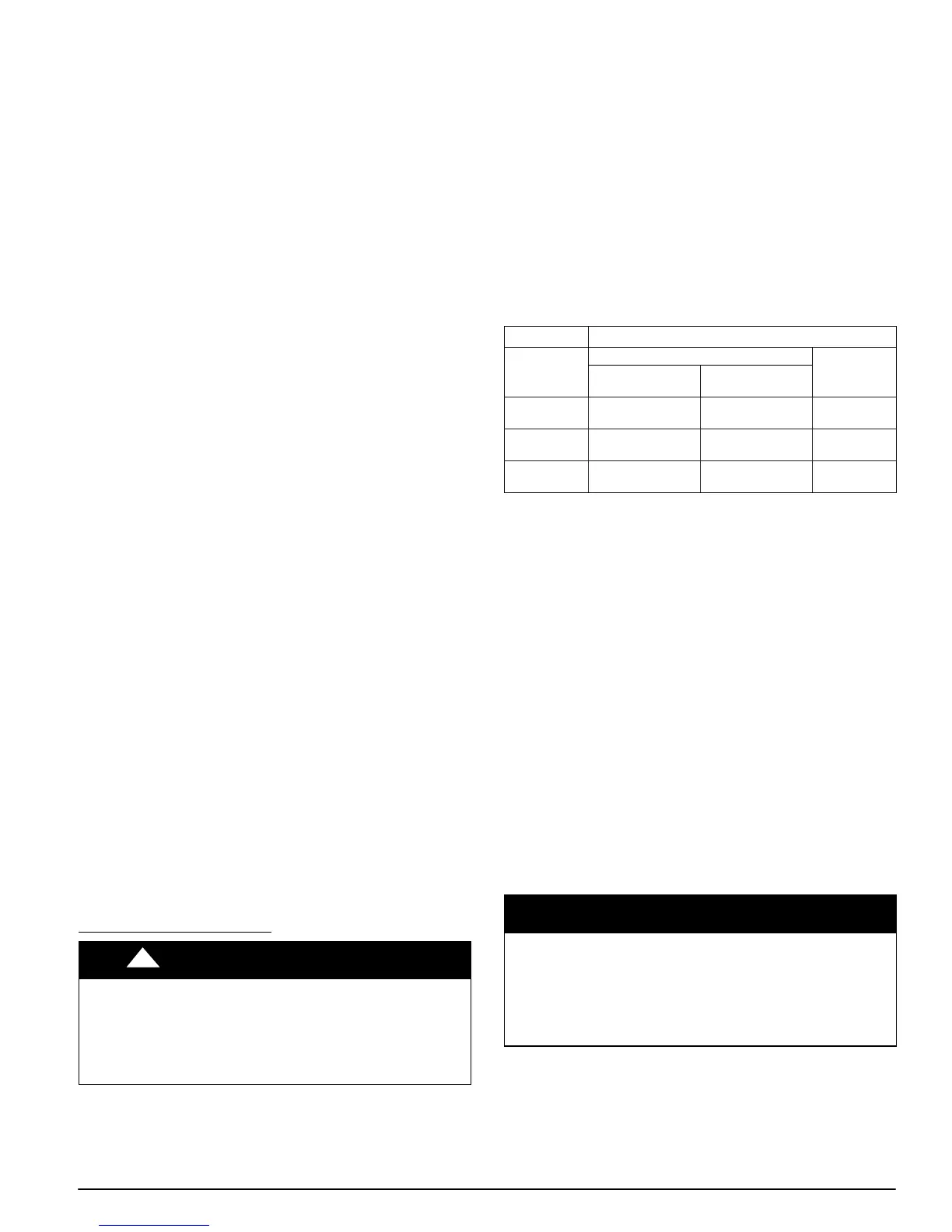
See Table 6 for recommended filter size details.
Table 6 Filter Size Information − inch (mm)
FURNACE
CASING
WIDTH
FILTER SIZE
FILTER
TYPE
SIDE RETURN
BOTTOM
RETURN
17-1/2
(445)
16 x 25 x 3/4
(406 x 635 x 19)
16 x 25 x 3/4
(406 x 635 x 19)
Washable*
21 (533)
16 x 25 x 3/4
(406 x 635 x 19)
20 x 25 x 3/4
(508 x 635 x 19)
Washable*
24-1/2
(622)
16 x 25 x 3/4
(406 x 635 x 19)
24 x 25 x 3/4
(610 x 635 x 19)
Washable*
* Recommended to maintain air filter face velocity. See Product Data for part
number.
Refer to the instructions supplied with the Filter Rack or
accessory air filter for additional assembly and installation
options.
Filter and Return Duct Sizing
Pressure drop must be taken into account when sizing filters,
filter racks, IAQ devices, and associated system ductwork. See
Table 7 for a comparison of Pressure Drop (initial/clean
resistance to airflow) versus Airflow for a variety of filter media
types and sizes. These are representative numbers. Consult
the filter or IAQ device manufacturers’ specification sheet for
performance data for a particular filter media or IAQ device.
Design the filter and associated ductwork for the best match of
pressure drop versus filter size. Best practice usually chooses filter
systems with pressure drops under 0.2 in. w.c. (50 Pa), with the
best blower electrical efficiency and system airflow performance
occurring with filter pressure drops under 0.1 in. w.c. (25 Pa).
Due to the relatively high pressure drops of 1-in (25 mm) thick
after-market filter media, it is recommended that the filtration
system be designed for at least 2-in (51 mm) thick media.
TIPS FROM CONTRACTORS: Install a media cabinet capable
of incorporating a 4-in (102 mm) thick media filter. This allows
room for future upgrades to other IAQ devices.
NOTICE
Design the duct system FIRST to determine how much pres-
sure drop may be allowed in the filter system. See the AIR
DUCTS section. Excessive filter pressure drop often com-
promises system airflow and duct performance, causes inad-
equate airflow to the furthest ends of the duct system, as well
as causes excess noise and higher than anticipated electrical
consumption.
Provide duct transitions, as required, to smoothly transition airflow
from the return duct system to the filter (or IAQ device) to the
furnace when the dimensions of the ductwork or furnace return air
opening do not match the required filter or IAQ device dimensions.
See the instructions supplied with factory-accessory duct
adapters.



 To Next Page