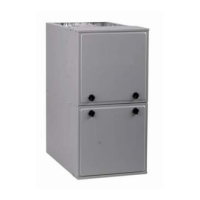
SERVICE AND TECHNICAL SUPPORT MANUAL Gas Furnace: N9MSB
Specifications subject to change without notice.
440 04 4413 03 5
Adjustments
FIRE HAZARD
Failure to follow this warning could result in personal injury,
death and/or property damage.
DO NOT bottom out gas valve regulator adjusting screw.
This can result in unregulated manifold pressure and result
in excess overfire and heat exchanger failures.
!
WARNING
FURNACE DAMAGE HAZARD
Failure to follow this caution may result in reduced furnace
life.
DO NOT redrill orifices. Improper drilling (burrs,
out−of−round holes, etc.) can cause excessive burner
noise and misdirection of burner flames. This can result in
flame impingement of heat exchangers, causing failures.
(See Figure 2)
CAUTION
!
Figure 2 Orifice Hole
A93059
BURNER
ORIFICE
For proper operation and long term reliability the furnace input
rate must be within +/−2 percent of input rate on furnace rating
plate, or as adjusted for altitude.
The gas input rate on rating plate is for installation at altitudes
up to 2000 ft. (610 M)
NOTICE
The NATURAL GAS manifold pressure adjustments in Table 3
compensate for BOTH altitude AND gas heating value. DO
NOT apply an additional de−rate factor to the pressures shown
in Table 3. The values in this Table and NOT referenced to sea
level; they are AS−MEASURED AT ALTITUDE.
The heating content of natural gas at altitude may already
provide for a reduction in capacity or altitude. Refer to Table 3.
No adjustments to the furnace may be necessary at altitude for
certain gas heating values.
Refer to the instructions provided in the factory-specified
Propane conversion kit for instructions for setting gas manifold
pressures for Propane applications.
In the USA, the input rating for altitudes above 2000 ft. (610 M)
must be reduced by 2 percent for each 1000 ft. (305 M) above
sea level refer to Table 1. The natural gas manifold pressures
in Table 3 adjust for BOTH altitude and natural gas heating
value.
In Canada, the input rating must be reduced by 5 percent for
altitudes of 2000 ft. to 4500 ft. (610 to 1372 M) above sea level.
The natural gas manifold pressures in Table 3 adjust for BOTH
altitude and natural gas heating value.
NOTE: For Canadian altitudes of 2000 to 4500 ft. (610 to 1372
M), use USA altitudes of 2001 to 3000 ft. (611 to 914 M) in
Table 3.
To adjust manifold pressure to obtain the proper input rate, first,
determine if the furnace has the correct orifice installed. At
higher altitudes or different gas heat contents, it may be
necessary to change the factory orifice to a different orifice.
Tables have been provided in the furnace Service and
Technical Manual to match the required orifice to the manifold
pressure to the heat content and specific gravity of the gas. To
do this:
1. Obtain average yearly gas heat value (at installed
altitude) from local gas supplier.
2. Obtain average yearly gas specific gravity from local gas
supplier.
3. Find installation altitude range for your installation in the
manifold pressure tables in Table 3.
4. Find closest natural gas heat value and specific gravity in
Table 3. Follow heat value and specific gravity lines to
point of intersection to find orifice size and low-and
high-heat manifold pressure settings for proper
operation.


 To Next Page
 Loading...