Need help?
Do you have a question about the ICP PGF Series and is the answer not in the manual?
Explains DANGER, WARNING, and CAUTION signal words and their usage in manuals and on labels.
Details the visual characteristics and color coding of DANGER, WARNING, and CAUTION product labels.
Details the physical dimensions and connection points for smaller capacity units.
Details the physical dimensions and connection points for larger capacity units.
Shows specific measurements for gas, electrical, and condensate drain connections.
Covers qualified installers, code compliance, and general operational warnings.
Details minimum clearances to combustible materials and location considerations.
Includes warnings about corrosive atmospheres and the need for level installation.
Covers requirements for ground-level and rooftop installation, plus safe hoisting methods.
Details converting the unit for downflow use and installing the heating vent assembly.
Explains the requirements for installing a condensate trap and drain line for proper drainage.
Details gas supply requirements, pipe sizing based on length, and BTU ratings.
Covers connections at the unit, including materials, joint compound, and critical safety warnings.
Details orifice sizes for natural and LP gas, considering altitude and BTU input.
Step-by-step instructions for safely changing unit orifices and manifold measurements.
Emphasizes electrical safety, proper grounding, and line voltage connection requirements.
Covers thermostat/heat anticipator setup and final electrical inspection procedures.
Discusses maximum recommended duct velocities and air delivery capacities.
Covers combustion blower pipe installation and requirements for ductwork insulation.
Guides on initial checks, including filters, panels, and scroll compressor rotation.
Details gas pressure requirements and procedures for manifold pressure adjustment.
Specifies minimum, recommended, and maximum inlet pressures and manifold pressure settings.
Outlines steps to check the circulating air blower's operation and safety shutoffs.
Details the sequence for ignitor glow, pilot flame, main burner ignition, and blower activation.
Explains how to check temperature rise and verify limit control function during operation.
Describes how to enable and configure continuous fan operation using speed taps.
Guides on selecting and connecting blower motor speed taps for heating, cooling, and continuous fan.
Details checks for contactor, compressor, condenser fan, and blower operation in cooling mode.
Explains how the fan control module manages combustion and indoor blower for heating and cooling.
Instructions for inspecting, cleaning, or replacing air filters to ensure optimal performance.
Guidance on monthly checks for pilot flame stability and main burner flame characteristics.
Covers monthly checks for the condenser coil and condensate drain during the cooling season.
Instructions for oiling the condenser fan motor after specified periods of operation.
Details accessing and maintaining the blower motor and housing, including removal.
Guidance on oiling the blower motor and cleaning the blower wheel and compartment.
Procedures for inspecting burners, heat exchangers, and flue gas passages for wear or blockage.
Step-by-step instructions for cleaning burners, collector box, and flue gas passages.
Provides essential safety warnings and instructions for rigging and lifting the unit.
Details maximum dimensions and weights for small and large cabinet units for rigging purposes.
Outlines the general terms, conditions, and limitations of the limited warranty for residential products.
Lists specific conditions and damages that are not covered by the limited warranty.
Details limited lifetime and specific term warranties for various gas and oil furnace heat exchangers.
Covers warranty terms for compressors, optional accessories, and functional component parts.
This document provides installation, operation, and maintenance instructions for Combination Units with Gas Heat and Electric Cool functionalities, specifically covering PGF, PGC, PGS, GPFM, GPCM, and GPSM models ranging from 1.5 to 5 tons.
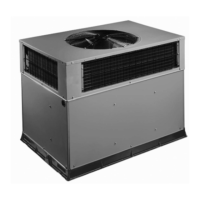
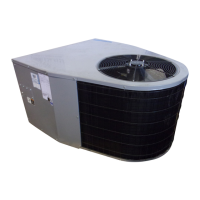
These combination units are designed to provide both heating and cooling for residential or commercial applications. They utilize gas for heating and an electric cool system for air conditioning. The units are self-contained, meaning all major components for both heating and cooling are housed within a single cabinet. The gas heating system involves burners, a heat exchanger, and a combustion air blower, while the electric cooling system includes a compressor, condenser coil, and evaporator coil. A circulating air blower distributes conditioned air throughout the building via ductwork. The unit's operation is controlled by a fan control module and a thermostat, allowing for automatic regulation of temperature.
The units are adaptable for both ground-level and rooftop installations, with specific platform requirements outlined for each. For ground-level installations, a level and strong platform, either concrete or pressure-treated wood, is necessary, ensuring proper condensate drainage. Rooftop installations require an adequate roof structure or reinforcement to support the unit's weight. The units can be converted for downflow applications by removing and reinstalling blockoff plates in the return and supply air compartments.
Gas supply and piping are critical for the heating function. The manual emphasizes using the correct type of gas (natural gas or LP gas) as specified on the rating plate and ensuring the gas supply line is of adequate size. Proper pipe joint compound application and the installation of a drip leg are highlighted to prevent dirt and moisture from entering the gas valve. Orifice sizes must be matched to the heating value of the gas and adjusted for high altitudes if necessary. The manual provides detailed instructions for changing orifices, a procedure that requires a qualified service technician.
Electrical wiring must conform to local codes and the National Electrical Code, with a separate fused circuit and a disconnect switch located within sight of the unit. All line voltage connections and grounding must be made with copper wire. The thermostat's location significantly impacts unit operation, and its heat anticipator must be set correctly.
Start-up procedures include checking blower motor speeds, ensuring clean and properly sized air filters are installed, and replacing all service access panels. For scroll compressor units, reverse rotation must be checked and corrected if necessary by reversing any two wires at the line voltage connections. Manifold gas pressure adjustment is a key step during heating start-up, requiring a U-tube manometer and careful adherence to specified pressure values to avoid property damage or injury. The heating start-up sequence involves the combustion air blower activating, the ignitor glowing, the pilot flame lighting, and then the main burners igniting, followed by the circulating blower.
For cooling, the thermostat is set to cool, and the system's components (contactor, compressor, condenser fan motor, and circulating air blower) are checked for proper operation during power application. The fan control module manages the "ON" and "OFF" delays for the circulating air blower, with adjustable settings for both heating and cooling cycles. Separate speed selections for heat, cool, and continuous fan operation are available, allowing for optimization of airflow and temperature rise.
Regular maintenance is crucial for the efficient and safe operation of the unit. Monthly checks include inspecting and cleaning air filters, which are a common cause of inadequate performance if dirty. Washable filters can be cleaned with mild detergent and cold water. Filters must be replaced with arrows pointing in the direction of airflow.
During the heating season, monthly checks involve inspecting the pilot flame to ensure it envelops the upper part of the flame sensor and observing the main burner flame for stability, solid blue color (without solid yellow tips), and proper extension into the heat exchanger tubes. The vent hood and inlet air opening in the burner compartment should be inspected for soot, rust, corrosion, or obstructions and cleaned as required.
For the cooling season, monthly checks focus on the condenser coil, ensuring it is clean and free of debris, and the condensate drain, which should be checked for proper drainage and cleaned as needed.
Annual maintenance and inspection require turning off electric power and gas supply before removing access panels. The condenser fan motor should be oiled after five years of operation and every five years thereafter, using SAE 10W30 motor oil. The blower wheel and compartment should be visually inspected for dirt or lint and cleaned. Excessive accumulation may necessitate removing the blower assembly.
Inspection and cleaning of the burner assembly, heat exchangers, and flue gas passages are critical and should only be performed by a qualified service technician. This involves disconnecting electrical power and gas, removing various components like the burner access panel, vent assembly flue pipe, gas pipe, and gas control valve, then cleaning the burners with a stiff brush or hot water. Flue gas passages are cleaned using small brushes and a vacuum cleaner. After cleaning, all parts and gaskets are reinstalled, gas supply is checked for leaks, and access panels are secured before restoring power and checking for normal operation. The spark gap for spark-to-pilot models must be checked during reinstallation.
 General
| Category | Air Conditioner |
|---|---|
| Series | PGF |
| Refrigerant | R410A |
| Warranty | 5 years |
| Dimensions (Outdoor Unit) | Varies by model (Consult product data sheet) |
| Weight (Outdoor Unit) | Varies by model (Consult product data sheet) |


 To Next Page