Need help?
Do you have a question about the ICP PHX336000K00A1 and is the answer not in the manual?
Provides detailed dimensional specifications and diagrams for the "B" chassis heat pump units.
Details dimensions and requirements for roof curb installations for "B" chassis units.
Covers essential safety precautions, unit placement, access panel locations, and minimum clearances for safe operation.
Outlines procedures for unit installation, including ground level, rooftop, hoisting, downflow conversion, and condensate drain setup.
Specifies requirements for disconnect switches and proper ground connections to ensure electrical safety.
Guides for making line voltage and low voltage/thermostat wiring connections within the unit.
Details guidelines for ductwork sizing, insulation, connections, and ensuring proper airflow.
Explains the necessity of filters and lists minimum recommended filter sizes for various unit models.
Presents a table of blower speeds and corresponding air delivery (CFM) at various static pressures.
Illustrates blower speed tap settings for low, rated, and high capacity airflow for different models.
Describes how to adjust blower speeds for heating and cooling, including specific wiring instructions.
Lists essential checks to perform before powering on the unit for initial startup.
Details the operational sequence for both cooling and heating modes, including stage changes and fan control.
Explains features like the scroll recycle delay timer, continuous fan operation, and defrost mode sequences.
Outlines routine monthly inspections, including checking and replacing air filters.
Details monthly checks for the cooling season, focusing on the condenser coil and condensate drain.
Covers comprehensive annual inspections, including fan motors, blower access, and cleaning procedures.
Presents the schematic wiring diagram for the 2 to 5 ton PHX3 series heat pumps.
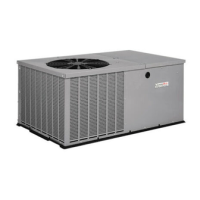
This manual describes the PHX3 Series Package Heat Pumps, available in 2 to 5 ton capacities. These are fully self-contained electric heat pump units designed for outdoor installation. They feature return and discharge openings for both horizontal and downflow configurations, with downflow duct openings factory-covered.
The PHX3 Series units provide both heating and cooling functions. In cooling mode, a two-stage indoor thermostat controls the operation. A first-stage call for cooling (Y1) energizes the indoor fan (low stage) and, after a 5-minute time delay (for initial start-up), the compressor (low stage) and outdoor fan motor. If the cooling demand is not met, a second-stage call (Y2) switches the compressor to high-stage cooling via an internal solenoid valve within the scroll compressor and switches the indoor fan to high stage. When the second-stage cooling demand is satisfied, Y2 de-energizes, returning to low-stage cooling. When the low-stage cooling demand is met, Y1 de-energizes, shutting off the compressor, indoor fan, and outdoor fan.
In heating mode, a first-stage call for heating (Y1) energizes the indoor fan (low stage) and, after a 5-minute time delay, the compressor (low stage) and outdoor fan motor. If the heating demand is not met, a second-stage call (Y2) switches the compressor to high-stage heating via an internal solenoid valve within the scroll compressor and switches the indoor fan to high stage. Auxiliary or backup heat is controlled by a third stage (W2) and, if the demand is still not met, W3 is energized for staged heating. When heating demand is satisfied, W3, W2, and Y2 sequentially de-energize, returning to low-stage heating. When the low-stage heating demand is met, Y1 de-energizes, shutting off the compressor, indoor fan, and outdoor fan.
The units are equipped with a defrost mode. When the defrost sensor closes in heating mode, a delay (30, 60, 90, or 120 minutes, selectable via dipswitches on the defrost board) precedes the defrost cycle. During normal defrost, the condenser fan turns off, the reversing valve energizes to cooling mode, and auxiliary electric heat (W2) is energized. After the defrost sensor opens or a maximum of 10 minutes, the condenser fan energizes (after 20 seconds), and the reversing valve de-energizes to heat mode. Electric strip heat also de-energizes (after 15 seconds) unless required by the thermostat. A scroll recycle delay timer on the defrost board delays compressor start-up for 5 minutes after a power interruption to prevent reverse rotation.


 To Next Page
 General