Separate Circuit
Page 23
If the open is not found after tracing the length of the run, the conductor may be capacitively
coupled. This condition causes a signal bleed-off onto the other adjacent conductors. To remove
this effect, ground the adjacent conductors and minimize the distance between the transmitter
connection and the open.
Finding Shorts and Incorrectly Spliced (Shared) Neutrals
Applications include determining causes of breakers tripping, fuses blowing, and current leaking
on the ground conductor. The tracer locates the origin of the ground fault or dead-short in these
circuits.
1) Use a continuity check to determine which conductors are shorted. (See note below for
specific methods when using the TR-946 vs. the TR-948.)
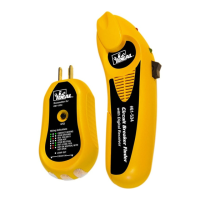
2) Connect the transmitter to the shorted circuit and power it on.
a) One lead should be connected to the faulted conductor and the other lead to ground.
b) If the ground fault is in metallic conduit, then the conduit is the ground.
c) If possible, ground the adjacent conductors.
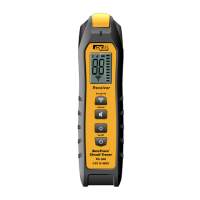
3) Turn on the receiver and use the default maximum sensitivity ( ).
4) Starting several feet from the transmitter, use a linear sweeping motion and the back of the
receiver to find the strongest signal location behind the wall, above the ceiling, or under
the floor.
c) If the signal is too strong, reduce the sensitivity range.
d) If the signal is too weak, connect one lead of the transmitter into the open conductor and
connect the other lead to a remote return path. Then, repeat step #3.
Note: By definition, a short is a connection between two conductors. Determining which two
conductors are shorted typically requires the use of a MultiMeter with a continuity function when
using the TR-946. The model TR-948, which is part of the 61-948 kit includes a patent pending
automatic continuity function to aid in determining which two conductors are shorted. Simply
clip one alligator clip to one of the suspect conductors and attach the other clip to various
conductors until you hear a short beep and see the red LED light up confirming continuity. Then
start your scan out on the branch circuit to locate the unintended short such as a shared neutral,
neutral to ground bond, or possibly a hot to neutral fault.


 To Next Page