Note on the sample
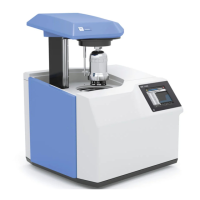
The calorimeter system IKA
®
C 6000 global stan-
dards/isoperibol is a precision measuring instru-
ment for the routine determination of calorific
values of solid and liquid substances. Exact mea-
surements can however be achieved only if the
individual steps of the trial are performed with
care. The procedure as described in the „For your
safety“ section and in the following sections must
therefore be adhered to exactly.
If you are burning unknown
samples, leave the room or
keep well away from the
calorimeter!
A few points should be noted in respect of the
substances to be combusted:
• Normally, solid substances can be burned direct-
ly in powder form. Rapidly burning substances (for
example benzoic acid) must not undergo combus-
tion in loose form.
Benzoic acid must only be burned in the form
of pellets! Combustible dust and powder must
be compressed into pellets before combustion.
Oven-dry dust and powder such as wood chips,
hay, straw etc. burn in an explosive manner! They
must be moistened first! Readily combustible liq-
uids with a low vapor pressure must not be come
in direct contact with the cotton thread (e.g. tet-
ramethyl dihydrogen disiloxan).
Rapidly burning substances tend to squirt. Such
substances must be pressed into tablets be-
fore combustion. Suitable for this is e.g. the
IKA
®
-pelleting press C 21, see „Accessories“.
• Most liquid substances can be weighed directly
into the crucible. Liquid substances exhibiting
turbidity or containing water that will settle out
must be dried or homogenized before they are
weighed in. The water content of these samples
must be determined.
• Highly volatile substances are placed in combus-
tion capsules (gelatin capsules or acetobutyrate
capsules, see „Accessories“) and undergo com-
bustion together with the capsules.
• For substances with low flammability or low
calorific substances use combustion aids (see
„Accessories“). Before the capsules or the com-
bustion bag is filled with the substance to be
determined, it must be weighed in order to de-
termine the additional extraneous energy intro-
duced into the system from the weight and the
gross calorific value. This is taken into consider-
ation with QExtern2. The amount of combustion
aid should be as little as possible.
• Under the conditions that prevail during calo-
rimetric measurements, sulfur and nitrogen un-
dergo combustion and form SO
2
, SO
3
and NO
X
.
Sulfuric and nitric acid arise in combination with
the water resulting form combustion. Heat of
solution is also generated. This heat of solution is
taken into consideration in calculating the gross
calorific value. In order to quantitatively record
and determine all acids that have been formed,
about 5 ml of distilled water or another suitable
substance can be added to the decomposition
vessel before the experiment.
The calibration of the system must have been
performed in accordance with the instructions!
After combustion, the water that was added, is
collected and the decomposition vessel is rinsed
thoroughly with distilled water. The rinsing water
and the solution formed from the water that was
added are combined and the acid content of the
combined solution is examined. If the sulfur con-
tent of the combustion aid and the nitric acid cor-
rection are known, the water does not need to be
analyzed.
To increase the service life of parts to wear
and tear (O rings, seals etc.) we recommend to
work with water added to the experiment as a
matter of general principle.
Caution! Risk of corrosion!
Substances with high halogen
content must not be combusted
in the C 6010 decomposition vessel; instead use the
C 6012 decomposition vessel.
DANGER
WARNING


 To Next Page
 Loading...