8
Analogue speed control
With this control, the speed of the pump, and therefore its suc-
tion power, is reduced the closer the measured pressure reaches
the target value. Once the target value is reached, the pump only
operates according to the leakage rate of the system. This enables
quiet functioning, precise vacuum control and a long service life
for the moving pump parts. Exact automatic boiling point recogni-
tion is possible with this type of control, meaning that the system
reaches and keeps the solvent at its boiling point in automatic
mode.
t
mbar
must be used, for example. Diaphragm vacuum pumps are often
used as pumps for the preliminary stage in these contexts.
Compressing and releasing the pressure on air creates a noise. The
pump is quieter the less air is transported. This means that there is less
operating noise during normal operation if the pressure is reduced.
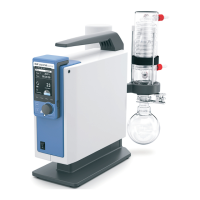
The IKA
Vacstar
control is controlled via a Wireless Controller
(WiCo). If the WiCo is attached to the station, data exchange bet-
ween the pump (station) and WiCo is performed via the contacts
(page 11, (A/Q)) "Home" symbol appears on the display of the
WiCo. If the WiCo is neither bolted to the station the data ex-
change between the pump and WiCo is performed via Bluetooth
®
.
In this case the Bluetooth
®
symbol is displayed. Depending on the
structure of the building, the WiCo can be operated at a distance
of up to 150 m from the station, using the Bluetooth
®
connection.
The WiCo can be attached to the pump (station), or can be ins-
talled in a safe place easily accessible by the user while the pump
is running. If the WiCo is attached to the station, the rechargeable
battery is automatically recharged via the contacts (page 11, (A/Q))
The rechargeable battery can also be charged via the USB port of
the WiCo.
In automatic operation with controlled speed the pump reduces its
speed when it reaches the target value. If the leakage rate in the
entire system is low enough, the speed may even be set to “zero”.
Schematic view of speed vacuum control
NOTE
Generally speaking, the smaller the
volume to be evacuated, the lower
the speed should be. The final pres-
sure is not controlled.
Diaphragm vacuum pumps are oscillating displacement pumps.
The diaphragms expand the volume of the vacuum chamber to
produce an underpressure, which sucks air into the chamber. The
air is then pressed out of the vacuum chamber by subsequent
compression. Changes between the inlet and outlet are controlled
by diaphragm valves.
The physical unit for pressure is 1 Pascal [Pa].
However people often still use the unit millibar [mbar] colloquially.
1 mbar = 100 Pa
1 bar = 10
5
Pa
1 Pa = 10
-5
bar
1 Pa = 0.01 mbar
A distinction is made between different ranges in vacuum tech-
nology.
Rough vacuum: 10
5
to 10² Pa (1000 to 1 mbar)
Fine vacuum: 10² to 10
-1
Pa (1 to 10
-3
mbar)
High vacuum: 10
-1
to 10
-5
Pa (10
-3
to 10
-7
mbar)
Ultra high vacuum < 10
-5
Pa (< 10
-7
mbar)
The periodic movements of the diaphragms create a vacuum at
the pump inlet. Diaphragm vacuum pumps work with a rough
vacuum of up to 10
2
Pa. Lower pressures cannot be achieved with
these pumps.
To create fine, high and ultra high vacuums, oil-sealed vacuum
pumps, screw pumps, diffusion pumps or turbomolecular pumps
Charging the RB 1 battery pack (rechargeable battery)
The battery pack of the Wireless Controller can be charged by any
of the following means:
• on the Vacstar station
• via a USB cable at the PC or station
• via an OS 1.0 power supply unit.


 To Next Page
 Loading...