IMCA M 229 9
7.2 Measurement Principles
7.2.1 Range
The range measurement is the most important function of traditional radars and it is achieved
by measuring the time T
R
taken by a signal to travel to the target and return (i.e. time of travel).
The more accurate the time measurement, the more accurate the range measurement R will
be.
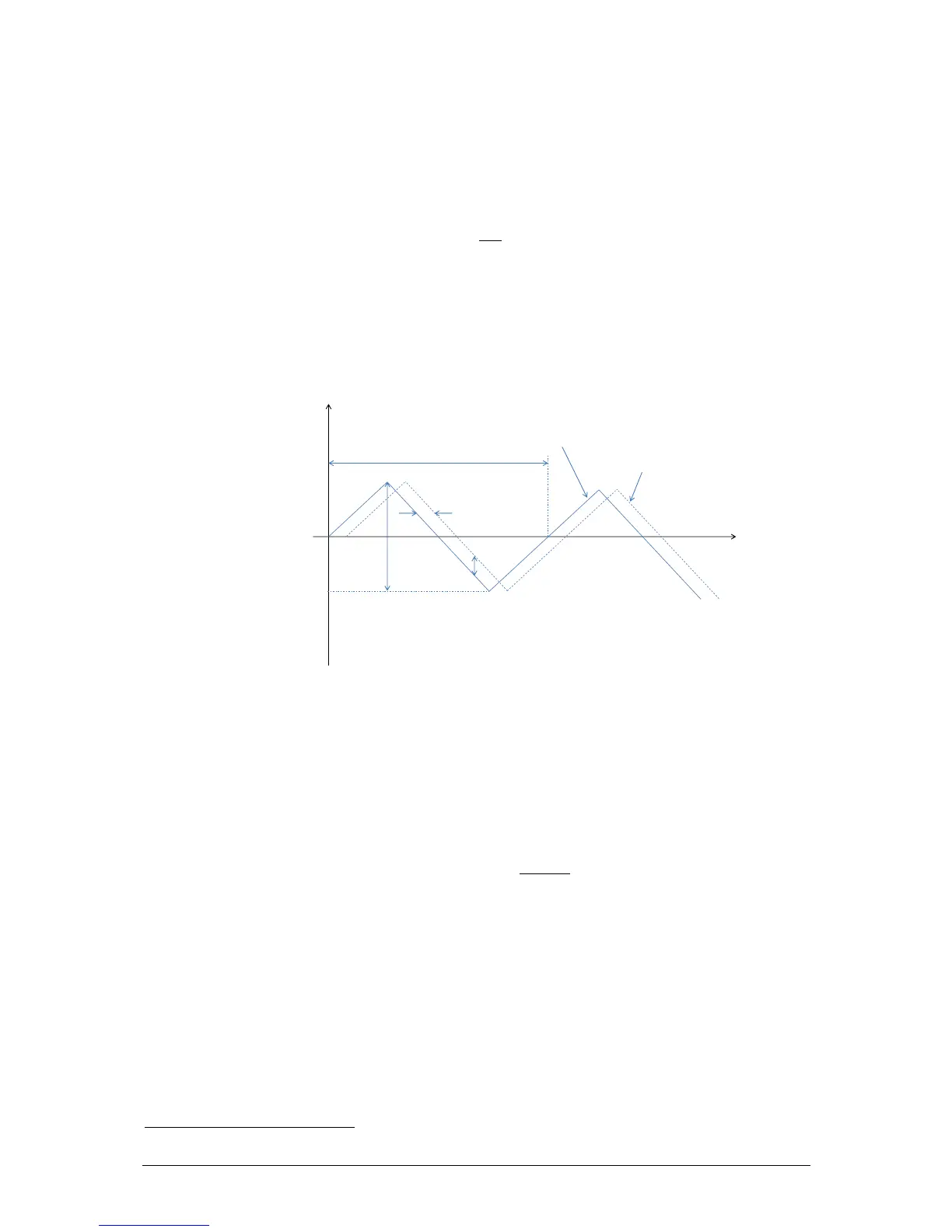
The Mini RadaScan sensor operates using the well-known principles of FMCW radars,
where
the difference in frequency between the transmitted (Tx) and the echoed signal (Rx) – f
b
(beat
frequency) – is proportional to the transit time and c is the speed of light.
Figure 5 – FMCW beat frequency illustration (no Doppler shift)
While DP operations are usually executed at low-speed, the vessel movements are still
significant enough to introduce a non-negligible Doppler frequency shift.
If the frequency is modulated at a rate f
m
over a range ∆f (Figure 5), the beat frequency can be
expressed as a function of the range:
By measuring the beat frequency within a few Hz and compensating for the Doppler shift, the
Mini RadaScan sensor is able to measure the range with great accuracy. However it should be
noted that the sensor only reports the range from the sensor to the responder and not the
horizontal distance to the structure (see Figure 6).
Skolnik MI, 1981, Introduction to Radar Systems, McGraw-Hill Book Co., Singapore



 To Next Page