IMCA M 229 21
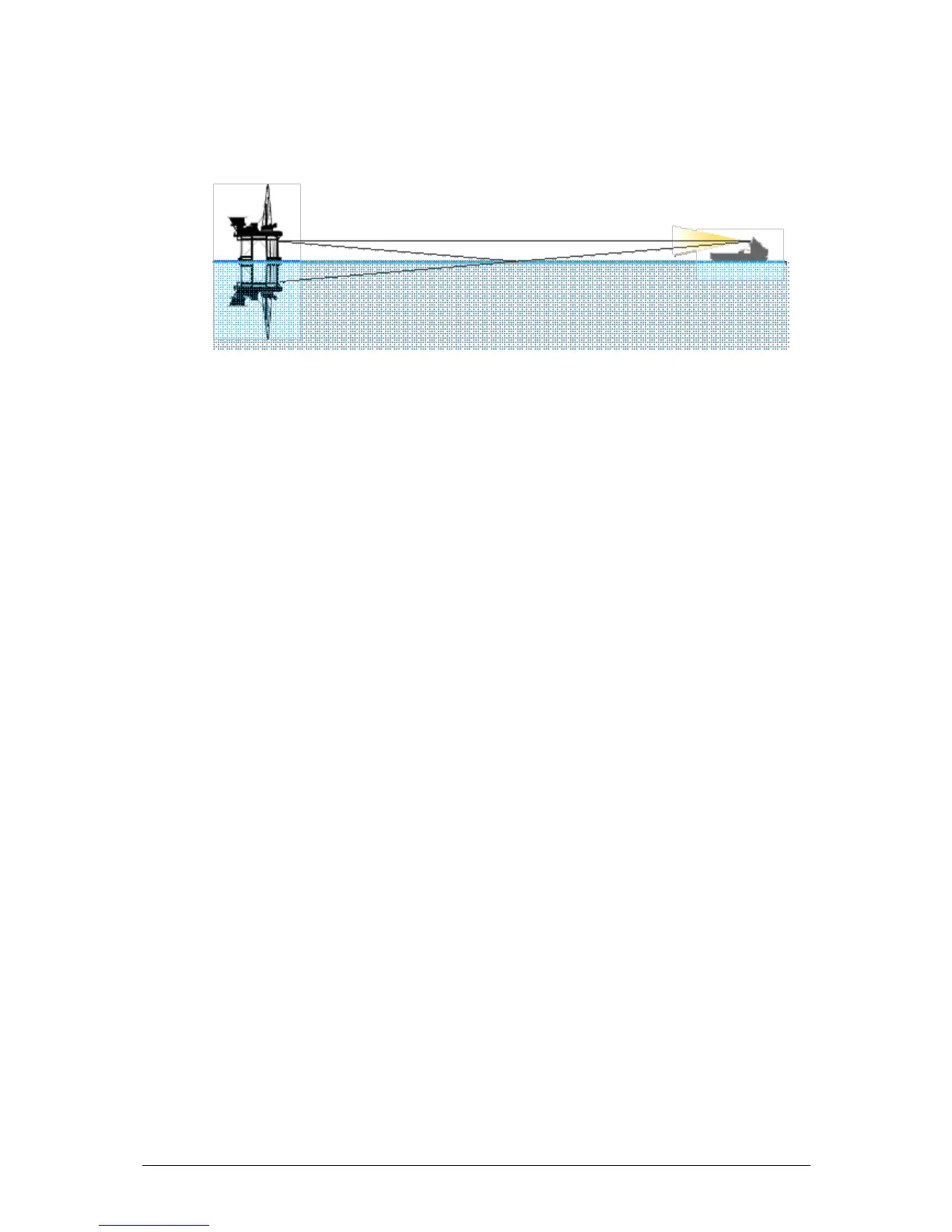
Longer ranges: Multi-path nulls are seldom a practical problem for DP vessels in any case. The effect
is most prominent at long distance and low height. A radar position reference sensor is typically
mounted at least 15 m above the surface of the water. At this height we can rely on the frequency
diversity of the FMCW radar to deliver a usable signal at least as far as 1000m. Height diversity measures
are not required for ordinary work boat operations, at least, not with Mini RadaScan.
Medium ranges: At more modest ranges (200 m to 300 m), sea reflections can have a significant effect
on accuracy. Here the direct image and the reflected image are not so close that they cancel each other
out in destructive interference. But they are closer than the range resolution capability of the radar.
That means that the two images interfere with each other and the range measured to either of them is
distorted. Resulting range errors can be up to a few decimetres. Again, this phenomenon from the
underlying physics affects all microwave radar systems. The effect is a function of bandwidth rather than
of radio frequency. Various mitigating measures are taken within Mini RadaScan, but it remains the fact
that operation in this range is the most challenging in terms of range accuracy. And in this range, sea
reflection is by far the most important source of measurement error.
Shorter ranges: At shorter ranges, sea reflection is less of a problem. First of all the difference in
distance between the direct image and the reflected image becomes great enough for the two images
to be separated, allowing accurate measurement of both ranges. Secondly the reflected image becomes
much fainter. As the grazing angle increases, the reflectivity of the water decreases. Also the reflection
moves to the edge of the main lobe of the radar antennas.
The geometry and environment are key to understanding the performance of a microwave radar system
such as Mini RadaScan so tests done on land at about 2 m above the ground are not a good indication
of the accuracy which is achievable in typical operations at sea.
Sea reflection is at its most troublesome when the sea is calm because waves tend to break up the
reflection. So conditions in the harbour approach represent the worst case.
11.4.1 Sea Reflection – Harbour Case Study
The sensor and responder were relatively low (average height above the water of 15 m), which
brings the onset of measurement errors due to sea reflection closer.



 To Next Page