IMCA M 229 23
The impact of sea reflection on accuracy depends on the region of operation:
Very little radiation reaches the
sea surface. Reflected image is a
few metres further away than the
direct image and can easily be
rejected
Reflected image is a metre or
two further away than the
direct image. It can usually be
rejected, but it can distort the
direct image
Reflected image is only a
fraction of a metre further
away than the direct image.
The images can’t be separated
Table 1 – Sea reflection accuracy summary
11.4.2 Sea Reflection – Typical Operating Conditions
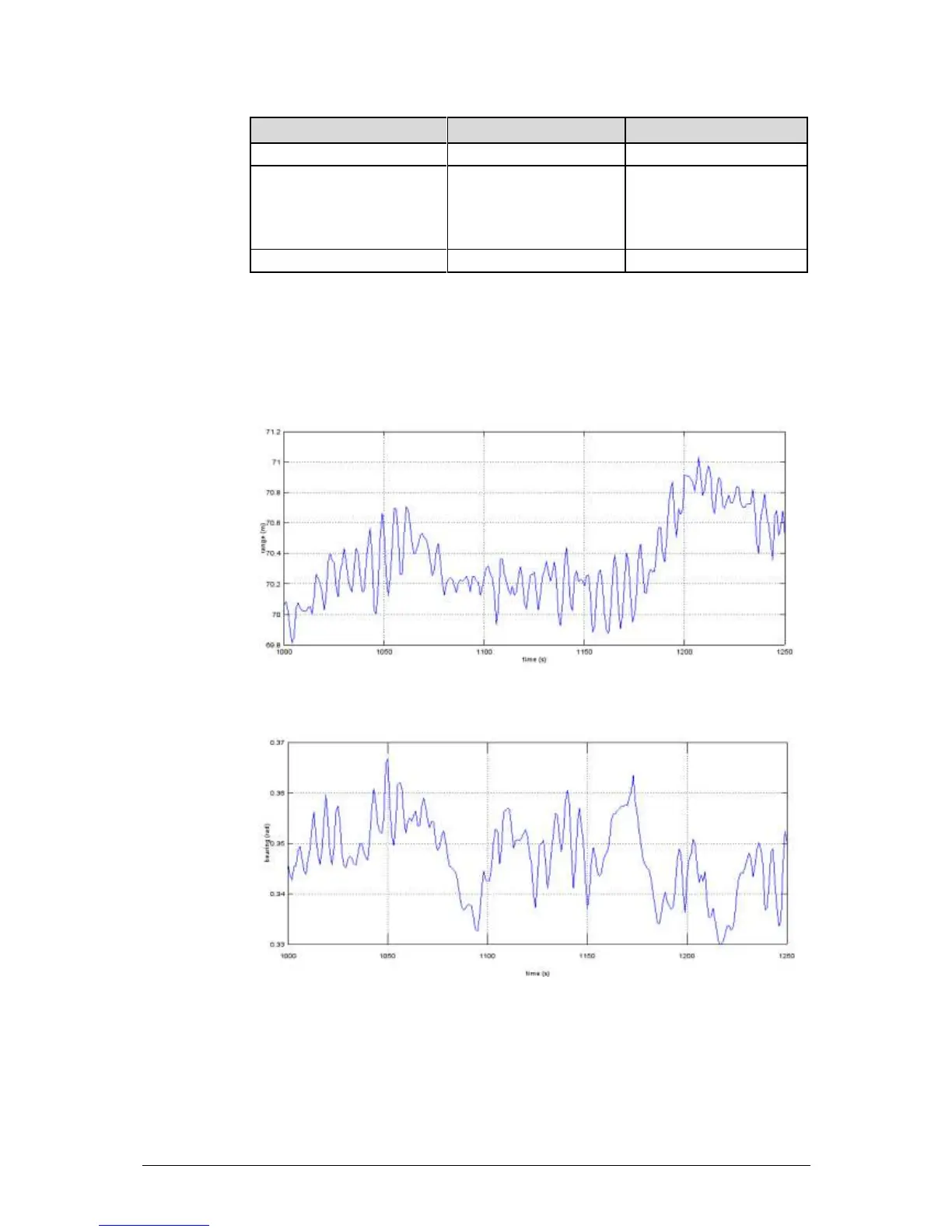
Here are some range and bearing measurements typical of station keeping operations in the
North Sea:
Figure 21 – Range and bearing plots at 70 m – Standard deviation: ≤ 0.085 m
Figure 22 – Range and bearing plots at 70 m – Standard deviation: ≤ 2.41 mrad
The wave motion is fairly strong, making it more difficult to quantify the accuracy performance.
In a comparison with an alternative sensor (e.g. GPS), timing and other registration errors
dominate over Mini RadaScan measurement errors. We can apply a high-pass filter which has
unity gain for white noise while attenuating the wave motion. This gives us an upper bound on
the standard deviation of the range and bearing measurements.



 To Next Page