Technical documentation
Technical documentation
STEME ed 07/03
10
EOLO MINI
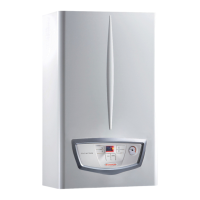
Idle position (central heating)
The thrust exercised by the spring “1”
affects the diaphragm plate “4” and the
d.h.w. valve “3” fastened to rod “5”.
The valve “2” is thus kept up tight
with consequent closing of the passage
towards the d.h.w. exchanger and the
simultaneous opening towards the
system delivery pipe (M).
Following a central heating request,
pump operation causes circulation in
the system through the delivery pipe
(M) and return pipe (R).
Operating position (d.h.w.)
The flow of domestic hot water inside
the valve invests the d.h.w. valve which,
when idle, is tight up against the plate of
the perforated diaphragm “4”.
Upon transit of the water, the pressure
downstream of valve “3” is less than that
upstream (“venturi effect”).
With a flow of at least 1.5 l/min and a
dynamic water pressure of 0.3 bar, the
pressure difference between the two
points is such as to cause movement of
diaphragm “4”.
This permits pressing spring “1” and the
release of spring “11” with the
consequent movement of valve “2” and
rods “5” and “6”.
In this condition, the delivery pipe (M) is
closed while the passage towards the
plate exchanger is open.
At the same time, rod “7” positions (drops) at the point of contact of rods “5” and “6” causing the
electrical closing of the d.h.w. microswitch “8”.
At the end of the supply, the pressure difference upstream and downstream of the d.h.w. valve “3” is
cancelled out, allowing the valve to return to idle position.




 To Next Page