Kappa Series Powered Subwoofer – Owner’s Manual
◆
25
1. Select a new test position: Cue the test track corresponding to the center frequency
of the dip. In the first example in Figure 19, you would play Track 13 (56Hz). Press
Play
G
. You will see a reading very close to what you had before. Now, slowly move
the RSLM around the area, if possible remaining within about a foot of the original test
point. As you move the RSLM, watch the bar graph. You will observe large level
fluctuations. Find a position that restores the level to approximately that of the adjacent
test points. You may find it helpful to move the RSLM vertically. Dips can be oriented
in any axis. The position that restores the level to about that of the adjacent test points
is your new test position.
2. Reset the test level: Return to the section “Setting the Subwoofer Test Level” on
page 16. Perform the procedure as described.
3. Repeat the measurements: Now that you are familiar with the measurement
process, you can go much faster by using Tracks 27– 50. These tracks contain all the
test tones necessary for measurement. However, each test is only about three
seconds, and there is no frequency announcement. The first test is 100Hz. Just place
each test mark in order until finished. Connect the dots.
Your second measurement will no longer exhibit the deep response dip. However, the
peak will still be evident. Without the influence of the response dip, the amplitude and
center of the peak may have changed. Compare your new data to the examples given
in this section of the manual. Follow the instructions for the example that most closely
matches your new measurement.
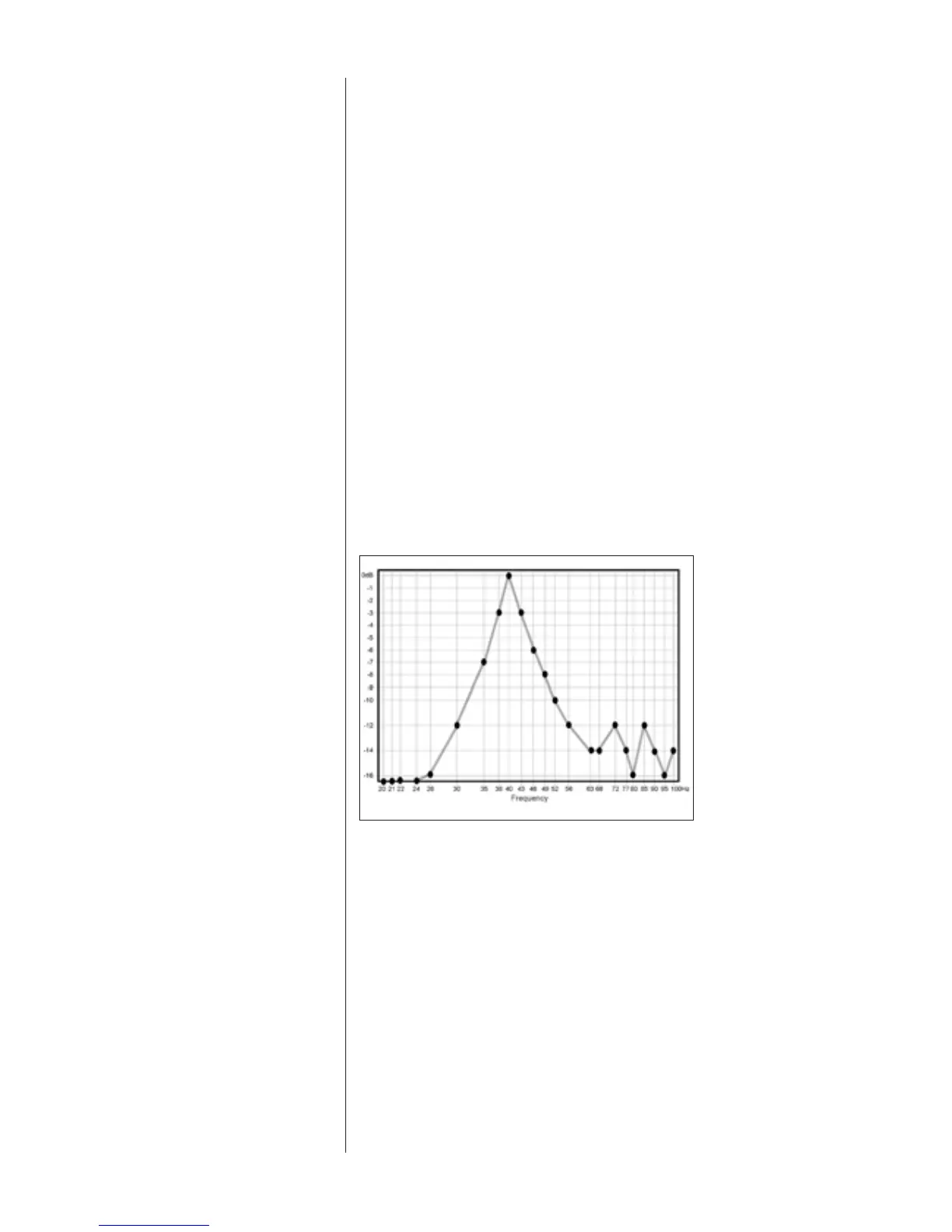
Example 4. Narrow Response:
Figure 20
Narrow Response




 To Next Page