26
◆
Kappa Series Powered Subwoofer – Owner’s Manual
Although it looks as though this speaker is quite bass-deficient, this is actually
indicative of a single, very narrow peak in excess of 10 dB high.
Apply the Width Selector as described above. Align the center-line of the Selector over
the center of the peak, as shown in Figure 15. Now adjust the Selector until you have
achieved the “best fit”. The slider now points to the correct width setting. In this
example, the frequency is 40 Hz and the best-fit width is 10%. Fill in the Width and
Frequency fields provided on the template.
Determine the appropriate level using the technique described earlier. In this example,
-13 dB is indicated. Enter 13 in the field provided.
Skip to the “Adjusting the R.A.B.O.S. Equalizer” section on page 28.
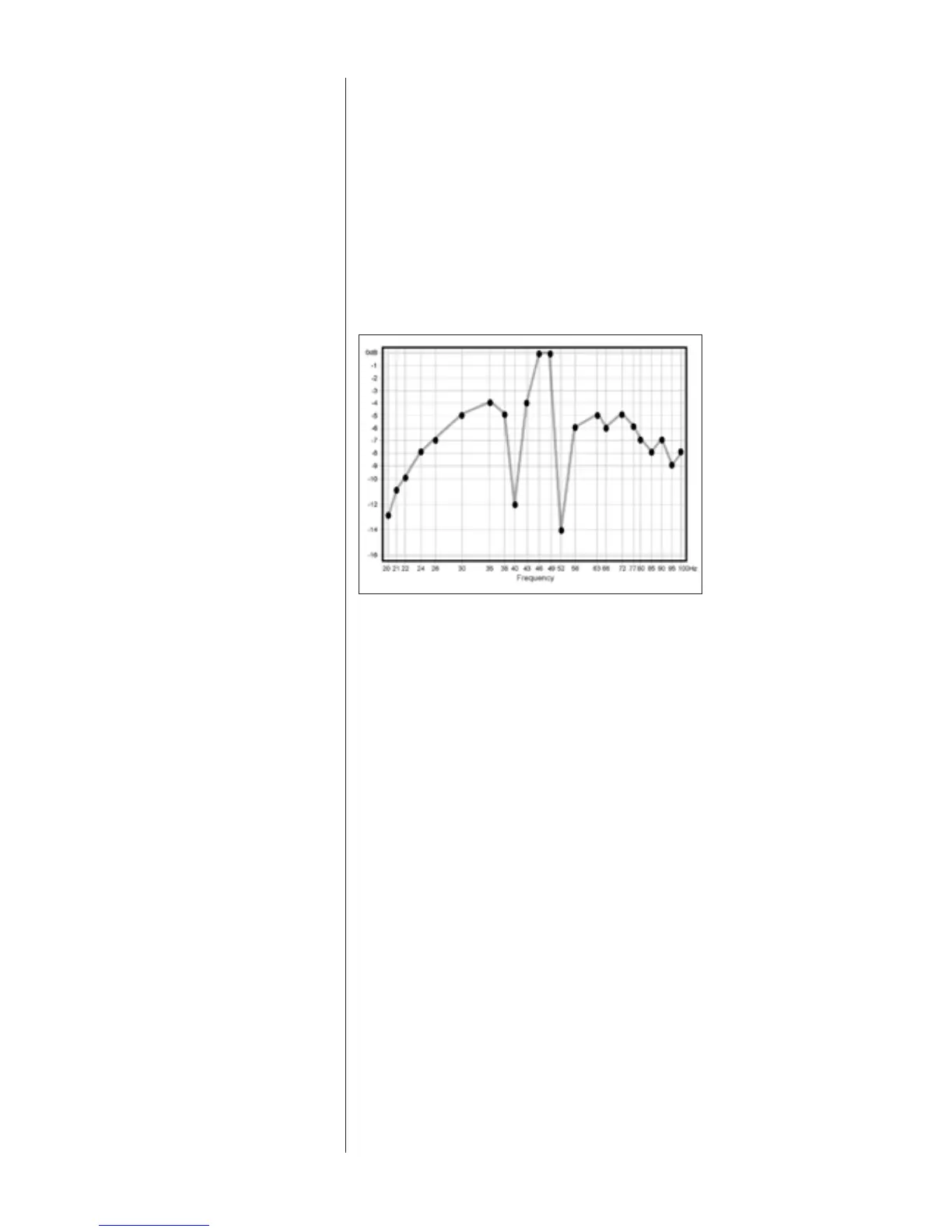
Example 5. One or More Narrow Dips:
Response dips can occur at any frequency, sometimes immediately adjacent to the
peak you want to correct. In this example, there are two such dips on either side of the
peak. Deep response dips such as these are caused by destructive wave interference.
Destructive interference dips occur only in one spot within the room. It is not
uncommon to completely eliminate their effect by moving the RSLM to a different
location. Note that this does not eliminate the dips. We have simply moved away from
them. Sometimes only a few inches are required. Do not attempt to correct this
condition with equalization. If you encounter dips like this, take the following steps:
Figure 21
Example of two narrow dips




 To Next Page