
 Need help?
Do you have a question about the Insignia NS-CF33SS8 and is the answer not in the manual?
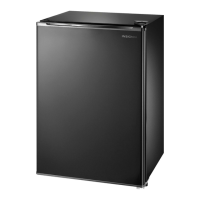
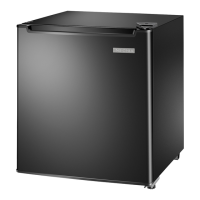
This document serves as a user guide for the Insignia 3.3 Cubic Foot Compact Refrigerator, covering models NS-CF33SS8, NS-CF33WH8, NS-CF33BK8, and NS-CF33BK8-C. It provides comprehensive instructions for setting up, operating, maintaining, and troubleshooting the appliance, ensuring reliable and trouble-free performance.
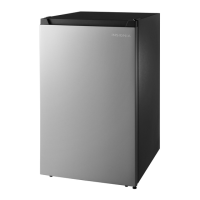
The Insignia 3.3 Cubic Foot Compact Refrigerator is a freestanding appliance designed for cooling and storing food. It operates on a 110V-120V, 60Hz power supply and utilizes R600a refrigerant. The refrigerator features a thermostat that allows users to adjust the internal temperature within a range of 32° to 46.4°F (0° to 8°C). It includes adjustable shelves, a bottom shelf, a crisper compartment, and can storage on the door, providing various options for organizing food items. The door is reversible, offering flexibility in placement and access.
Before initial use, it is crucial to remove all exterior and interior packing materials. The refrigerator should stand upright for approximately four hours before being connected to power to allow the cooling system to stabilize after transportation. The interior surface should be cleaned with lukewarm water and a soft cloth.
The refrigerator is designed for freestanding use and should not be recessed or built-in. It requires a strong, level floor capable of supporting its weight when fully loaded. Adequate ventilation is essential, so a minimum of five inches of space should be maintained between the back and sides of the refrigerator and any surrounding walls. The appliance should be located away from direct sunlight and heat sources such as stoves, heaters, or radiators, as these can affect its performance and increase electrical consumption. It is not designed for use in garages or outdoor installations, and moist areas should be avoided.
Proper leveling is critical for the refrigerator's efficient operation and to ensure the doors close and seal correctly, preventing cooling, frost, or moisture issues. The leveling feet can be adjusted by turning them clockwise to raise a side or counter-clockwise to lower it. Pushing against the top of the refrigerator can help ease the adjustment process.
Maintaining at least five inches of space from the wall ensures proper airflow to the compressor, which is vital for efficient cooling and to prevent strain on the compressor.
The refrigerator requires a 110V-120V, 60Hz power supply and must be plugged into a grounded 3-prong receptacle. The power cord is equipped with a 3-prong (grounding) plug to minimize the risk of electric shock. It is recommended to use an individual electrical outlet that matches the refrigerator's voltage rating. Extension cords or ungrounded adapters should not be used, as they can negatively affect performance and pose a safety risk. The power cord should always be unplugged by gripping the plug firmly, not by pulling the cord.
Upon initial startup, the thermostat should be set to "4" and allowed to cool for a full 24 hours before food is introduced. After this initial cooling, the temperature can be adjusted as needed, with "1" being less cool and "7" being cooler. The "4" setting is generally suitable for home or office use. Setting the thermostat to "0" stops the cooling cycle but does not cut off power to the refrigerator. If the refrigerator is unplugged or loses power, a three to five-minute delay is required before restarting to prevent damage. Large amounts of food can reduce cooling efficiency. When adjusting the thermostat, changes should be made one increment at a time, allowing several hours for the temperature to stabilize between adjustments.
The refrigerator door can be reversed to open from the left or right, offering installation flexibility. This process requires a 10 mm socket driver and a Phillips screwdriver. Before starting, the refrigerator must be unplugged and empty. It is helpful to have assistance, and all removed parts should be kept for reuse. The refrigerator needs to be tilted backward during this process, with the leveling feet adjusted to their highest position. It is important not to lay the refrigerator completely flat to avoid damaging the coolant system. The steps involve removing the top hinge cover, top hinge, and screw hole covers, then lifting the door off. The bottom hinge and door stopper are then removed, and the leveling foot is transferred. The bottom hinge and door stopper are reinstalled on the opposite side, followed by the door, top hinge, and screw covers. Finally, the door's fit and alignment should be checked, and the leveling feet adjusted.
The refrigerator is designed for minimal year-round cleaning and maintenance. The exterior should be periodically wiped with a mild detergent and warm water, then dried with a soft cloth, to keep it looking new. Abrasive cleaners, gasoline, benzine, thinner, or similar solvents should not be used, as they can damage the finish.
To clean the interior, first turn off and unplug the refrigerator. All food should be removed. The inside can be washed with a damp warm cloth soaked in a solution of one quart of lukewarm water to two tablespoons of baking soda. The door gasket (seal) should be kept clean to ensure efficient operation. After cleaning, both the interior and exterior should be dried with a soft cloth.
For extended periods of non-use, the refrigerator should be turned off and unplugged. All food must be removed, and the interior cleaned. The door should be left slightly ajar to prevent the formation of condensation, mold, or odors. Extreme caution should be exercised with children, ensuring the unit is not accessible for play to prevent entrapment.
To maximize energy efficiency, place the refrigerator in the coolest area of the room, away from heat-producing appliances or direct sunlight. Allow hot foods to cool before placing them inside. Avoid overloading the refrigerator, as this forces the compressor to run longer. Properly wrap foods and wipe containers dry to reduce frost buildup. Organize and label food to minimize door openings and search times.
 General
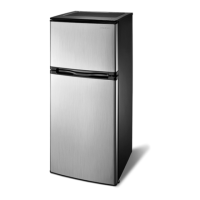
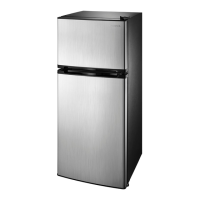
| Brand | Insignia |
|---|---|
| Model | NS-CF33SS8 |
| Color | Stainless Steel |
| Type | Top Freezer Refrigerator |
| Total Capacity | 33 cu. ft. |
| Energy Star Certified | Yes |
| Ice Maker | Yes |
| Water Dispenser | No |
| Defrost Type | Frost-Free |
| Shelves | Adjustable Glass Shelves |
| Door Storage | Yes |
| Reversible Door | No |
| Temperature Control | Mechanical |


 To Next Page