Inspire System Models 3024, 4063, 4323 English 27
200-079-101 Rev A
3024EN_ch.fm 5/6/14 10:31 pm
4.625 x 6 inches (117 mm x 152 mm)
Inspire Medical Confidential
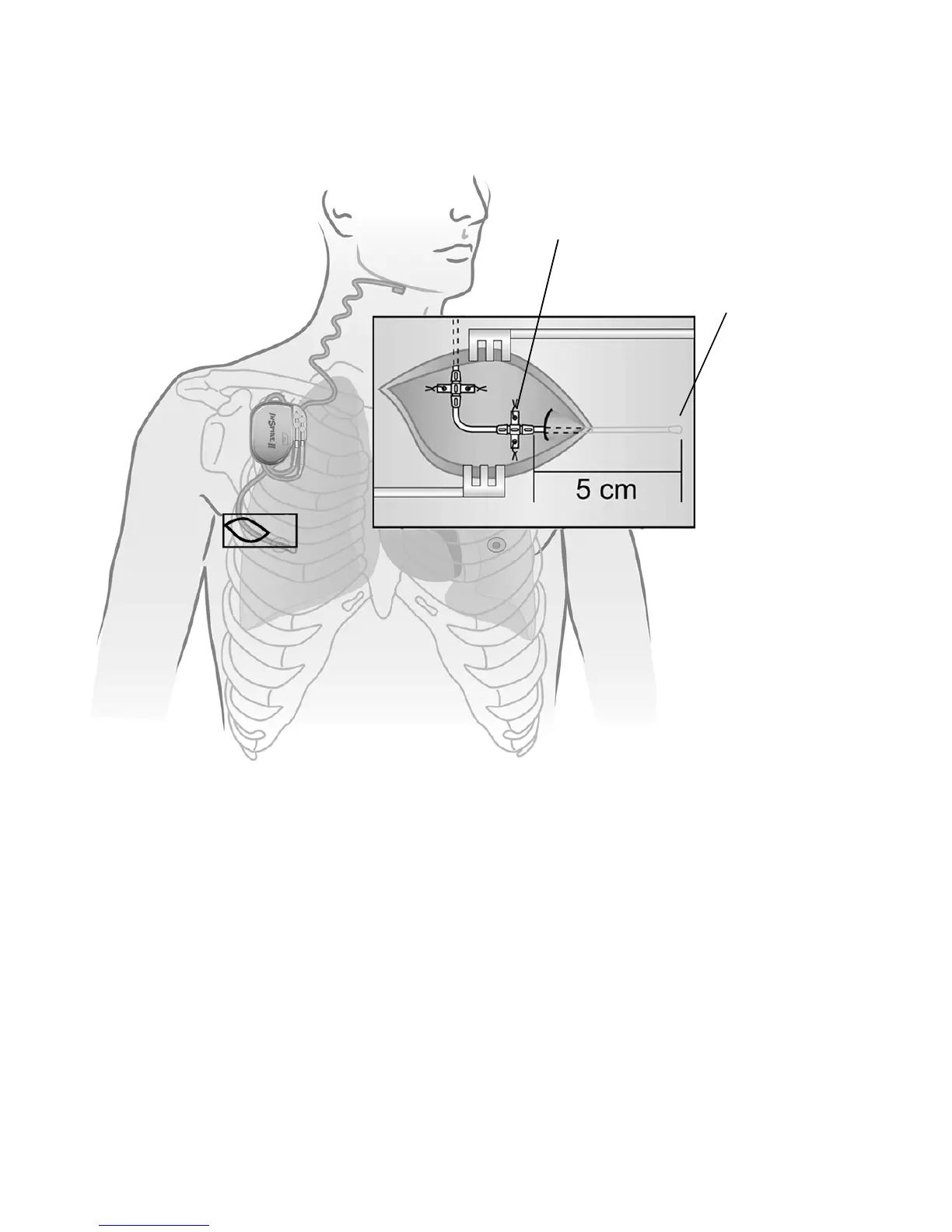
The respiratory sensing lead is placed in the extrapleural space (Figure 14).
The potential complications of bleeding and tension pneumothorax can be avoided by
positioning the incision as outlined in the following steps:
Figure 14. Respiratory sensing lead extrapleural placement
1. Make a 4–6 cm (1.6–2.4 in) incision starting near the midaxillary line, parallel to the ribs,
and toward midline on the right side of the chest.
Note: The respiratory sensing lead will be tunneled approximately 3–5 cm (1–2 in) in
length between the intercostal muscle layers, and therefore the incision should be
approximately 3–5 cm (1–2 in) from the desired sensor location. The desired sensor
location is in line with the nipple.
Note: A neurovascular bundle is located inferior to each rib. Therefore, implantation of the
sensor should be as close as possible to the superior rib surface.
2. Place the sensor between ribs 2–6, with a preference for the 4th or 5th intercostal space.
3. Use sharp and blunt dissection to expose the intercostal muscle layers.
• Dissection is required to reach and identify the internal intercostal muscle.
• The sensor will be inserted between the internal intercostal muscle and the external
intercostal muscle layers.
Sensor
Sensor membrane
must face pleura
Anchor with
raised ridges



 To Next Page