12
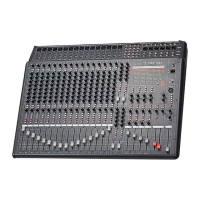
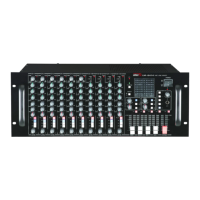
CA-6220/8220
STEREO POWERED MIXER
USING THE GRAPHIC EQUALIZER
The CA-6220/8220’s built-in graphic equalizer (GEQ) has two main uses: compensation for acoustic defi-
ciencies in the listening area, and feedback control. Like the channel equalizers, the GEQ should not be
used unless it is absolutely necessary. The more equalization you use, the more phase deviation you intro-
duce into the program signal–and the greater the chance that the phase deviation can result in an unnatu-
ral, distorted sound.
There are many instances, however, in which the acoustic characteristics of the listening area cause
response anomalies. Large areas of uncovered glass or tiled floors, for example, are extremely effective
reflectors of high-frequency sound. Amplified sound produced in such environments can seem painfully
sharp, in which case some reduction in the high-frequency range may be called for.
Smaller symmetrical rooms (a square room being the worst case) can actually have resonant frequencies
within the audible low-frequency range. In such rooms, a slight reduction in the low frequencies can help to
clarify the sound. Please note that in almost all cases, good equalization demands a cut in the offending
frequency range rather than a boost in ranges where response is lacking.
The GEQ can also be used–although to a limited degree–to control feedback. Proper microphone place-
ment is the primary means of preventing feedback, but this can be extremely difficult if you’re working in a
tight stage area. To get around this problem, try cutting response in the frequency range where the feed-
back is occurring. (You may have to experiment a bit to find this range.) This solution will compromise the
overall frequency response of the program, but it is better than running the risk of squealing feedback in
the middle of an important performance.
CONNECTING SPEAKERS
The CA-6220/8220 Powered Mixer have 1/4” phone jack and speakon speaker outputs per channel. The
outputs for each channel are connected in parallel internally. This places some restrictions on their use, as
described below:
- If you connect speakers to only one of the output jacks on either channel (R or L), the total impedance of
the speaker system connected to that channel may be no less than 4 ohms.
- If you plug speakers into both jacks of either channel (R or L), the total load impedance of the speaker sys-
tems connected to each output of that channel must be no less than 8 ohms. (Note that two 8-ohm speaker
systems connected in parallel form a 4 ohm load).
- The maximum total impedance of speakers connected to the speaker outputs of each channel should be
16 ohms.
- The maximum speakers allowable per channel are: one 4-ohm speaker, two 8-ohm speakers, or four 16-
ohm speakers.
Although a higher total load impedance than the recommended 16 ohms will only result in a loss of power
output, a total load impedance that is too low can actually damage the CA-6220/8220.
- Never connect or disconnect speakers while the mixer’s power supply is turned on!



 To Next Page