11
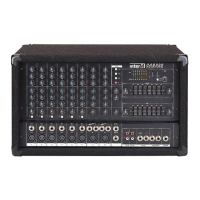
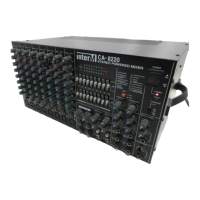
CA-6220/8220
STEREO POWERED MIXER
Operating Tips
Operating Tips
CAUTIONS FOR CONNECTED SOURCESS
Please observe the following cautions when connecting sound sources to the CA-6220/8220.
- TURN THE POWER OFF FIRST
Always make sure that the mixer’s POWER switch is turned off before connecting or disconnecting any
cables. Failure to do so can damage the CA-6220/8220 or connected equipment.
- TURN THE MIXER ON LAST
Always turn the mixer’s POWER switch on after first turning on connected sound sources such as electron-
ic instruments or audio equipment.
- DO NOT CONNECT AMPLIFIED INPUT
Never connect the speaker-level output of any amplifier to the mixer’s inputs unless you use a suitable
high-level attenuation pad or “direct box” to lower the signal’s level.
USING THE CHANNEL EQUALIZERS
Each of the CA-6220/8220’s input channels has three equalizer (EQ) controls that make it possible to
independently equalize the channel’s signal to some degree. The rule of thumb, however, is that equaliza-
tion should not be used unless it is absolutely necessary. Always put some effort into proper microphone
selection, careful microphone placement, and fine adjustment of source instrument controls before resorting
to equalization. Settle for this option only if you have set everything up as best you can and are still not sat-
isfied with the sound.
Channel equalization can be most useful in tonally separating one sound from another, or from a group of
sounds. Slightly boosting the high frequency of a guitar sound, for example, can give it the extra bite it
needs to stand out more clearly from the background. Vocals tend to stand out better if given a bit of boost
in the middle range. Speech generally benefits from a reduction in the low frequencies, to prevent the
“boomy” sound that occurs when the speaker gets too close to the microphone. Experimentation and
experience will tell you how much of what type of equalization is appropriate for different sound sources.
Also keep in mind the fact that the channel’s PEAK LED indicator is post-EQ. Excessive boosting of a signal
frequency may cause the PEAK LED to light more than briefly, indicating that you need to either reduce the
input gain or reduce the amount of boost being applied.



 To Next Page