Need help?
Do you have a question about the Inter-Tel Eclipse 2 and is the answer not in the manual?
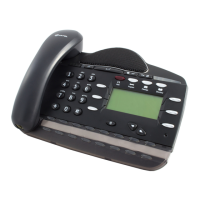
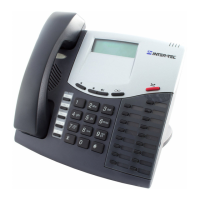
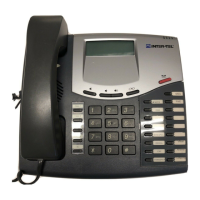
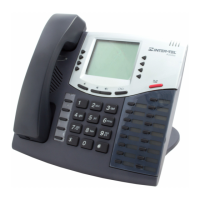
The Inter-Tel Eclipse² Associate Display and Basic Digital Phone (models 560.4200 and 560.4100 respectively) is a telecommunication device designed for business environments, offering a range of features for efficient call management and communication. The phone is equipped with a two-line, 16-character LCD display (on the Associate Display model) for easy navigation and information viewing, a message indicator light, and a handsfree microphone for speakerphone functionality. It also includes a hearing aid compatible handset and controls for adjusting ring and voice volume.
The phone serves as a comprehensive communication tool, facilitating both internal (intercom) and external calls. It supports various call handling functions such as answering, placing, holding, and transferring calls. Users can initiate conference calls with multiple parties, forward calls to different extensions or outside numbers, and redial previously dialed or saved numbers. The device integrates with a voice mail system, allowing users to set up mailboxes, retrieve messages, send messages, and manage personal greetings.
Intercom Calls: Users can dial an extension number to place an intercom call. The system provides visual and auditory cues (double tone for handsfree, continuous ringing for non-handsfree) to indicate call status. For non-handsfree calls, pressing "#" before dialing ensures the call rings until answered. If an extension is busy or unanswered, users can leave a message using the MSG key or request a callback by pressing "6". Answering intercom calls can be done via speakerphone or by lifting the handset for privacy. The handsfree answering feature can be enabled or disabled by dialing "319". Ringing calls can be redirected using SPCL and "331" followed by the desired extension or outside number. The phone also supports Off-Hook Voice Announce (OHVA) calls, allowing handsfree conversation during an active call, with options to block such calls using DND or SPKR.
Outside Calls: Outgoing calls are placed by pressing the "OUTGOING" key and dialing the number. Depending on system programming, an account code may be required. Alternative methods for placing outside calls include using the outgoing call feature code (8), an unlit CALL button, Automatic Route Selection feature code (92000 default), or Select Line Group feature code (92001-92208 default). If all lines are busy, a callback can be requested by pressing "6". Emergency calls (911) can be dialed directly without needing to access an outside line first.
Call Waiting: When a waiting call is indicated by a tone, users can end the current call, place it on hold using HOLD and answer the new call, or send the new caller to Do-Not-Disturb mode using DND.
Call Holding: Calls can be placed on individual hold (retrievable only by the user's phone) or system hold (retrievable by any phone with the flashing key). To retrieve a held call, lift the handset and press the flashing key.
Conference Calls: The phone supports connecting up to four intercom and/or outside callers. This is initiated by pressing CNF, placing another call, and pressing CNF again. The flashing CNF key connects all parties. Conferences can be placed on hold, and individual parties can leave the conference. Additional parties can be added, and the conference can be transferred to another extension or voice mail. The MUTE key allows users to mute their microphone during a conference.
Call Forwarding: Calls can be forwarded to another extension or outside number using FWD or specific feature codes ("355" for all calls, "356" for no answer, "357" for busy, "358" for no answer and busy). Calls can also be forwarded to the message center. Call forward requests can be canceled by pressing FWD and then SPKR. Call redirect (versions 5.3 and higher) allows forwarding a ringing call without answering it, using SPCL, "331", and the destination number. Automatic System Forward, if enabled by the administrator, routes calls based on call type and phone status, and can be enabled/disabled with "354".
Redial: The phone supports redialing the last number dialed or saved using the REDIAL key, both when idle or during a call.
Displaying Information: On display models, SPCL and "300" show date, time, name, and extension. SPCL and "397" display caller ID information during an outside call.
Headset Usage: The phone can be used with a headset. SPKR connects/disconnects calls. To connect a headset, unplug the handset cord, insert the headset plug, and dial "315" (display shows "HEADSET MODE ON"). To disconnect, unplug the headset, plug the handset cord back in, and dial "316" (display shows "HEADSET MODE OFF").
Speaker Usage: The speaker and microphone enable handsfree conversation, on-hook dialing, call monitoring, and background music. Group listening allows others in the room to hear both sides of a conversation while the user speaks via handset/headset; this feature is toggled with SPCL and "312".
Message Key: The MSG key is used to leave messages, causing the MSG light to flash at the recipient's extension. Pressing the flashing MSG key places a call to the sender. Messages can be left during intercom calls or without placing a call using "367" and the extension number. Messages can be canceled with "366" and the extension number. On display phones, MSG can be pressed repeatedly to view messages, and "#" or lifting the handset and pressing "#" answers a selected message.
Voice Mail: Accessing voice mail involves dialing the voice mail extension, pressing "*", and entering the mailbox number and password.
Do-Not-Disturb (DND) Mode: DND blocks all pages and calls except queue callbacks, recalls, and direct ring-in calls. Extensions calling a DND-enabled phone hear four fast tones. Users can select from pre-programmed messages (e.g., "IN MEETING," "OUT TO LUNCH") and customize a second display line for more detail. DND is activated by pressing DND and dialing a two-digit message number or scrolling. Customization of the second line involves dialing numbers or letters using the keypad (MSG key for alphanumeric input, FWD for character advancement or space, MUTE for backspace). DND is canceled by pressing DND.
Reminder Messages: Users can program reminders up to 24 hours in advance. At the set time, the phone sounds eight short tones and displays the message. Reminders are set by dialing "305", selecting a message, and entering the time. All future reminders can be canceled with "306", and received reminders cleared with "*".
Speed Dialing: Station speed dial numbers (0-9) can be programmed with names and numbers. Programming involves dialing "383", selecting a location code or speed dial key, entering a name (alphanumeric mode with MSG, FWD, MUTE), and then the number (numeric mode). Line access codes (e.g., "8") can be included for outside lines. Special characters like asterisk, pound, hookflash, or pause can be entered using SPCL. Programmed speed dial keys can be reviewed with "396" and the key. Names/numbers can be erased by dialing "383", selecting the location, and pressing MUTE. System speed dial stores up to 1,000 numbers, viewable and dialable with SYS SPDL or "381" and the location code.
Recording a Call: The Record-a-Call feature records an in-progress call as a voice mail message. It is activated by pressing SPCL, dialing "385", and entering the mailbox number if required. A confirmation tone indicates recording has begun. To stop recording, press SCL and "385" or hang up.
Paging: The system supports paging to specific zones (0-9) or all phones. Paging is initiated by lifting the handset, dialing "7" and the zone number, or pressing the PAGE ZONE key and the zone number. Paging on one's own phone can be enabled/disabled with "325".
Programming Feature Keys: Some feature keys are programmable. To program, dial "397" on-hook, press the desired key, and dial the feature code or extension number. All keys can be reset to default values with "395".
Secondary Extension Keys: These keys indicate call activity at other extensions (ringing, answered, on hold) and can be used to answer calls at those extensions or place intercom calls to them. Current assignments are viewed with "396" and the key. A primary phone can be assigned to a secondary key with "397", the secondary key, and the desired extension number. Calls answered via a secondary key can be transferred back to the original extension.
Account Codes: If SMDR is enabled, account codes may be required for calls. Standard codes are automatic, forced codes are mandatory for outside calls, and optional codes can be entered anytime during a call. Optional codes are entered with SPCL, "390", and the code. An account code for all calls can be set with "391" and the code, and disabled with "391" and "#".
Call Screening: If programmed, voice mail can screen calls. When a screened call is transferred, options include accepting ("#"), replaying ("1"), sending to voice mail ("2"), forwarding to another extension ("3"), or refusing ("*").
Directories: The phone's directory allows searching for names and numbers (extensions, system speed dials, feature codes) using the keypad. Search is initiated by dialing "307", selecting the directory type (intercom, outside, feature), entering letters/numbers, and pressing "#". The volume keys navigate alphabetically. Once the desired entry is displayed, pressing "#" uses it. The directory can also be used to leave voice mail messages.
Remote Feature Access: This feature allows users to place their phone in DND or forward calls from another phone on the system, or access phone features from an outside line via a special dial-up line. Passwords for remote access can be changed with "392", entering the current and new passwords. Remote access from another phone involves dialing the DISA number (if outside) or "359" (if within the system), entering the extension number and password, then choosing a feature (e.g., "370" for DND on, "355" for call forward all calls).
Agent Help: If programmed, users can request help from a designated agent help extension during a call by pressing SPCL and dialing "375". If the agent accepts, they can join or monitor the call. If rejected, a confirmation tone sounds, and the display shows "AGENT HELP REJECTED". At a display phone, an agent help request shows "
Hunt Groups: These are groups of phones sharing a common extension. Users can enable/disable hunt group calls with "324". ACD (Automatic Call Distribution) hunt groups distribute calls equally among logged-in agents. Agents can log in/out of all ACD groups with "328" and their Agent ID, or specific groups with "326" and the group number. Logging out of all groups is done with "328" or "327". After an ACD call, a wrap-up timer starts, preventing new calls until it expires or is ended early with "329".
Adjusting Volume: Volume settings for the handset (intercom and outside call), speakerphone (intercom and outside call), background music, ringing, and intercom dial tone can be adjusted. To change a setting, the user must be actively using that feature. The up/down arrow keys adjust volume, and the center of the volume key saves the setting.
Ring Tones: Users can select a new ring tone by dialing "398" on-hook. "0" disables ringing, up/down arrows scroll through tones, and 1-9 select a specific tone. Pressing "#" or lifting/replacing the handset saves the selection.
Background Music: If programmed, background music can be enabled or disabled through the speaker by dialing "313".
Changing the Language: The system installer can program two of four languages (American English, British English, Japanese, or Spanish). Users can toggle between these languages for display and voice mail prompts by dialing "301".
Returning to Default Settings: All phone settings can be returned to their default level by dialing "394".
Voice Mail Options (Personal Greetings): Users can store a primary and alternate greeting. To change a personal greeting, access voice mail, press "4", then "1". Options include recording/enabling primary ("1"), alternate ("2"), or enabling the system default greeting ("3"). After recording, options include accepting ("#"), replaying ("1"), appending ("2"), erasing/re-recording ("3"), or exiting without changes ("*").
Voice Mail Options (Directory Name): To change the name recorded in the voice mail directory, access voice mail, press "4", then "2". The current name is played, and "1" replays it. To record a new name, press "3", record, and then use options to accept, replay, append, or erase/re-record.
Voice Mail Options (Mailbox Password): To change the mailbox password, access voice mail, press "4", then "3". Enter a new password (up to 12 digits) or skip for no password, then press "#" to accept or "3" to erase/re-enter.
Voice Mail Options (Message Envelope): The message envelope includes time/date, message source, and message length. To change what information is included, access voice mail, press "4", then "4". Options include enabling/disabling specific elements ("1" for time/date, "2" for source, "3" for length), enabling all ("4"), or disabling all ("5"). Press "#" to accept or "*" to return without changes.
Voice Mail Options (Call Screening Transfer Method): If call screening is enabled, the transfer method can be changed. Access voice mail, press "4", then "9" for more options, then "5". Options include unannounced transfers ("1"), screened transfers ("2"), or announce only transfers ("3").
Voice Mail Options (Fax Destination): Users can specify a fax destination number for callers to send faxes to their mailbox. To change this, access voice mail, press "4", then "9", then "1". Enter the fax number followed by "#", then "#" to accept or "3" to erase/re-enter.
Voice Mail Options (Message Search Order): The order in which messages are retrieved can be changed (oldest first or newest first). Access voice mail, dial "4", then "9", then "2". Press "1" for new messages or "2" for saved messages, then select "1" for oldest first or "2" for newest first. "*" returns to the menu.
Voice Mail Options (Remote Messaging): If enabled, voice mail can call the user when a message is left, using a "cascade" of up to nine telephone numbers (pager, answering machine, etc.). Primary and Alternate cascades can be programmed for specific days and times. To set up remote messaging, access voice mail, press "4", then "5". Select "1" for Primary or "2" for Alternate. Then, program cascade levels (1-9) by pressing "1", enabling/disabling ("1"), setting extension/phone number ("2"), or pager number ("3"). Time of day for notification is set by pressing "2" and entering hours/minutes. Days of the week are set by pressing "3" and choosing Monday-Friday ("1"), all days ("2"), or individual days ("3"). Message types (all messages "1" or priority messages only "2") can be selected with "4". "#" saves and exits.
Retrieving Messages: Once in the mailbox, press "1" for new messages or "3" for saved messages. While listening, options include skipping to end ("#"), rewind ("1"), pause ("2"), fast forward ("3"), lower volume ("4"), play envelope ("5"), raise volume ("6"), save ("7"), or delete ("9"). After a message, options include replay ("1"), reply ("2" - voice mail or return call), forward a copy ("3"), listen to previous ("4"), play introductory envelope ("5"), listen to next ("6"), save ("7"), or delete ("9").
Undelete Messages: Accidentally deleted voice mail messages can be recovered within a system-specified time. To recover, enter the mailbox, press "5" for message options, then "2" for undelete options. Users can listen to deleted messages ("1" with options to replay, reply, forward, listen to previous/next, play envelope, recover, purge), recover all deleted messages ("2"), or erase all deleted messages ("3").
 General
| Lines | 2 |
|---|---|
| Speakerphone | Yes |
| Headset Jack | Yes |
| Speed Dial | Yes |
| Caller ID | Yes |
| Volume Control | Yes |
| Programmable Keys | Yes |
| Proprietary | Yes |
| Type | Digital Phone |
| Display | 2-line LCD |
| Compatibility | Inter-Tel Axxess systems |


 To Next Page