Affinity
2.0
Additional Information Page 37
Test Procedure:
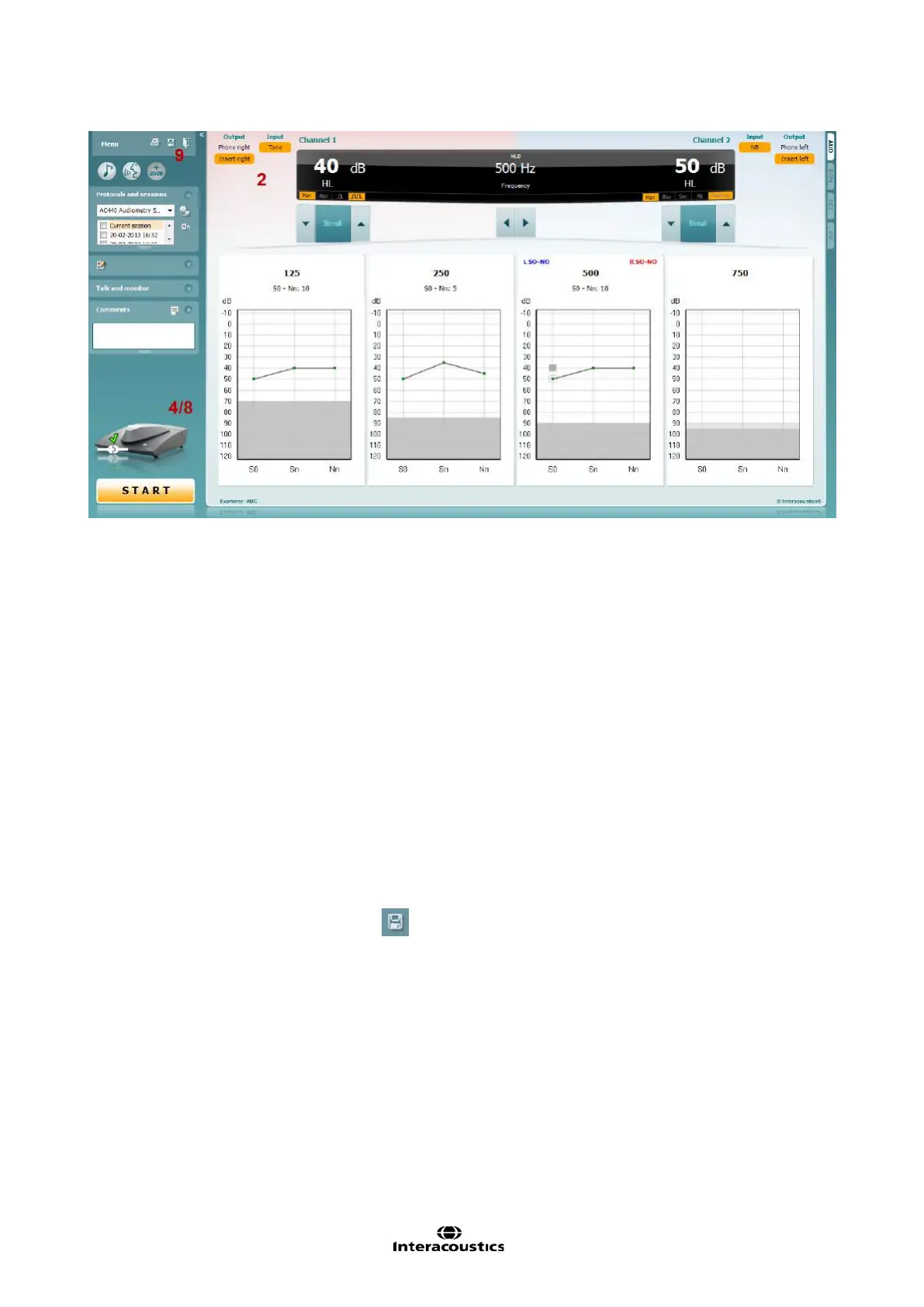
1) Open the AC440 and enter the MLD screen by selecting Menu | Te sts | MLD.
2) Select headset or inserts in the channel 1 output list.
3) Before mounting the headphones on the patient, explain to them that they will now hear both tones
(identical to the ones from the air conduction audiometry) and noise through the headphones.
Emphasize that they should only focus on the tones and press the response button whenever it is
audible.
4) Select the frequency you would like to test; 250 Hz or 500 Hz is a good starting point
5) Set the intensity level to be the same level in both ears (50, 60 or 65 dB).
6) Press START and the signal will be presented to both ears in phase (SoNo condition)
7) Do a masked threshold search. Typically, the masked threshold for the SoNo condition will be equal to
the noise level. When you have established a threshold, click in the Stimuli area for Store or press S
on the PC keyboard. Once the SoNo condition has been stored, the cursor will automatically jump to
the SπNo condition., in which the signal is out of phase and the noise is still in phase. Note that
frequency adjustments also can be performed manually (see illustration)
8) Leaving the intensity of the noise at the same level, perform a threshold again, press Store, and the
cursor will switch to SoNπ. Where the signal is in phase and the noise in reversed phase.
9) Establish the threshold once more.
10) Press STOP to end the test.
11) The MLD will be the difference between the threshold of the the homophasic condition (SoNo) and the
threshold of one of the antephasic conditions (SoNπ or SπNo)
12) Save the MLD test by clicking Save
Note: In the setup for MLD (see section 1.7.2.4) you can choose whether you would like MLD to be
calculated using SoNo minus SoNπ or SoNo minus SπNo.



 To Next Page