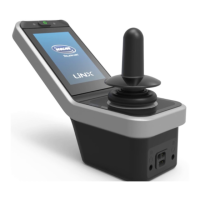
LiNX® Control System - Remote User Manual
This document serves as a supplement to the mobility device's documentation, providing essential information for the LiNX® Control System Remote, including models REM110, REM210, REM211, REM215, and REM216. It details the function, technical specifications, usage, and maintenance of these remote modules, which are designed to allow powered wheelchair users to interact with the LiNX System.
Function Description
The LiNX remote modules facilitate control of drive functions, and depending on the model, may also include actuator and lighting functions. All REM200-series remote modules provide an input for battery charging. The REM110 offers drive functions, battery charging input, and a Bluetooth® interface for programming and diagnostics. The REM210 and REM211 modules control drive and actuator functions, with the REM211 supporting more than two actuators. The REM215 and REM216 modules add lighting functions to drive and actuator control, with the REM216 also supporting more than two actuators.
The system operates using Bluetooth wireless technology, supporting both Smart (low energy) and Classic Bluetooth protocols within the 2.400 GHz to 2.4835 GHz ISM band. Data transmission occurs at 1Mbit/s with a maximum transmit power of 5mW, utilizing frequency hopping to mitigate interference.
Important Technical Specifications
Mechanical Specifications:
- Operating Temperature: -13°F (-25°C) to 122°F (+50°C)
- Storage Temperature: -40°F (-40°C) to 149°F (+65°C)
- Operating Humidity: 0-90% RH
- Degree of Protection: IPX4 (protected against spray water)
- Operating Forces:
- Joystick: 1.9 N
- Speed dial: 1.2 N
- Horn: 2.5 N
Electrical Specifications:
- Operating Voltage (Vbatt): 17V (Min), 24V (Nominal), 34V (Max)
- Idle Current: 56 mA at 24V
- Quiescent Current (power off): 0.23 mA at 24V
Bluetooth Technology Specifications:
- Class: Class 2
- Distance/Range (theoretical maximum): 10 m (33 ft)
- Over the Air Data Rate: 1-3 Mbit/s (Classic), 1 Mbit/s (Smart)
- Application Throughput: 0.7-2.1 Mbit/s (Classic), 0.27 Mbit/s (Smart)
- Security: 56/128-bit and application layer user defined (Classic), 128-bit AES with Counter Mode CBCMAC and application layer user defined (Smart)
- Robustness: Adaptive fast frequency hopping, FEC, fast ACK (Classic), Adaptive frequency hopping, Lazy Acknowledgment, 24-bit CRC, 32-bit Message Integrity Check (Smart)
- Latency (from a non-connected state): Typically 100 ms (Classic), 6 ms (Smart)
- Network Topology: Scatternet
- Power Consumption: 5 mW
Usage Features
Powering On/Off:
- Press the ON/OFF button to power up the remote. The status indicator lights green if no fault is detected, and the battery gauge displays the current status.
- Press the ON/OFF button again to power down the system.
- The ON/OFF button also functions as an emergency stop while driving.
Drive Function Control:
- The wheelchair always powers up in drive function 1.
- For remotes with multiple drive functions (REM210, REM211, REM215, REM216), use the Drive function selector keys to cycle through available drive functions.
Maximum Speed Control:
- The speed dial allows users to limit the maximum speed of the mobility device, offering 10 discrete steps.
- Joystick shaping can be configured by providers to calibrate the joystick, reducing the deflection needed for full demand.
Operating Lights and Hazard Lights:
- Short press the Light button to turn position lights on or off.
- Short press the Hazard lights button to turn hazard lights on or off.
- Long press the Hazard lights button (for more than three seconds) to activate the left turn signal. Short press again to turn off.
- Long press the Light button (for more than three seconds) to activate the right turn signal. Short press again to turn off.
Operating Powered Seating Functions:
- Seating functions can be controlled via external switches (egg switch, stereo toggle switch, stereo button switch) or the joystick, depending on configuration.
- The egg switch alternates single power configurations like powered recline, seat tilt, or center-mount elevating legrest.
- The stereo toggle switch and stereo button switch also alternate similar single power configurations.
- The 4-way toggle switch allows for control of various seating functions (tilt, recline, elevate, legrest) by deflecting the switch in different directions.
- When using the joystick for seating functions, deflect it to the front or rear to activate the actuator. The distance of deflection determines the speed of movement.
Speed Reduction:
- If the elevating seat is adjusted above a certain point, the drive electronics reduce wheelchair speed. The status display will show pulsing symbols for the elevating seat and drive to indicate speed reduction.
Charging the Batteries:
- Plug the battery charger into the remote charger socket.
- The battery gauge indicates charging status with a left-to-right chase sequence.
- The wheelchair enters drive inhibit mode during charging.
- New batteries require a synchronization procedure within 24 hours of powering on the wheelchair.
USB Charger:
- The USB charger allows charging of mobile phones or compatible devices.
- Both USB ports can be used simultaneously, each providing up to 1A charging current.
- Always replace the bung when USB ports are not in use.
Rest State:
- The system can enter a "rest" state, where the driver control is fully or partly disabled, to prevent unintended actions.
- Audible cues indicate entry and exit from the rest state.
- Exiting rest can be done manually by activating a control input configured for user functions, menu navigation, or profile changes.
Maintenance Features
General Maintenance:
- No user-serviceable parts inside the remote case. Do not attempt to open or repair, as this will void the warranty.
- If any component is damaged, consult a qualified Invacare provider.
Setup/Delivery Inspection (by provider):
- Check for shipping damage.
- Verify proper routing and securing of cables.
- Ensure proper operation of powered functions (drive, seating, legrests).
User/Attendant Inspection Checklists:
- Weekly: Ensure proper operation of powered functions.
- Monthly: Check all components for loose, damaged, or corroded parts. Ensure all connectors are fully mated. Inspect cables for proper routing, pinching, chafing, or wear. Remove any foreign objects.
- Periodically: Check the joystick boot for damage. Ensure all labels are present and legible.
Cleaning:
- Use a cloth dampened with warm water and mild non-abrasive soap.
- Dry the surface with a dry cloth.
- Do not use solvents or kitchen cleaners.
Troubleshooting:
- If the status display is OFF, check if the drive electronics system is powered up, cables are connected, and batteries are charged.
- If a fault number displays, refer to the fault codes and diagnosis codes table for possible actions (e.g., check cables, recharge batteries, contact provider).
- OON ("Out Of Neutral") Warning: A safety feature that prevents accidental driving or seating movements if the joystick is not in the center position or if direct access switches are active during power-up or function change.
- Drive Inhibit Indication: A right-to-left chase sequence on the battery gauge indicates drive inhibit mode when connected to the charger.
- Cut-off Voltage: When battery voltage is low, the status indicator flashes red, the red LED on the battery gauge flashes, and the horn sounds every 10 seconds. Power down and charge immediately.

 Need help?
 General

 To Next Page