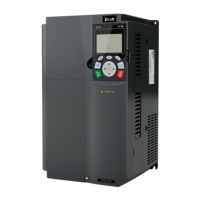
This document describes the Goodrive350-UL Series Variable-Frequency Drive (VFD), a high-performance, multi-function VFD designed for controlling both asynchronous AC induction motors and permanent-magnet synchronous motors.
Function Description
The Goodrive350-UL VFD integrates synchronous and asynchronous motor drive, torque control, speed control, and position control. It utilizes advanced vector control technology and a dedicated digital processor for motor control, enhancing product reliability and environmental adaptability.
Control Modes:
- SVPWM control
- Sensorless Vector Control (SVC)
- Vector Control (VC)
Motor Types Supported:
- Asynchronous motor
- Permanent-magnet synchronous motor
Speed Regulation Ratio:
- Asynchronous motor: 1:200 (SVC)
- Synchronous motor: 1:20 (SVC), 1:1000 (VC)
Frequency Setting Modes:
- Digital, analog, pulse frequency, multi-step speed running, simple PLC, PID, Modbus communication, PROFIBUS communication, etc.
- Supports switching between set combinations and channels.
Automatic Voltage Regulation (AVR) Function:
- Keeps the output voltage constant when grid voltage changes.
Fault Protection Functions:
- Provides over 30 kinds of fault protection, including overcurrent, overvoltage, undervoltage, over-temperature, phase loss, and overload.
Speed Tracking Restart Function:
- Enables impact-free starting of the motor in rotation (available for 4kW and above models).
Torque Control:
- Supports torque control and speed control. Speed control stabilizes speed with torque limits, while torque control stabilizes output torque with frequency limits.
Multi-step Speed Running (Simple PLC):
- Functions as a multi-step speed generator, automatically changing running frequency and direction based on time to fulfill process requirements.
- Supports 16-step speed control and provides four groups of acceleration/deceleration times.
PID Control:
- Adjusts VFD output frequency or voltage by performing scaling, integral, and differential operations on the difference between the feedback signal and the target signal, forming a negative feedback system. Suitable for flow, pressure, and temperature control.
Wobbling Frequency:
- Mainly applied in textile and chemical fiber industries for transverse movement and winding functions.
Position Control and Spindle Positioning:
- Supports pulse string control, digital positioning, and photoelectric switch positioning based on closed-loop vector control.
Important Technical Specifications
Power Input:
- Input voltage: AC 3PH 200V–240V (Rated: 220V), AC 3PH 380V–480V (Rated: 460V), AC 3PH 520V–600V (Rated: 575V)
- Allowable voltage fluctuation: -15%–+10%
- Input frequency: 50Hz or 60Hz, allowable range: 47–63Hz
Power Output:
- Output voltage: 0–input voltage
- Output frequency: 0–400Hz
Speed Control Precision:
- ±0.2% (SVC), ±0.02% (VC)
- Speed fluctuation: ±0.3% (SVC)
Torque Response:
Torque Control Precision:
Starting Torque:
- Asynchronous motor: 0.25Hz/150% (SVC)
- Synchronous motor: 2.5 Hz/150% (SVC), 0Hz/200% (VC)
Overload Capacity:
- G type: 150% for 1 minute, 180% for 10 seconds, 200% for 1 second
- P type: 120% for 1 minute, 150% for 10 seconds, 180% for 1 second
Peripheral Interface:
- Analog Input: 2 inputs (AI1: 0–10V/0–20mA; AI2: -10–10V)
- Analog Output: 1 output (AO1: 0–10V/0–20mA)
- Digital Input: 4 regular inputs (max. 1kHz), 2 high-speed inputs (max. 50kHz, supports quadrature encoder input with speed measurement)
- Digital Output: 1 high-speed pulse output (max. 50kHz), 1 Y terminal open collector output
- Relay Output: 2 programmable relay outputs
- Extension Interfaces: 3 slots (SLOT1, SLOT2, SLOT3) for PG card, programmable extension card, communication card, I/O card, etc.
Environmental Conditions:
- Operating temperature: -10–50°C (derating required above 40°C)
- Storage temperature: -30–+60°C
- Protection level: IP20
- Pollution level: Level 2
- Cooling mode: Air cooling
- Altitude: Below 1000m (derating required above 1000m)
- Humidity: Relative humidity (RH) of air less than 90% (no condensation)
- Vibration: Max. amplitude not exceeding 5.8m/s² (0.6g)
Brake Unit:
- Built-in for 220V (≤15kW) and 460V (≤30kW) VFDs.
- Optional for 220V (18.5–55kW), 460V (≥37kW), and 575V VFDs.
EMC Filter:
- 460V VFDs are configured with built-in C3 filters, meeting IEC61800-3 C2 requirements.
Usage Features
Keypad Operation:
- LCD keypad for start/stop control, state data reading, and parameter setting.
- Supports parameter copy function.
- Real-time clock (requires CR2032 battery for power-off timekeeping).
- Keypad extension cable and installation bracket available for remote mounting.
Parameter Management:
- Hierarchical menu structure (First-level, Second-level, Third-level, Fourth-level).
- Users can customize monitoring lists for stop and running states, adding, deleting, or shifting parameters.
- Parameters can be added to a "common parameter setting" list for quick access.
- Password protection for function codes to prevent inadvertent modification.
Motor Autotuning:
- Supports rotary autotuning (requires motor to be disconnected from load) and static autotuning (can be performed with load).
- Essential for accurate motor parameter models, especially for vector control.
Multi-Motor Control:
- Supports two sets of motor parameters, switchable via multi-function digital input terminals or communication modes.
Safety Precautions:
- Emphasizes the importance of reading the manual, qualified electricians, disconnecting power, waiting for discharge, and proper grounding.
- Highlights the need for mechanical brake devices for emergency stops.
Installation Flexibility:
- Supports wall-mounting, flange-mounting, and floor-mounting based on VFD dimensions.
- Vertical installation is required for good heat dissipation.
- Windshields are necessary for vertical multi-unit installations to prevent mutual interference.
Communication Protocol (Modbus RTU):
- RS485 interfaces for centralized control via PC/PLC or other devices.
- Supports standard Modbus RTU mode for reading and writing parameters, and monitoring VFD status.
- Provides detailed frame structures, error detection (bit check, CRC check), and command examples.
Maintenance Features
Periodical Inspection:
- Routine checks on ambient environment (temperature, humidity, dust, vibration), main circuit voltage, keypad display, and physical condition of components (bolts, conductors, terminal blocks, capacitors, resistors, transformers, relays).
- Specific criteria for each inspection item, such as checking for deformation, cracks, discoloration, or loose connections.
Cooling Fan:
- Service life of over 25,000 hours.
- Running duration can be monitored via P07.14.
- Replacement recommended if unusual noise occurs. Spare parts available from INVT.
Capacitor Reforming:
- Instructions for reforming DC bus capacitors if the VFD has been stored for a long time (more than 1 year).
- Charging procedures vary based on storage duration and VFD voltage class, using a voltage-controlled power supply or a resistor in series.
Power Cable:
- Regular checks to ensure firm connections.
Extension Cards:
- Installation process involves unscrewing covers, removing the keypad, inserting the card, aligning positioning holes, and tightening screws.
- Grounding of shielded cables is crucial for anti-interference.
Troubleshooting:
- Comprehensive guide for fault diagnosis, including indications of alarms and faults, fault reset procedures, and fault history (P07.27–P07.32).
- Detailed table of VFD faults, possible causes, and corrective measures (e.g., increasing acceleration time for overcurrent, checking input power for overvoltage/undervoltage).
- Analysis of common interference phenomena (meter switches, sensors, communication) and countermeasures (cable arrangement, adding capacitors, proper grounding).

 Need help?

 To Next Page
 General