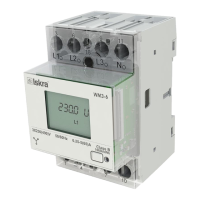
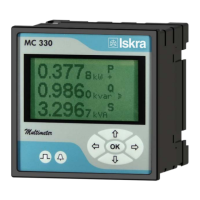
User’s Manual WM3M4 &WM3M4C
7.5 EU Directives conformity
EU Directive on Measuring instruments MID 2014/32/EU
EU Directive on EMC 2014/30/EU
EU Directive on Low Voltage 2014/35/EU
EU Directive WEEE 2002/96/EC
List of considered harmonized standards confirming appliance with the essential requirements of the
Regulation:
EN 50470-1:2006 Electricity metering equipment (ac) - Part 1: General requirements, tests and test
conditions - Metering equipment (class indexes A, B and C)
EN 50470-3:2006 Electricity metering equipment (ac) - Part 3: Particular requirements - Static meters for
active energy (class indexes A, B and C)
Other standards taken into account in the design and testing of the meter:
EN 62052-11:2003, EN 62052-11:2003/A1:2017 Electricity metering equipment (ac) - General
requirements, tests and test conditions - Part 11: Metering equipment
EN 62053-21:2003, EN 62053-21:2003/A1:2017 Electricity metering equipment (ac) - Particular
requirements - Part 21: Static meters for active energy (classes1 and 2)
EN 62053-23:2003, EN 62053-23:2003/A1:2017 Electricity metering equipment (ac) - Particular
requirements - Part 23: Static meters for reactive energy (classes 2 and 3)
EN 62053-31:1998 Electricity metering equipment (a.c.) - Particular requirements - Part 31: Pulse output
devices for electromechanical and electronic meters (two wires only)
EN 62052-31:2016 Electricity metering equipment (a.c.) - General requirements, tests and test
conditions - Part 31: Safety requirements and tests
EN 62059-32-1:2012 Electricity metering equipment - Dependability - Part 32-1: Durability - Testing of
the stability of metrological characteristics by applying elevated temperature
CLC/TR 50579:2012 Electricity metering equipment - Severity levels, immunity requirements and test
methods for conducted disturbances in the frequency range 2 -150 kHz


 To Next Page