PhaseStation 53100A User’s Manual V1.04 25-Apr-2022 136
Measure single DUT with cross ADEV
statistics
This measurement role is useful when the
lowest achievable instrument performance
floor is required in Allan deviation
measurements. Like Measure single DUT
with single external reference and the various
dual-reference roles, the cross ADEV role
performs stability and noise measurements of
a single source against one or two references,
but it departs from other measurement roles
in several key respects.
The most important difference is that both
channel pairs (3-1 and 4-2) are used for data acquisition when the cross ADEV role is selected, rather
than only channels 3 and 1. As a result, two independent phase records are acquired during the
measurement. Both of these records are associated with the resulting plot and are stored in a single
.TIM file. TimeLab uses data from both of these records when rendering a cross ADEV plot. The record
associated with the 3-1 DUT-reference combination is considered the primary record, while the 4-2
channel pair contributes to the secondary phase record.
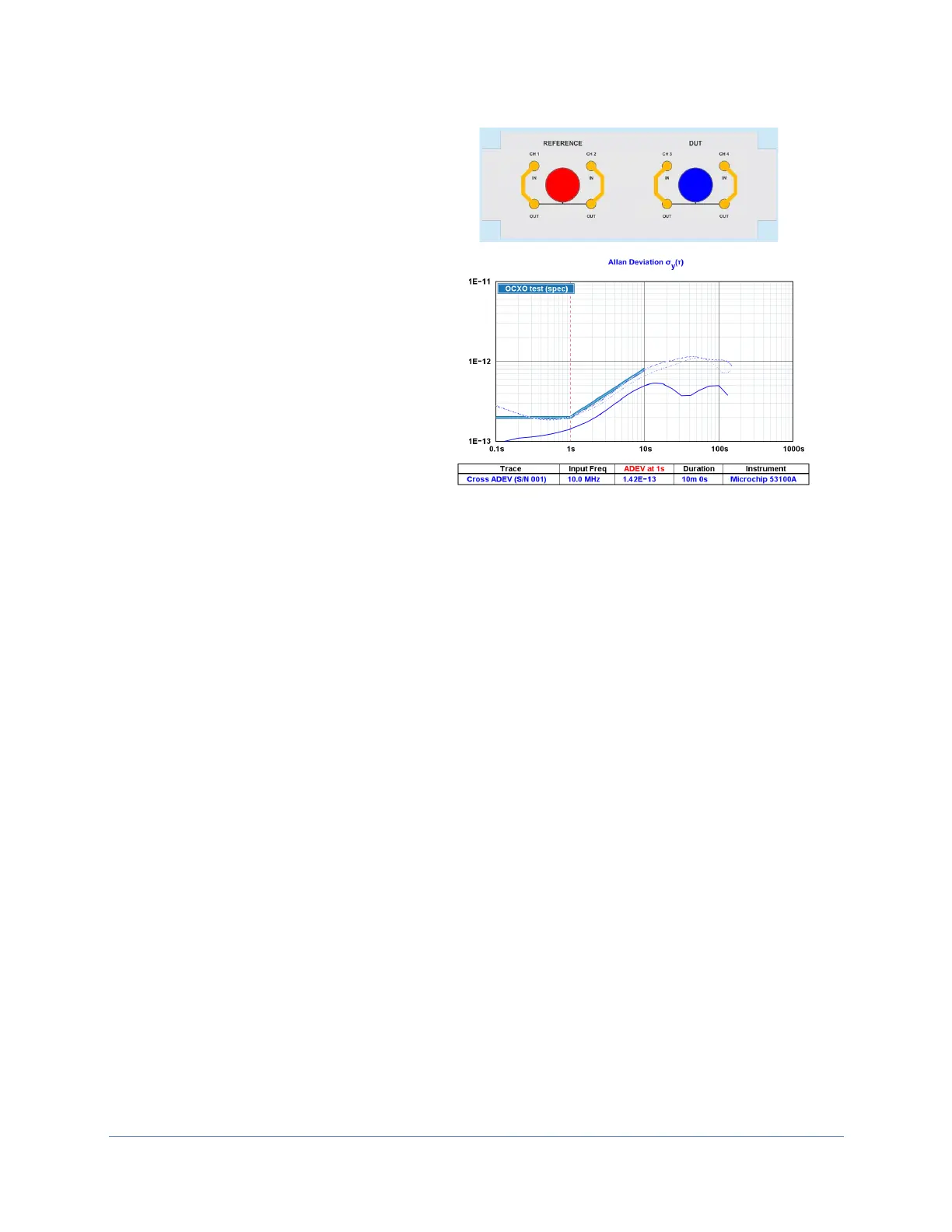
You can inspect the conventional Allan deviation traces for each record separately with the F6 hotkey
(Trace→Show original traces in computed xDEV displays). When this function is turned on, as shown in
Figure 62 above, two dashed (broken) traces will appear in addition to the composite cross ADEV trace,
assuming that cross ADEV displays have been enabled with Trace→Show cross ADEV traces when
available (Ctrl-j). The trace corresponding to the primary (3-1) channel pair is slightly thicker than the
other trace which represents the secondary (4-2) channel pair.
The improvement in measurement floor performance can be substantial when both ADC channel pairs
contribute. Figure 62 depicts a short-term stability measurement of a high-performance oscillator using
two other examples of the same part as independent references. The two broken traces indicate what
would be observed if one of the other stability measurement roles had been selected at acquisition
time. (In fact, the heavier trace is what would be seen if Trace→Show cross ADEV traces when
available (Ctrl-j) were used to toggle off the cross ADEV display altogether.)
Two distinct advantages of cross ADEV measurement can be observed here. First, the use of all four
ADC channels rather than only two improves the performance dramatically between t=0.1s and t=1.0s.
Both of the conventional ADEV traces reveal the 53100A’s own performance floor in this region, while in
the cross-ADEV trace, uncorrelated noise from the two independent ADC channel pairs falls out of the
measurement over time in a manner similar to cross-correlated phase noise measurements.


 To Next Page