PhaseStation 53100A User’s Manual V1.04 25-Apr-2022 45
Modified Allan Deviation (m)
MDEV, or Mod σ
y
(τ), is a slight variation on ADEV that can discriminate between white
PM and flicker PM noise. Both ADEV and MDEV render flicker PM noise at a slope of τ
-1
.
White PM noise is also rendered by ADEV at τ
-1
, but it appears as a steeper downward
slope of τ
-3/2
in MDEV. Consequently an ADEV plot may appear artificially elevated when
either of these two noise types is present. Switching to Measurement→Modified Allan
Deviation (m) will render the two noise types separately at the intervals where they
belong.
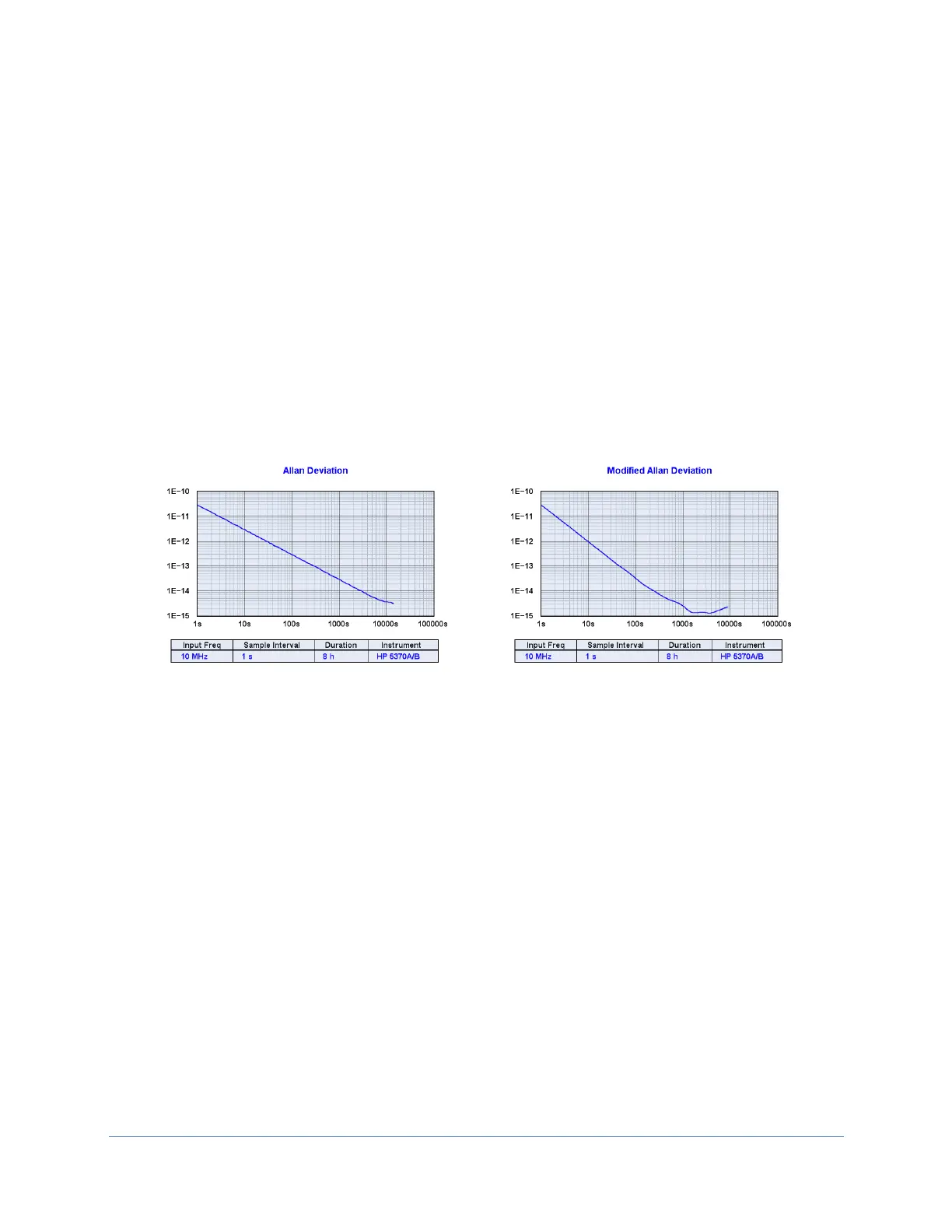
As an example, here are ADEV and MDEV plots showing the residual noise of an
HP 5370B time interval counter. For this test, the counter’s START input was fed with a
1-pps divider, which was driven by a 10 MHz clock that was also connected to the STOP
input using an RF splitter. The counter’s noise floor consists almost entirely of white PM
and flicker PM noise.
Figure 9: Contrasting the HP 5370B's ADEV and MDEV floors
The ADEV plot shows a consistent τ
-1
slope to 10000 seconds, which could be indicative
of either white PM or flicker PM noise. The MDEV plot renders the white PM noise at a
slope of τ
-3/2
, transitioning to flicker PM near τ=400s or so. Limited sample availability
beyond τ=2000s makes it difficult to draw further conclusions, but it’s clear that MDEV
reveals more about the counter’s noise characteristics than ADEV.
Hadamard Deviation (h)
HDEV, expressed as Hσ
y
(τ), can be thought of as a 3-sample alternative to ADEV. HDEV
plots of drift-free sources will generally appear similar to ADEV, but while ADEV fails to
converge in the presence of linear drift, HDEV is unaffected by it. This means that
switching from ADEV to HDEV will yield results similar to viewing ADEV after an
Edit→Subtract global linear frequency trend (drift line) (Ctrl-l) operation. (The results
will not be identical because HDEV also responds to some high-divergence noise types.)
One interesting use for HDEV is predicting the ADEV performance of crystal oscillators
that have not yet fully warmed up. Unless the oscillator is exhibiting frequency jumps or


 To Next Page