4.3 EVACUATION
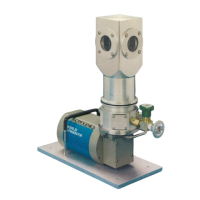
Janis CCR systems are equipped with a bellows sealed evacuation valve, which allows
evacuation and sealing of the insulating vacuum jacket. Prior to cooldown, connect a
turbomolecular or diffusion pump to the valve and evacuate the shroud to a pressure of
1.0 x
torr or less. Better vacuum levels provide greater insulation, resulting in
shorter cooldown times and lower final temperatures. A cold-trapped mechanical
vacuum pump can be used instead; however, this may limit the lowest temperature
attainable.
The evacuation valve can remain open during the initial phase of the system cooldown.
However, it should be closed before the sample temperature reaches 200 K to avoid
backstreaming of oil from the vacuum pump into the cryostat. Outgassing and o-ring
permeation will cause the pressure to rise slowly over time, therefore periodic re-
evacuation may be necessary. Re-evacuation is required whenever a new sample is
installed, or when the minimum temperature obtained begins to increase.
The CCS-450 high temperature model is equipped for operation to 475 K. When
operating above 325 K, the system should be evacuated continuously to prevent
contamination due to heater outgassing.
4.4 CRYOSTAT COOLDOWN
Switch on the automatic temperature controller and observe the temperature readings.
Temperature values of —290 K to 300 K should be displayed.
Review Section 3 of the CTI compressor manual before beginning the cooldown.
Establish a flow of cooling water as described in the CTI manual, then switch on the
compressor. The temperature should begin to drop within a few seconds, and the system
will achieve 10 K in about 1 hour.
Occasionally, time constraints will not permit thorough evacuation before the cooldown
begins. In this case, water vapor and other condensables can freeze out and contaminate
the sample. To avoid this problem, the cold finger can be kept at 300 K (using the
automatic temperature controller) during the first 40 minutes of operation, which will
cause the contaminants to settle on the cold radiation shield rather than on the sample.
An additional 20 - 30 minutes will be needed for the sample to reach the base
temperature. (This technique only needs to be used if initial system pressure is greater
than 5 x 10
-3
ton).
4.5 TEMPERATURE CONTROL
Most systems are supplied with an automatic temperature controller, silicon diode
thermometer, and 25 ohm control heater. Options include other diode or resistance
thermometers, thermocouples, and different heater resistance. The actual configuration
of your system can be found on the data sheet contained in this manual.
Most Janis CCR models operate from <10 K to 325 K. (The CCS-450 operates from —12
K to 475 K). Choose a temperature setpoint from within the appropriate range, and enter
values from Proportional (P), Integral (I), and Derivative (D) parameters. Some


 To Next Page
 Loading...