85
Air Conditioner
The air conditioning system is controlled by the Firey System. Refer to the Firey manual
for detailed information on air conditioner temperature control. Cooled air enters the RV
through the grill. Make sure you have sucient power available before operating the air
conditioner. Do not operate the air conditioner without the return air lter. Operating the
system without the lter allows the lint and dirt that is normally stopped by the lter to ac-
cumulate on the cooling coil of the air conditioner. This also will lead to a loss of air volume,
possible equipment damage and an expensive cleaning process.
A special foam gasket is placed between the roof material and the subframe of the air con-
ditioner to guard against water leakage. The air conditioner is subjected to wind pressures
along with motor vibration during normal operation. Inspect the mounting bolts for tight-
ness to ensure there is no leakage or looseness at least annually. Re-tighten bolts when
they are loose. over tighten these bolts as it may damage this gasket. The air
conditioner gasket is a wearable part that eventually will need to be replaced. To gain access
to the bolts, remove the ltered panel cover on central air systems or the entire air box on
non-central air conditioners.
Keep the air inlet grill and cabinet clean by wiping with a cloth dampened with warm water
and a mild detergent.
Set the thermostat for either electric or gas heat. On the electric setting, the heat pump
will become the primary heat source as long as the interior temperature of the RV has not
dropped 5° below the thermostat set point. If this occurs, the thermostat will automatically
activate your gas furnace.
The furnace will continue as the heat source until the thermostat set point has been satised.
At that point, the heat pump will again become the primary heat source.
For RV models with a touch screen system, the heating cooling controls are included on the
touch screen selectable screens.
refer to the manufacturer’s owner’s manual included in your
warranty packet or consult your dealer.
Power Roof Vent (if so equipped)
The 12-volt DC attic fan (or powered roof vent) allows fresh air to circulate through the
recreational vehicle. Do not leave the attic fan open when the recreational vehicle is stored
or unattended for long periods.
High winds, other unusual conditions or obstructions may prevent the dome from closing;
the resulting leakage could cause non-warrantable damage.
To use your fan most eectively, close all vents and slightly open a
window on a shaded side of your recreation vehicle. You are directing
the air ow by opening a window.
refer to the manu-
facturer’s owner’s manual.
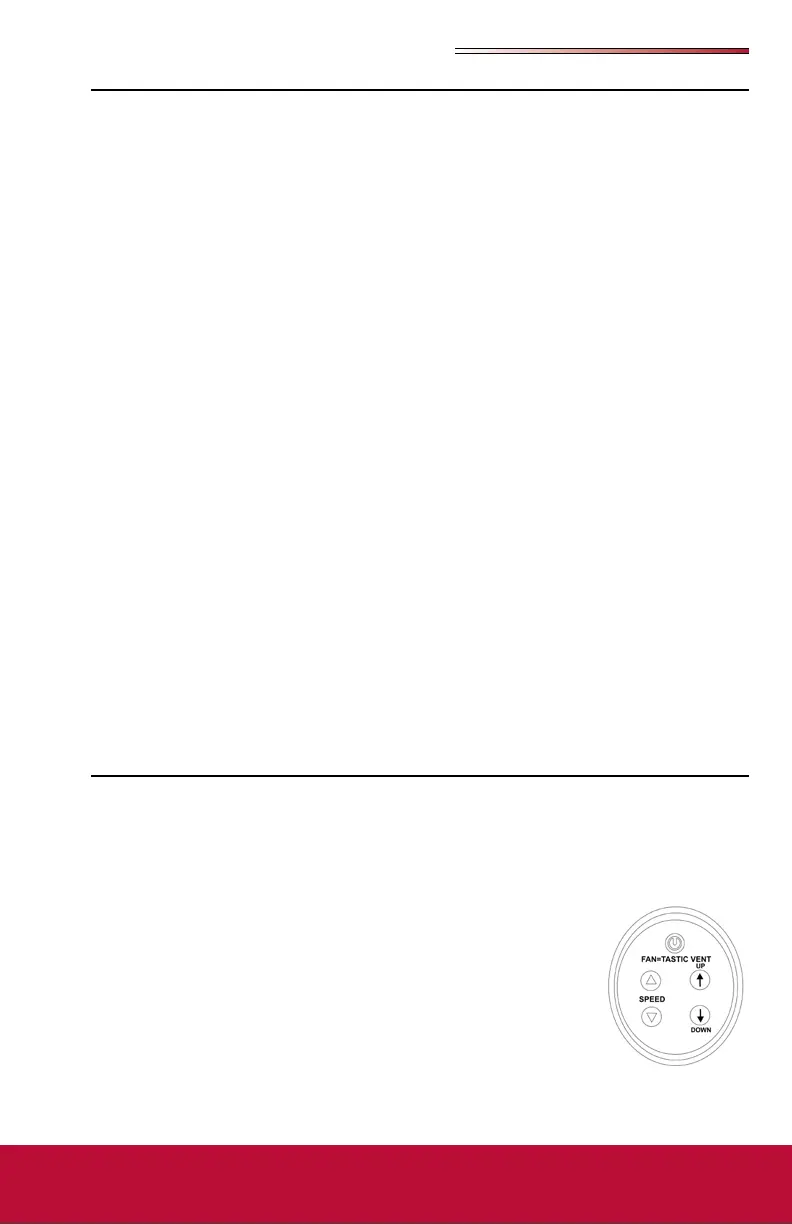
The attic fan may be controlled by a control pad. The dome can be
raised or lowered with the UP/DOWN buttons, and the speed of the
fan is controlled by the ARROW buttons. It is also equipped with a
rain sensor that will close the vent automatically when it rains. The
rain sensor can be turned on/o by holding the DOWN button for 3 seconds.




 To Next Page