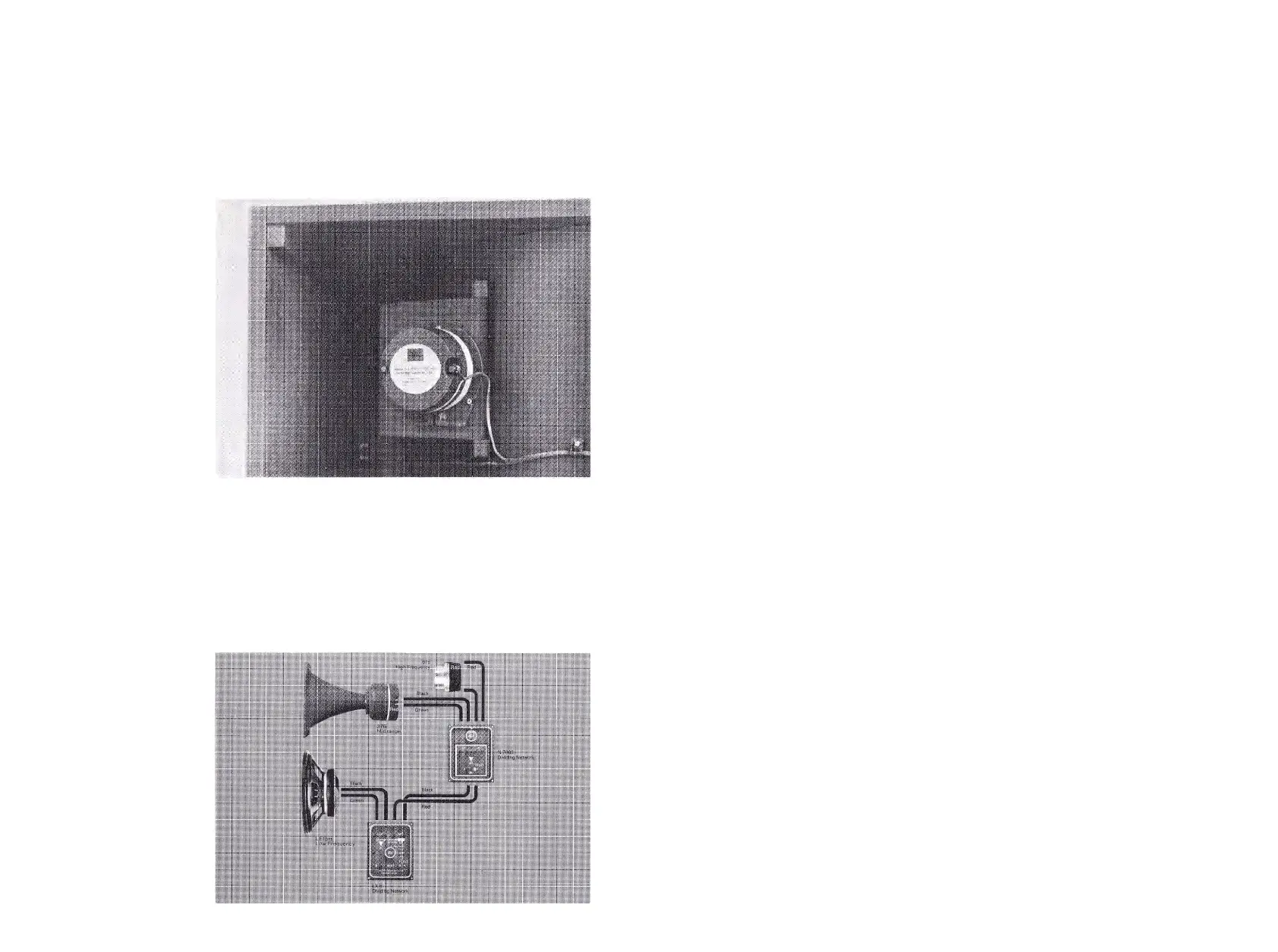
HIGH FREQUENCY The wire leads from the high frequency
driver are accessible from the rear of the enclosure. After
detaching these, the five Phillips-head wood screws that at
tach the driver’s clamp ring to the baffle board should be
removed. The driver is removed by loosening the screw at
the bottom of the clamp ring. When reinstalling the high
frequency driver, the two larger wood screws are inserted
through the holes nearest the base of the clamp ring. The
ring is positioned so that its base is directed towards the
bottom of the enclosure.
DIVIDING NETWORKS Detach the amplifier leads from the
network terminals. Remove the four screws from the corners
of each network mounting plate. Lift out each network and
remove the wire leads by gently pulling them through the
holes in the network mounting plate. Identify each wire so
that it can be replaced in the proper hole when the network
is reinstalled. Use the wiring diagram below to verify that
connections have been properly made. Each channel is color-
coded as shown.
8
REPLACEMENT Reverse the removal procedure to replace the
loudspeaker system components. Mounting screws should
be tightened evenly to avoid the possibility of frame warp-
age, and just enough to prevent air leaks between the com
ponents and the enclosure. Avoid excessive force.
Although JBL loudspeakers are extremely rugged, the
cone and other moving parts are subject to accidental
damage. Exercise extreme caution whenever using a
screwdriver or other tools in their immediate vicinity.
Whenever the horn is removed from the compression
driver, the mouth of the driver should be covered with
plastic tape. An intense magnetic field exists in the
mouth of the driver, and it is extremely important that
foreign objects such as iron chips, mounting hardware,
tools or other metal items be kept from the area.
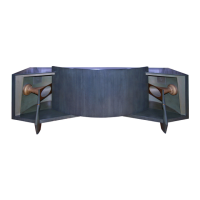
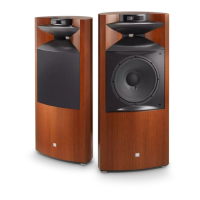
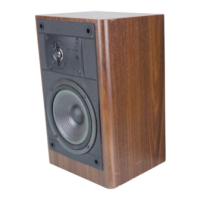
JBL cabinetry represents the finest quality available in the THE PARAGON ENCLOSURE
high fidelity industry, uniquely styled and solidly constructed
to last a lifetime. Designed to complement the characteristics
of the loudspeaker components, the Paragon enclosure features
tight, wood-welded, lock-mitered joints and acoustic padding
to eliminate undesired resonance and warpage. Only the finest
compressed woods, furniture hardwoods and hardwood
veneers are used —carefully selected, skillfully prepared and
hand-rubbed to a rich, lustrous finish enhancing the natural
beauty of individual grain structure and color. Detail work
is obvious: hand-fitted joints are expertly closed; edge
veneering is flawless; scratches, dents, gluelines and other
defects are non-existent. Typical assembly line procedures
are avoided; each cabinet receives all of the personal atten
tion it must have before it can bear the JBL medallion —the
symbol for quality throughout the world.
Occasional dusting with a clean, soft cloth will maintain
the original beauty of the oiled walnut enclosure. Since
moisture cannot penetrate the oiled surface, most household
stains can be easily removed with a damp cloth. The surface
should be treated only with wax specifically formulated for
use on oiled finishes. Conventional furniture waxes, polishes
or cleaners are not recommended.
As the oil penetrates deeper and deeper into the walnut,
the finish may appear to be drying out. Many owners find it
desirable to re-oil the enclosure surface from time to time.
With each application, the beauty of the finish will become
more obvious, and a warm, rich patina will eventually be
obtained.
To re-oil the finish, use the JBL finishing oil supplied with
the Paragon or any one of the several clear oil finishing
preparations available through furniture or hardware outlets.
Apply a liberal amount of the preparation over the entire
finished surface of the enclosure. In ten to fifteen minutes
wipe off the remaining oil with a soft, clean, dry cloth. Small
9




 To Next Page