AMPLITUDE SHADING
Amplitude Shading
Amplitude shading is a technique that allows the coverage pattern of a loudspeaker array to be shaped by
adjusting the relative acoustic output of some of the devices in the array. Most often, array shading involves
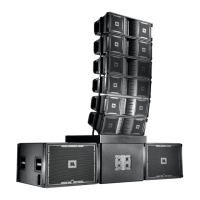
only the mid and high-frequency sections of the array. In a simple system consisting of three
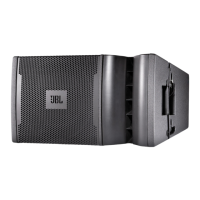
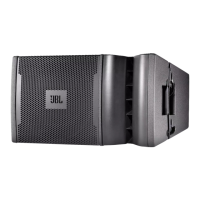
VRX932LA/VRX928LAs, the lower speaker (which covers the nearest listeners) may have its high-frequency
output reduced. At the same time, the upper speaker may have its high frequency output increased. The overall
sound-power in the room is unchanged but the distribution of acoustic energy to the audience is far more
uniform. Amplitude shading of a VRX932LA/VRX928LA array may be accomplished in passive or bi-amplified
systems.
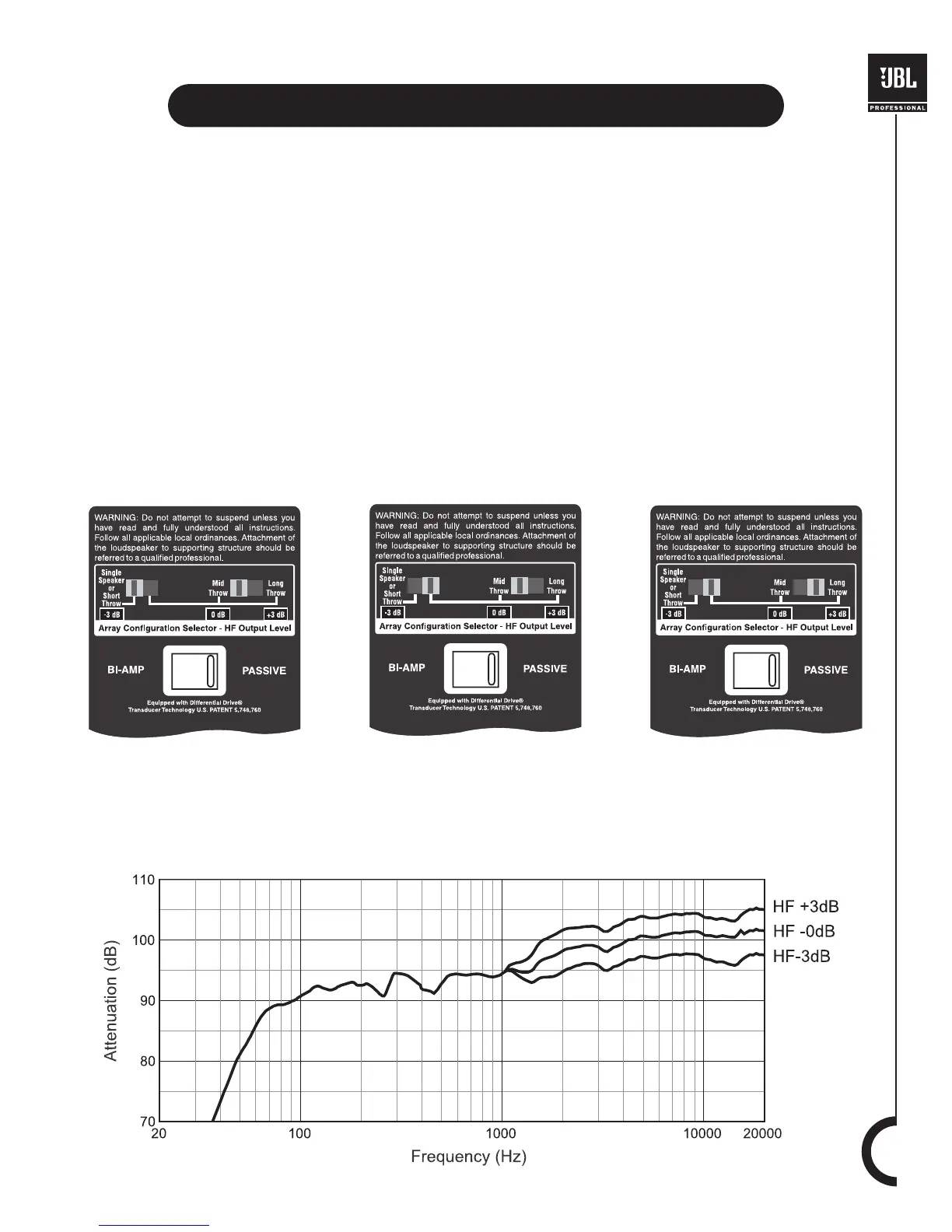
Array Configuration Selector (ACS)
In passive mode, the Array Configuration Selector may be used. The -3 dB position will typically be used for
the speaker(s) in an array that are covering the nearest listening area. The +3 dB position will be used for the
speaker(s) covering the more distant areas; or to compensate for the low-frequency build-up resulting from
mutual coupling of multiple woofers in an array.
Short Throw (-3 dB)
Long Throw (+3 dB)
Medium Throw (0 dB)
Frequency Response
The frequency response graph represents measurements from a single typical VRX900LA speaker, applying the
three different ACS settings: +3dB, 0dB, -3dB.
15


 To Next Page