EasyManua.ls Logo

Jeep UNIVERSAL CJ-2A - Page 23

Jeep UNIVERSAL CJ-2A
281 pages
Print Icon
To Next Page IconTo Next Page
To Previous Page IconTo Previous Page
Loading...
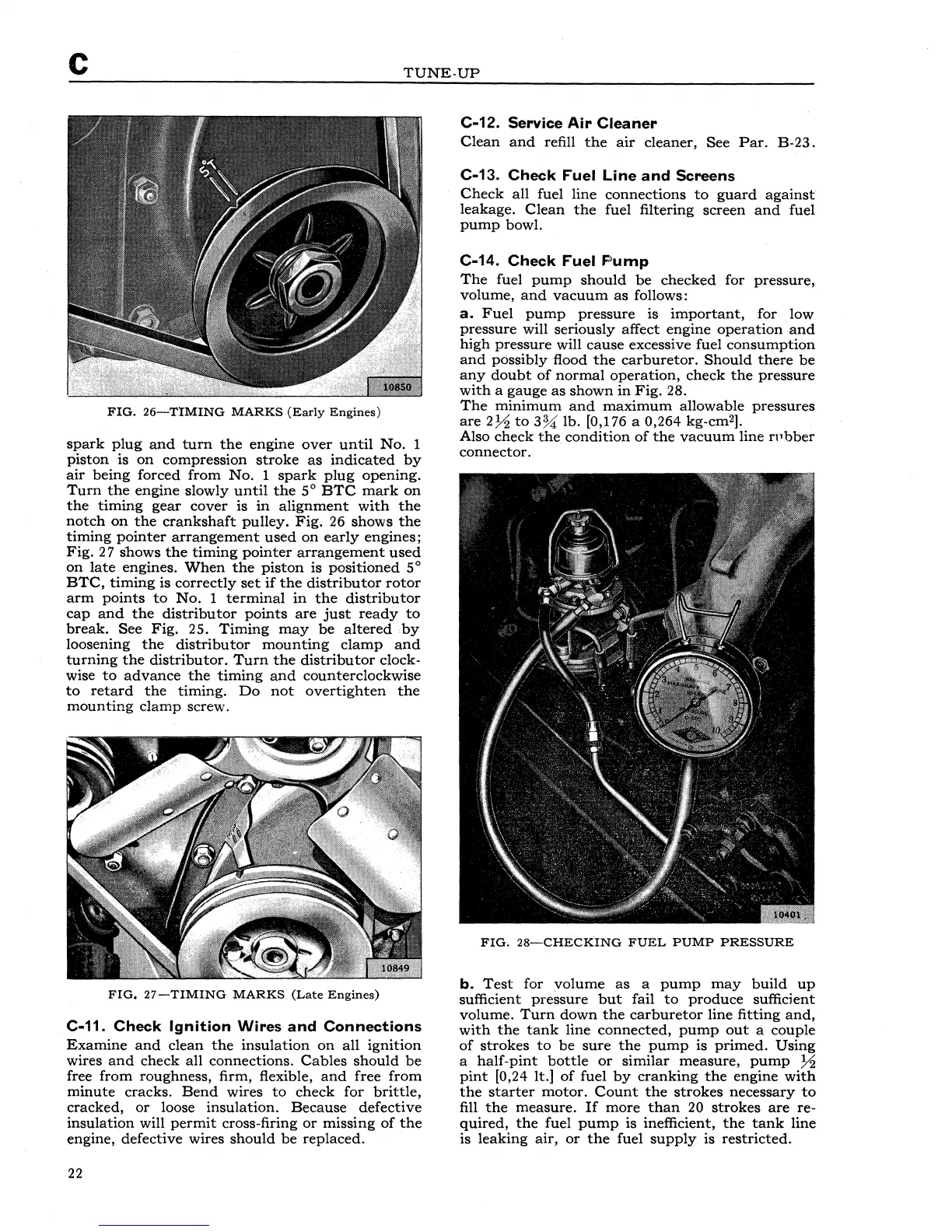
c
TUNE-UP
FIG.
26-T!MING
MARKS
(Early
Engines)
spark
plug
and
turn
the
engine
over
until
No.
1
piston
is
on
compression
stroke
as
indicated
by
air
being
forced
from
No.
1
spark
plug
opening.
Turn
the
engine
slowly
until
the
5o
BTC
mark
on
the
timing
gear
cover
is
in
alignment
with
the
notch
on
the
crankshaft
pulley.
Fig.
26
shows
the
timing
pointer
arrangement
used
on
early
engines;
Fig.
2 7
shows
the
timing
pointer
arrangement
used
on
late
engines.
When
the
piston
is
positioned
BTC,
timing
is
correctly
set
if
the
distributor
rotor
arm
points
to
No.
1
terminal
in
the
distributor
cap
and
the
distributor
points
are
just
ready
to
break.
See
Fig.
25.
Timing
may
be
altered
by
loosening
the
distributor
mounting
clamp
and
turning
the
distributor.
Turn
the
distributor
clock-
wise
to
advance
the
timing
and
counterclockwise
to
retard
the
timing.
Do
not
overtighten
the
mounting
clamp
screw.
FIG,
27-TIMING
MARKS
(Late
Engines)
C-11.
Check
Ignition
Wires
and
Connections
Examine
and
clean
the
insulation
on
all
ignition
wires
and
check
all
connections.
Cables
should
be
free
from
roughness, firm, flexible,
and
free
from
minute
cracks.
Bend
wires
to
check
for
brittle,
cracked,
or
loose
insulation.
Because
defective
insulation
will
permit
cross-firing
or
missing
of
the
engine, defective wires
should
be
replaced.
22
C-12.
Service
Air
Cleaner
Clean
and
refill
the
air
cleaner, See
Par.
B-
2 3 .
C-13.
Check
Fuel
Line
and
Screens
Check
all fuel line
connections
to
guard
against
leakage.
Clean
the
fuel filtering
screen
and
fuel
pump
bowl.
C-14.
Check
Fuel
Pump
The
fuel
pump
should
be
checked
for
pressure,
volume,
and
vacuum
as
follows:
a.
Fuel
pump
pressure
is
important,
for low
pressure
will
seriously
affect
engine
operation
and
high
pressure
will
cause
excessive fuel
consumption
and
possibly
flood
the
carburetor.
Should
there
be
any
doubt
of
normal
operation,
check
the
pressure
with
a
gauge
as
shown
in
Fig.
28.
The
minimum
and
maximum
allowable
pressures
are
2
72
to
3%
lb. [0,176 a
0,264
kg-cm2].
Also
check
the
condition
of
the
vacuum
line r11bber
connector.
FIG.
28-CHECKING
FUEL
PUMP
PRESSURE
b.
Test
for
volume
as
a
pump
may
build
up
sufficient
pressure
but
fail
to
produce
sufficient
volume.
Turn
down
the
carburetor
line
fitting
and,
with
the
tank
line
connected,
pump
out
a
couple
of
strokes
to
be
sure
the
pump
is
primed.
Using
a
half-pint
bottle
or
similar
measure,
pump
72
pint
[0,24 It.]
of
fuel
by
cranking
the
engine
with
the
starter
motor.
Count
the
strokes
necessary
to
fill
the
measure.
If
more
than
20
strokes
are
re-
quired,
the
fuel
pump
is inefficient,
the
tank
line
is
leaking
air,
or
the
fuel
supply
is
restricted.

Related product manuals