EasyManua.ls Logo

Jeep UNIVERSAL CJ-2A - Page 24

Jeep UNIVERSAL CJ-2A
281 pages
Print Icon
To Next Page IconTo Next Page
To Previous Page IconTo Previous Page
Loading...
'Jeep'
UNIVERSAL
and
'Jeep'
DISPATCHER
c
c.
To
test
the
pump
for
vacuum,
disconnect
the
tank
line
and
connect
a
vacuum
gauge
in
its
place.
Crank
the
engine
and
observe
the
vacuum
read-
ing.
If
less
than
8
inches
[20,8 em.]
of
mercury
[Hg)
the
pump
is
at
fault.
If
10
inches
[25,4 em.]
or
more,
check
the
fuel line.
C-15.
Vacuum
Check
Disconnect
the
vacuum
line
fitting
from
the
head
just
below
the
carburetor
and
install
the
proper
adapter.
Connect
a
vacuum
gauge
to
the
adapter
and
start
the
engine.
Connect
a
tachometer
from
the
distributor
primary
terminal
to
ground
and
set
the
engine
speed
at
600
rpm.
Observe
the
vacuum
reading
and
interpret
as
follows:
a.
A
steady
reading
from
18
to
21
inches
[46 a 63
em.]
of
mercury
[Hg.) is a
normal
reading
indicat-
ing
that
valve
and
spark
timing,
valve
seating,
and
piston
ring
sealing
are
all
satisfactory.
b.
A
steady
but
below
normal
reading
indicates
a
condition
common
to
all
cylinders·
such
as
a
leak
at
the
carburetor
gasket,
late
ignition
or
valve
timing,
or
uniform
piston
ring
and
bore
wear.
c.
A
slowly
fluctuating
or
drifting
reading
indicated
that
the
idle
mixture
is
incorrect
and
the
cause
should
be
looked
for
in
the
fuel
system.
d.
A
rhythmic
pulsating
reading
is
caused
by
a
condition
affecting
one
or
more
cylinders,
but
not
all,
and
indicates
leaky
valve,
gasket
blowby,
re-
stricted
intake
port,
or
an
electrical
miss.
e.
An
intermittent
pulsating
reading
is
caused
by
an
occasional
malfunction
such
as
a
sticking
valve
(all
valves
may
be
erratic
in
operation
if
the
valve
springs
are
weak),
and
electrical
miss
caused
by
insufficient
distributor
point
tension
or
low
coil
voltage
coupled
with
inconsistent
spark
plug
gaps
or
fouled
plugs,
or
dirt
in
the
fuel
system
fi.nding
its
way
into
passages
of
critical
size
or
valve
seats
in
the
carburetor.
f.
A
normal
reading
that
quickly
falls
off
(with
engine
running
at
2000
rpm.)
indicates
exhaust
back
pressure
caused
by
a
restriction
in
the
exhaust
system.
g.
Make
indicated
corrections
or
advise
vehicle
owner
of
engine
condition.
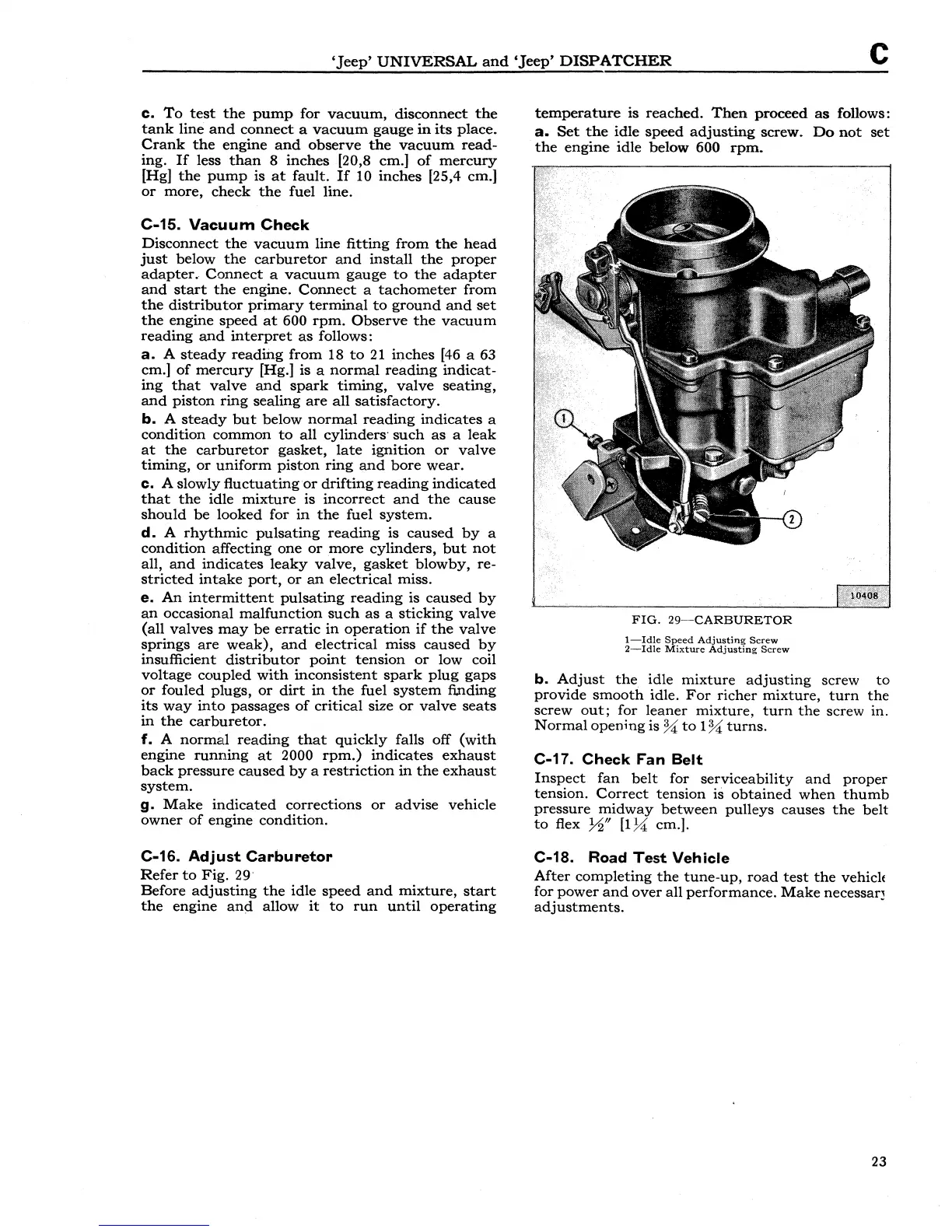
C-16.
Adjust
Carburetor
Refer
to
Fig.
29 ·
Before
adjusting
the
idle
speed
and
mixture,
start
the
engine
and
allow
it
to
run
until
operating
temperature
is
reached.
Then
proceed
as
follows:
a.
Set
the
idle
speed
adjusting
screw.
Do
not
set
the
engine
idle
below
600
rpm.
FIG.
29~-CARBURETOR
1-Idle
Speed
Adjusting
Screw
2-ldle
Mixture
Adjusting
Screw
b.
Adjust
the
idle
mixture
adjusting
screw
to
provide
smooth
idle.
For
richer
mixture,
turn
the
screw
out;
for
leaner
mixture,
turn
the
screw
m.
Normal
opening
is%
to
1%
turns.
C-17.
Check
Fan
Belt
Inspect
fan
belt
for
serviceability
and
proper
tension.
Correct
tension
is
obtained
when
thumb
pressure
midway
between
pulleys
causes
the
belt
to
flex
Y2"
[1
>-4
em.].
C-18.
Road
Test
Vehicle
After
completing
the
tune-up,
road
test
the
vehich
for
power
and
over
all
performance.
Make
necessar~
adjustments.
23

Related product manuals