EasyManua.ls Logo

Jeep UNIVERSAL CJ-2A - Page 71

Jeep UNIVERSAL CJ-2A
281 pages
Print Icon
To Next Page IconTo Next Page
To Previous Page IconTo Previous Page
Loading...
E
F4-134
ENGINE
with
the
oil
hole
in
the
block,
and
that
the
bearing
lock
fits
properly
in
the
notch
in
the
block.
Install
the
crankshaft
if
replacing
bearings
with
the
engine
out
of
the
vehicle.
The
desired
running
fit
(dif-
ference
between
the
diameter
of
the
crankshaft
journal
and
the
inside
diameter
of
the
fitted
bear-
ing)
for
a
main
bearing
is .0003
11
to
.00 2 9
11
[ .0008
a .0074 mm.].
With
a
dimension
in
excess
of
this
standard
running
fit, a
satisfactory
bearing
replace-
ment·
cannot
be
made
and
it
will
be
necessary
to
regrind
the
crankshaft.
Install
the
bearing
lower
half
and
the
bearing
cap
and
draw
the
nuts
down
equally
and
only
slightly
tight.
Rotate
the
crank-
shaft
by
hand
to
be
sure
it
turns
freely
without
drag.
Pull
the
nuts
tighter,
first
one
then
the
other,
a
little
at
a
time,
intermittently
rotating
the
crank-
shaft
by
hand
until
the
recommended
torque
of
35
to
45
lb-ft.
[4,8 a 6,2 kg-m.] is
reached.
If
the
bearings
are
of
the
correct
size,
and
lubricated
with
light
oil
before
.installation,
the
crankshaft
should
turn
freely
in
the
bearings.
If
the
crankshaft
cannot
be
turned,
a
larger
bearing
is
required.
If
there
is
no
binding
or
tightness,
it
is
still
necessary
to
check
clearance
to
guard
against
too
loose a fit.
Never
file
either
the
bearing
cap
or
the
bearing
to
compensate
for
too
much
clearance.
Do
not
use
shims
under
a
bearing
cap
or
behind
a
bearing
shell.
Do
not
run
a
new
bearing
half
with
a
worn
bearing
half.
The
use
of
"Pla&tigage"
of
the
proper
size
to
measure
.001"
[0,025 mm.]
clearance
is
recommended
for
check-
ing
crankshaft
main
bearing
clearance.
The
method
of
checking
clearance
is
as
follows:
a.
Remove
the
bearing
cap
and
carefully
wipe
all
oil
from
the
bearing
and
the
journal.
b.
Lay
a piece
of
"Plastigage"
Ys
11
[3
mm.]
shorter
than
the
width
of
the
bearing
across
the
journal
(lengthwise
of
the
crankshaft).
c.
Install
the
bearing
and
cap
and
tighten
first
one
nut,
then
the
other,
a
little
at
a
time
to
the
specified
torque.
As
the
bearing
tightens
down
around
the
journal,
the
"Plastigage"
flattens
to
a
width
that
indicates
the
bearing
clearance.
d.
Remove
the
cap
and
measure
the
width
of
the
flattened
"Plastigage,"
using
the
scale
printed
on
the
edge
of
the
envelope.
The
proper
size
"Plasti-
gage"
will
accurately
measure
clearance
down
to
.001
11
•
e.
If
the
flattened
"Plastigage"
tapers
toward
the
middle,
or
toward
the
end,
or
both
ends,
there
is
a difference
in
clearance,
indicating
a
taper,
a
low
spot,
or
other
irregularity
of
the
bearing
or
journal.
E-47.
Fitting
Crankshaft
Main
tsearings
Using
Shim
Stock
Thin
feeler
or
shim
stock
may
be
used
instead
of
"Plastigage"
to
check
bearing
clearances.
The
method
is simple,
but
care
must
be
taken
to
protect
the
bearing
metal
surface
from
injury
by
too
much
pressure
against
the
feeler
stock.
a.
Cut
a piece
of
.001
11
[0,025
mm.]
thick,
by
;Y2
11
[12,7
mm.]
wide, feeler
stock
Ys
11
[3
mm.]
shorter
than
the
width
of
the
bearing.
Coat
this
feeler
stock
with
light
engine
oil
and
lay
it
on
the
bearing
in
the
cap,
as
shown
in
Fig.
86.
With
the
70
shim
in
this
position,
install
the
bearing
and
cap
on
the
crankshaft.
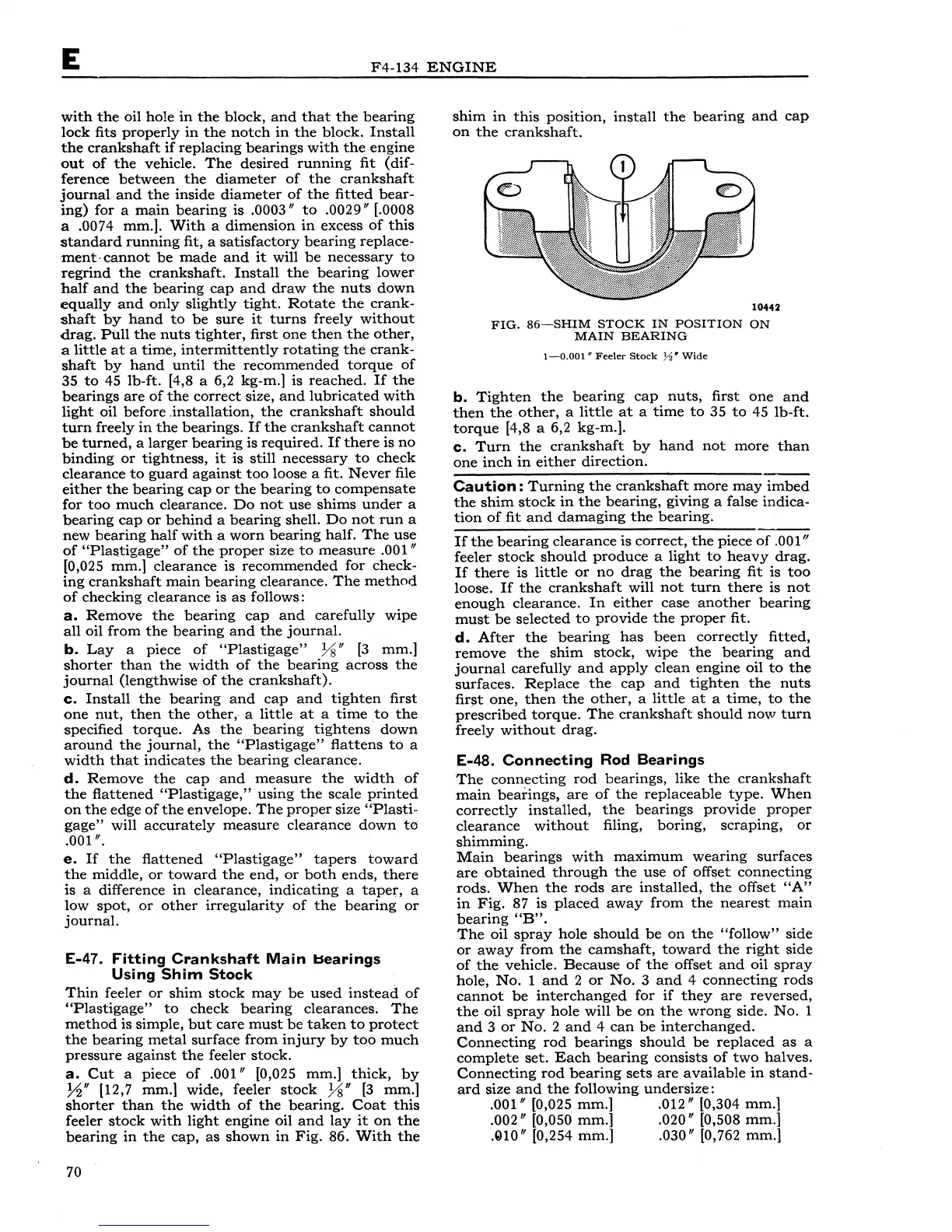
10442
FIG.
86-SHIM
STOCK
IN
POSITION
ON
MAIN
BEARING
1-0.001"
Feeler
Stock
Yz"
Wide
b.
Tighten
the
bearing
cap
nuts,
first
one
and
then
the
other,
a
little
at
a
time
to
35
to
45
lb-ft.
torque
[4,8 a 6,2 kg-m.].
c.
Turn
the
crankshaft
by
hand
not
more
than
one
inch
in
either
direction.
Caution:
Turning
the
crankshaft
more
may
imbed
the
shim
stock
in
the
bearing,
giving
a false
indica-
tion
of
fit
and
damaging
the
bearing.
If
the
bearing
clearance
is
correct,
the
piece
of
.001"
feeler
stock
should
produce
a
light
to
heavy
drag.
If
there
is
little
or
no
drag
the
bearing
fit
is
too
loose.
If
the
crankshaft
will
not
turn
there
is
not
enough
clearance.
In
either
case
another
bearing
must
be
selected
to
provide
the
proper
fit.
d.
After
the
bearing
has
been
correctly
fitted,
remove
the
shim
stock,
wipe
the
bearing
and
journal
carefully
and
apply
clean
engine
oil
to
the
surfaces.
Replace
the
cap
and
tighten
the
nuts
fir&t
one,
then
the
other,
a
little
at
a
time,
to
the
prescribed
torque.
The
crankshaft
should
now
turn
freely
without
drag.
E-48.
Connecting
Rod
Bearings
The
connecting
rod
bearings,
like
the
crankshaft
main
bearings,
are
of
the
replaceable
type.
When
correctly
installed,
the
bearings
provide
proper
clearance
without
filing,
boring,
scraping,
or
shimming.
Main
bearings
with
maximum
wearing
surfaces
are
obtained
through
the
use
of
offset
connecting
rods.
When
the
rods
are
installed,
the
offset
"A"
in
Fig.
87 is
placed
away
from
the
nearest
main
bearing
"B".
The
oil
spray
hole
should
be
on
the
"follow"
side
or
away
from
the
camshaft,
toward
the
right
side
of
the
vehicle.
Because
of
the
offset
and
oil
spray
hole,
No.
1
and
2
or
No.
3
and
4
connecting
rods
cannot
be
interchanged
for
if
they
are
reversed,
the
oil
spray
hole
will
be
on
the
wrong
side.
No.
1
and
3
or
No.
2
and
4
can
be
interchanged.
Connecting
rod
bearings
should
be
replaced
as
a
complete
set.
Each
bearing
consists
of
two
halves.
Connecting
rod
bearing
sets
are
available
in
stand-
ard
size
and
the
following
undersize:
.001
11
[0,025
mm.)
.012
11
[0,304
mm.]
.002
11
[0,050
mm.]
.020
11
[0,508
mm.]
.Q10
11
[0,254
mm.]
.030
11
[0,762
mm.]

Related product manuals