EasyManua.ls Logo

Jeep UNIVERSAL CJ-2A - Page 72

Jeep UNIVERSAL CJ-2A
281 pages
Print Icon
To Next Page IconTo Next Page
To Previous Page IconTo Previous Page
Loading...
'Jeep'
UNIVERSAL
and
'Jeep'
DISPATCHER
E
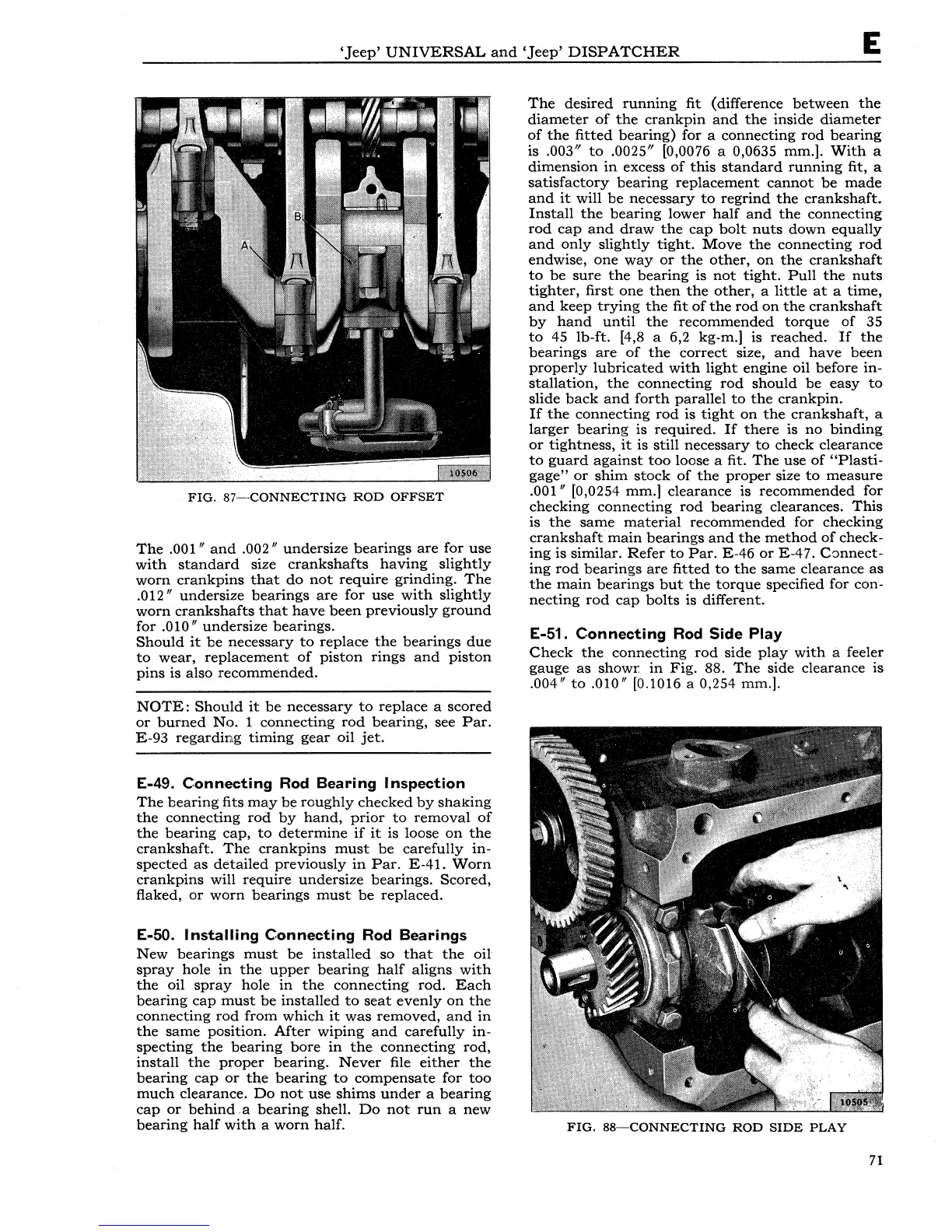
FIG.
87--CONNECTING
ROD
OFFSET
The
.001"
and
.002"
undersize
bearings
are
for
use
with
standard
size
crankshafts
having
slightly
worn
crankpins
that
do
not
require
grinding.
The
.012"
undersize
bearings
are
for
use
with
slightly
worn
crankshafts
that
have
been
previously
ground
for
.010"
undersize
bearings.
Should
it
be
necessary
to
replace
the
bearings
due
to
wear,
replacement
of
piston
rings
and
piston
pins
is also
recommended.
NOTE:
Should
it
be
necessary
to
replace
a
scored
or
burned
No.
1
connecting
rod
bearing,
see
Par.
E-93
regarding
timing
gear
oil
jet.
E-49.
Connecting
Rod Bearing
Inspection
The
bearing
fits
may
be
roughly
checked
by
shaking
the
connecting
rod
by
hand,
prior
to
removal
of
the
bearing
cap,
to
determine
if
it
is loose
on
the
crankshaft.
The
crankpins
must
be
carefully
in-
spected
as
detailed
previously
in
Par.
E-41.
Worn
crankpins
will
require
undersize
bearings.
Scored,
flaked,
or
worn
bearings
must
be
replaced.
E-50.
Installing
Connecting
Rod Bearings
New
bearings
must
be
installed
so
that
the
oil
spray
hole
in
the
upper
bearing
half
aligns
with
the
oil
spray
hole
in
the
connecting
rod.
Each
bearing
cap
must
be
installed
to
seat
evenly
on
the
connecting
rod
from
which
it
was
removed,
and
in
the
same
position.
After
wiping
and
carefully
in-
specting
the
bearing
bore
in
the
connecting
rod,
install
the
proper
bearing.
Never
file
either
the
bearing
cap
or
the
bearing
to
compensate
for
too
much
clearance.
Do
not
use
shims
under
a
bearing
cap
or
behind
.a
bearing
shell.
Do
not
run
a
new
bearing
half
with
a
worn
half.
The
desired
running
fit (difference
between
the
diameter
of
the
crankpin
and
the
inside
diameter
of
the
fitted
bearing)
for a
connecting
rod
bearing
is .003"
to
.0025" [0,0076 a 0,0635 mm.].
With
a
dimension
in
excess
of
this
standard
running
fit, a
satisfactory
bearing
replacement
cannot
be
made
and
it
will
be
necessary
to
regrind
the
crankshaft.
Install
the
bearing
lower
half
and
the
connecting
rod
cap
and
draw
the
cap
bolt
nuts
down
equally
and
only
slightly
tight.
Move
the
connecting
rod
endwise,
one
way
or
the
other,
on
the
crankshaft
to
be
sure
the
bearing
is
not
tight.
Pull
the
nuts
tighter,
first
one
then
the
other,
a
little
at
a
time,
and
keep
trying
the
fit
of
the
rod
on
the
crankshaft
by
hand
until
the
recommended
torque
of
35
to
45 lb-ft. [4,8 a 6,2 kg-m.] is reached.
If
the
bearings
are
of
the
correct
size,
and
have
been
properly
lubricated
with
light
engine oil before in-
stallation,
the
connecting
rod
should
be
easy
to
slide
back
and
forth
parallel
to
the
crankpin.
If
the
connecting
rod
is
tight
on
the
crankshaft,
a
larger
bearing
is
required.
If
there
is
no
binding
or
tightness,
it
is still
necessary
to
check
clearance
to
guard
against
too
loose a fit.
The
use
of
"Plasti-
gage"
or
shim
stock
of
the
proper
size
to
measure
.001" [0,0254 mm.]
clearance
is
recommended
for
checking
connecting
rod
bearing
clearances.
This
is
the
same
material
recommended
for
checking
crankshaft
main
bearings
and
the
method
of
check-
ing
is similar.
Referto
Par.
E-46
or
E-47.
C~nnect
ing
rod
bearings
are
fitted
to
the
same
clearance
as
the
main
bearings
but
the
torque
specified
for
con-
necting
rod
cap
bolts
is different.
E-51.
Connecting
Rod
Side
Play
Check
the
connecting
rod
side
play
with
a feeler
gauge
as
showr.
in
Fig.
88.
The
side
clearance
is
.004"
to
.010" [0.1016 a 0,254 mm.].
FIG.
88-CONNECTING
ROD
SIDE
PLAY
71

Related product manuals