EasyManua.ls Logo

Jeep UNIVERSAL CJ-2A - Page 86

Jeep UNIVERSAL CJ-2A
281 pages
Print Icon
To Next Page IconTo Next Page
To Previous Page IconTo Previous Page
Loading...
'Jeep'
UNIVERSAL
and
'Jeep'
DISPATCHER
E
Fig.
100).
This
gasket
position
allows a
positive
seal
along
the
narrow
surfaces
of
the
cylinder
head
between
the
combustion
chambers
and
eliminates
the
possibility
of
burning
combustion
gases
reach-
ing
an
asbestos
portion
of
the
cylinder
head
gasket.
Install
the
cylinder
head
bolts.
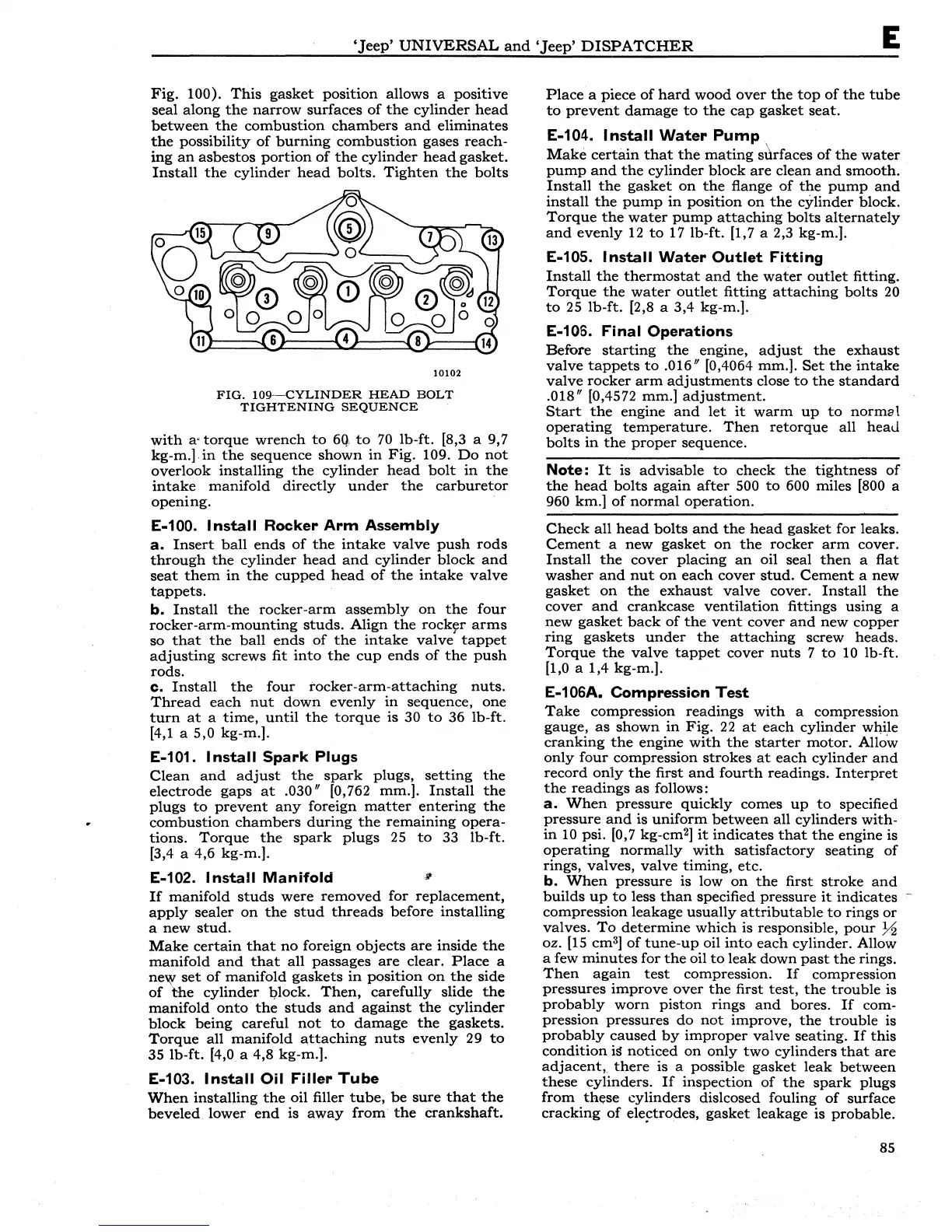
Tighten
the
bolts
10102
FIG.
109-CYLINDER
HEAD
BOLT
TIGHTENING
SEQUENCE
with
a•
torque
wrench
to
6Q,
to
70
lb-ft. [8,3 a 9,7
kg-m.].in
the
sequence
shown
in
Fig.
109.
Do
not
overlook
installing
the
cylinder
head
bolt
in
the
intake
manifold
directly
under
the
carburetor
opening.
E-100.
Install
Rocker
Arm
Assembly
a.
Insert
ball
ends
of
the
intake
valve
push
rods
through
the
cylinder
head
and
cylinder
block
and
seat
them
in
the
cupped
head
of
the
intake
valve
tappets.
b.
Install
the
rocker-arm
assembly
on
the
four
rocker-arm-mounting
studs.
Align
the
rocker
arms
so
that
the
ball
ends
of
the
intake
valve'
tappet
adjusting
screws fit
into
the
cup
ends
of
the
push
rods.
c.
Install
the
four
rocker-arm-attaching
nuts.
Thread
each
nut
down
evenly
in
sequence, one
turn
at
a
time,
until
the
torque
is
30
to
36
lb-ft.
[4,1 a
5,0
kg-m.].
E-101.
Install
Spark
Plugs
Clean
and
adjust
the
spark
plugs,
setting
the
electrode
gaps
at
.030"
[0,762 mm.].
Install
the
plugs
to
prevent
any
foreign
matter
entering
the
combustion
chambers
during
the
remaining
opera-
tions.
Torque
the
spark
plugs
25
to
33
lb-ft.
[3,4 a
4,6
kg-m.].
E-102.
Install
Manifold
...
If
manifold
studs
were
removed
for
replacement,
apply
sealer
on
the
stud
threads
before
installing
a
new
stud.
Make
certain
that
no
foreign
objects
are
inside
the
manifold
and
that
all
passages
are
clear.
Place
a
ne'f
set
of
manifold
gaskets
in
position
on
the
side
of
the
cylinder
Qlock.
Then,
carefully
slide
the
manifold
onto·
the
studs
and
against
the
cylinder
block being
careful
not
to
damage
the
gaskets.
Torque
all
manifold
attaching
nuts
evenly
29
to
35
lb-ft.
(4,0
a
4,8
kg-m.].
E-103.
Install
Oil
Filler
Tube
When
installing
the
oil filler
tube,
be
sure
that
the
beveled. lower
end
is
away
from
the
crankshaft.
Place
a piece
of
hard
wood
over
the
top
of
the
tube
to
prevent
damage
to
the
cap
gasket
seat.
E-104.
Install
Water
Pump
Make
certain
that
the
mating
silrfaces
of
the
water
pump
and
the
cylinder
block
are
clean
and
smooth.
Install
the
gasket
on
the
flange
of
the
pump
and
install
the
pump
in
position
on
the
cylinder block.
Torque
the
water
pump
attaching
bolts
alternately
and
evenly
12
to
17 lb-ft. [1,7 a 2,3 kg-m.].
E-105.
Install
Water
Outlet
Fitting
Install
the
thermostat
and
the
water
outlet
fitting.
Torque
the
water
outlet
fitting
attaching
bolts
20
to
25
lb-ft.
[2,8 a
3,4
kg-m.].
E-106.
Final
Operations
Before
starting
the
engine,
adjust
the
exhaust
valve
tappets
to
.016"
[0,4064 mm.].
Set
the
intake
valve
rocker
arm
adjustments
close
to
the
standard
.018"
[0,4572 mm.]
adjustment.
Start
the
engine
and
let
it
warm
up
to
normal
operating
temperature.
Then
retorque
all
heaJ
bolts
in
the
proper
sequence.
Note:
It
is
advisable
to
check
the
tightness
of
the
head
bolts
again
after
500
to
600 miles [800 a
960 km.]
of
normal
operation.
Check
all
head
bolts
and
the
head
gasket
for leaks.
Cement
a
new
gasket
on
the
rocker
arm
cover~
Install
the
cover
placing
an
oil seal
then
a flat
washer
and
nut
on
each
cover
stud.
Cement
a new
gasket
on
the
exhaust
valve
cover.
Install
the
cover
and
crankcase
ventilation
fittings using a
new
gasket
back
of
the
vent
cover
and
new
copper
ring
gaskets
under
the
attaching
screw heads.
Torque
the
valve
tappet
cover
nuts
7
to
10 lb-ft.
[1,0 a
1,4
kg-m.].
E-106A. Compression
Test
Take
compression
readings
with
a compression
gauge,
as
shown
in
Fig.
22
at
each
cylinder while
cranking
the
engine
with
the
starter
motor.
Allow
only
four
compression
strokes
at
each
cylinder
and
record
only
the
first
and
fourth
readings.
Interpret
the
readings
as
follows:
a.
When
pressure
quickly
comes
up
to
specified
pressure
and
is
uniform
between
all cylinders with-
in
10 psi. [0,7 kg-cm2)
it
indicates
that
the
engine is
operating
normally
with
satisfactory
seating
of
rings, valves,
valve
timing,
etc.
b.
When
pressure
is low
on
the
first
stroke
and
builds
up
to
less
than
specified pressure
it
indicates
-
compression
leakage
usually
attributable
to
rings
or
valves.
To
determine
which
is responsible,
pour
~
oz. [15
cm3)
of
tune-up
oil
into
each
cylinder. Allow
a few
minutes
for
the
oil
to
leak
down
past
the
rings.
Then
again
test
compression.
If
compression
pressures
improve
over
the
first
test,
the
trouble
is
probably
worn
piston
rings
and
bores.
If
com-
pression
pressures
do
not
improve,
the
trouble
is
probably
caused
by
improper
valve
seating.
If
this
condition
ill
noticed
on
only
two
cylinders
that
are
adjacent,
there
is a possible
gasket
leak
between
these
cylinders.
If
inspection
of
the
spark
plugs
from
th~se
cylinders dislcosed fouling
of
surface
cracking
of
eles:trodes,
gasket
leakage is
probable.
85

Related product manuals