EasyManua.ls Logo

Jeep UNIVERSAL CJ-2A - Page 87

Jeep UNIVERSAL CJ-2A
281 pages
Print Icon
To Next Page IconTo Next Page
To Previous Page IconTo Previous Page
Loading...
E
F4-l34
ENGINE
c.
When
pressure is
higher
than
normal
it
indicates
that
carbon
deposits
in
the
combustion
chamber
have
reduced
the
size
of
the
chamber
enough
to
give
the
effect
of
a raised compression
ratio.
This
will
usually
cause pinging
under
load
that
cannot
be
satisfactorily
corrected
by
timing.
The
carbon
must
be
cleaned
out
of
the
engine
to
correct
this
trouble.
d.
Reinstall
the
spark
plugs.
Torque
with
a
wrench
to
proper
setting.
E-107.
VALVE
ADJUSTMENT
Proper
valve
adjustment
is
important
to
prevent
burning
of
valves
and
poor
engine
performance.
This
adjustment
consists
of
obtaining
a specified
lash
in
the
valve
mechanism.
The
exhaust
valve
tappets
and
the
intake
valve
rocker
arms
should
be
adjusted
to
the
proper
clearance
with
the
engine
cold
(at
room
temperature).
Valve clearance
can
be
properly
adjusted
only
when
the
tappet
is
on
the
heel
qr
low
portion
of
the
cam.
E-108.
Valve
Adjustment
Procedure
The
exhaust
valve
tappets
are
adjusted
byturning
the
adjusting
screw
in
or
out
of
the
tappet
as
neces-
sary
to
obtain
the
proper
clearance.
Where
special
wrenches
can
be
obtained,
they
should
be
used
to
facilitate
the
adjustment.
The
proper
clearance
is
.016" [0,406 mm.]
between
the
end
of
the
adjusting
screw
and
the
bottom
of
the
exhaust
valve.
Crank
the
engine
over
to
close
a.
valve
and
check
the
clearance
with
a feeler gauge.
To
adjust,
hold
the
tappet
with
one
wrench
and
turn
the
adjusting
screw,
with
the
other.
Check
and
adjust
each
of
the.
tappets
in
proper
sequence.
Adjust
each
intake
valve
by
adjusting
the
rocker
arm
screw
at
the
push
rod
to
obtain
.018" [0,457
mm.] clearance
between
the
rocker
arm
and
the
valve
stem
with
tappet
on
the
heel
of
the
cam.
E
..
108A.
Vacuum
Check
Disconnect
the
vacuum
line
fitting
from
the
head
just
below
the
carburetor
and
install
the
proper
adapter.
Connect
a
vacuum
gauge
to.the
adapter
and
start
the
engine.
Connect
a tacho,meter
from
the
distributor
primary
terminal
to
ground
and
set
the
engine
speed
at
the
correct
rpm.
(F4-134
engine:
600
rpm.).
Observe
the
vacuum
reading
and
in-
terpret
as
follows:
a.
A
steady
reading
from
18
to
21
inches
[46
a 63
em.]
o(
mercury
[Hg] is a
normal
reading
indicat-
ing
that
valve
and
spark
timing,
valve
seating,
and
piston
ring
sealing
are
all
satisfactory.
b.
A
steady
but
below
normal
reading
indicates
a
condition
common
to
all
cylinders
such
as
a
leak
at
the
carburetor
gasket,
late,
ignition
or
valve
timing,
or
uniform
piston-ring-and-bore
wear.
e.
A slowly fluctuatine;
or
drifting
reading
indicates
that
the
idle
mixture
is
incorrect
and
the
cause
should
be
looked for
in
the
fuel
system.
d.
A
rhythmic
pulsating
reading
is
caused
by
a
condition
affecting one
or
more
cylinders,
but
not
all,
and
indicates
leaky
valve,
gasket
blowby,
re-
stricted
intake
port,
or
an
electrical miss.
e.
An
intermittent
pulsating
reading
is
caused
by
an
occasional
malfunction
such
as
a
sticking
valve
(all valves
may'
be
erratic
in
operation
if
the
valve
86
springs
are·
weak),
or
electrical miss .caused
by
insufficient
distributor
point
tension
or
low coil
voltage
coupled
with
inconsistent
spar_k
'plug
gaps
or
fouled plugs,
or
dirt
in
the
fuel
system
finding
its
way
into
passages
of
critical size
or
valve
seats
in
the
carburetor.
f.
A
normal
reading
that
quickly
falls off
(with
engine
running
at
2000
rpm.)
indicates
exhaust
back-pressure
caused
by
a
restriction
in
the
exhaust
system.
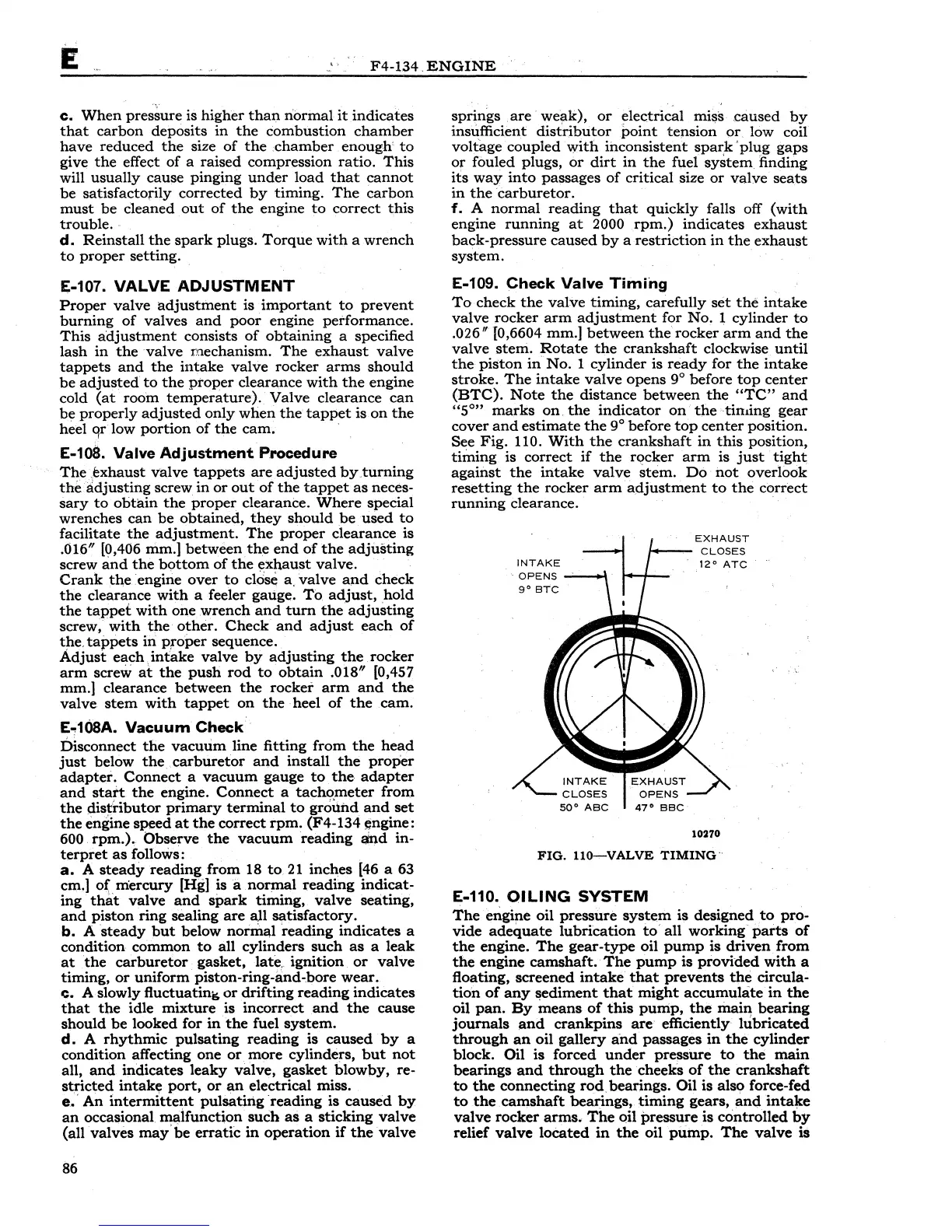
E-109.
Check
Valve
Timing
To
check
the
valve
timing,
carefully
set
the
intake
valve
rocker
arm
adjustment
for
No.
1
cylinder
to
.026" [0,6604 mm.]
between
the
rocker
arm
and
the
valve
stem.
Rotate
the
crankshaft
clockwise
until
the
piston
in
No.
1
cylinder
is
ready
for
the
intake
stroke.
The
intake
valve
opens
go before
top
center
(BTC).
Note
the
distance
between
the
"TC"
and
"5°"
marks
on
the
indicator
on
the
tin1ing
gear
cover
and
estimate
the
go before
top
center
position.
See
Fig.
110.
With
the
crankshaft
in
this
position,
timing
is
correct
if
the
rc;>cker
arm
is
just
tight:
against
the
intake
valve
stem.
Do
not
overlook
resetting
the
rocker
arm
adjustment
to
the
correct
running
clearance.
50°
ABC
47°
BBC
10270
FIG.
110-VALVE
TIMING·
E-110.
OILING
SYSTEM
The
engine oil
pressure
system
is designed
to
pro-
vide
adequate
lubrication
to
all
working
parts
of
the
engine.
The
gear-type
oil
pump
is
driven
from
the
engine
camshaft.
The
pump
is
provided
with
a
floating,
screened
intake
that
prevents
the
circula-
tion
of
any
!!ediment
that
might
accumulate
in
the
oil
pan.
By
means
of
this
pump,
the
main
bearing
journals
and
crankpins
are
efficiently
lubricated
through
an
oil
gallery
and
passages
in
the
cylinder
block. Oil
is
forced
under
pressure
to
the
main
bearings
and
through
the
cheeks
of
the
crankshaft
to
the
connecting
rod. bearings. Oil is also force-fed
to
the
camshaft
bearings,
timing
gears,
and
inta~e
valve
rocker
arms.
The
oil
pressure
is
controlled
by
relief
valve
located
in
the
oil
pump.
The
valve
is

Related product manuals