
 Need help?
Do you have a question about the Jensen XA4150 and is the answer not in the manual?
Instruction to disconnect the vehicle's negative battery terminal before installation.
Details on connecting the amplifier's main power input directly to the vehicle's battery.
Instructions for connecting the remote turn-on wire from the receiver to the amplifier.
Guidance on establishing a proper ground connection for the amplifier to the vehicle chassis.
Explains how to connect audio signals using low-level RCA or high-level speaker inputs.
Diagram illustrating wiring configurations for connecting four speakers to the amplifier.
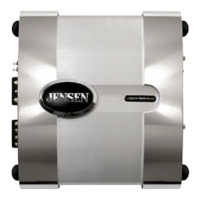
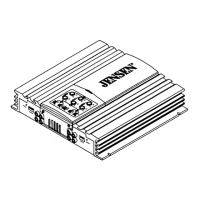
The Jensen XA4150 is a four-channel, 400-watt total system power automotive amplifier designed to enhance the audio experience in your vehicle. This manual serves as a comprehensive guide for both installation and operation, aiming to make the process clear and straightforward.
The primary function of the XA4150 amplifier is to boost the audio signal from your car's receiver, delivering a fuller, richer sound even at lower volume levels. While many automotive receivers provide limited power (typically 4 to 10 watts), the XA4150 significantly increases this output to 75 watts RMS per channel (or 200 watts RMS when bridged into a 4-ohm load), allowing for the use of more powerful speakers and a substantially louder playback.
The amplifier features both RCA inputs (low-level) and high-level inputs, offering flexibility in connecting to various types of car receivers. Low-level input is generally preferred for optimal performance. A continuously variable low-pass or high-pass crossover is integrated, enabling you to tailor the frequency response to your specific speaker setup. This means you can direct only bass tones to subwoofers (LPF), block very low tones from smaller speakers (HPF), or send all tones to full-range speakers (FULL). Additionally, a Bass Boost feature allows you to increase the volume of bass by up to 6 dB at 45Hz, adding depth to your audio.
For convenience, the amplifier includes a remote turn-on/off function, which activates the amplifier whenever your receiver is turned on, provided it's connected to the radio's power antenna lead or an accessory fuse. Electronic protection circuitry is built-in to safeguard the amplifier against short circuits, DC offset, and thermal overload, ensuring its longevity and reliable operation.
The XA4150 is bridgeable, meaning its power can be combined to drive two speakers with increased output, ideal for subwoofers. It also features a unique, super-efficient heat sink design to manage heat dissipation effectively, crucial for maintaining performance during extended use.
The XA4150 offers several user-adjustable controls to fine-tune your audio system. The Input Level Control is crucial for matching the amplifier's input sensitivity to your radio's output. This control should be set carefully, starting with the amplifier's control turned down, playing a CD or tape with flat EQ settings, and slowly increasing the radio volume until distortion is heard. Then, the radio volume is backed down slightly, and the amplifier's input level control is slowly increased until distortion is heard again, then backed down slightly. This process ensures optimal signal matching and prevents premature distortion.
The Crossover control allows you to select between Low Pass Filter (LPF), High Pass Filter (HPF), or Full (FULL) modes, with adjustable frequencies from 50 to 250Hz. LPF is used for subwoofers, HPF for smaller speakers (6" or less), and FULL for full-range speakers. For advanced setups like Tri-mode operation (running a subwoofer and two full-range speakers), external high-pass and low-pass crossovers are required to prevent damage to the amplifier and speakers.
The amplifier's status is indicated by two lights: a Power Light that illuminates when 12-volt power is available to both the battery and remote wires, and a Protect Light that turns red when the amplifier shuts down due to overheating or a short circuit (speaker failure).
The Pass Output connectors are a useful feature, allowing you to easily add other amplifiers to your system without needing additional signal sources from the receiver.
While the manual doesn't detail specific routine maintenance for the amplifier itself, it emphasizes several practices that contribute to its longevity and proper functioning.
Proper installation is paramount. The manual stresses the importance of allowing adequate air circulation around the amplifier to prevent overheating, advising against covering it with carpets or enclosing it behind interior trim panels. It also recommends selecting a mounting location where air can circulate freely.
Wiring integrity is critical. The manual provides detailed instructions for power, ground, remote, and speaker wiring, highlighting the use of appropriate gauge wires (e.g., 8 gauge for power) and secure connections. It warns against common issues like bundling RCA cables with speaker or power wires, running speaker wires parallel to power wires, and ensuring all ground wires connect to the same point on the vehicle chassis to prevent alternator noise.
The troubleshooting section acts as a maintenance guide, offering solutions for common problems such as the amplifier not operating, distorted sound, blown fuses, alternator whine, or the protect light activating. It guides the user through checking connections, fuse integrity, input level settings, and speaker wiring. For instance, if the protect light comes on, it suggests letting the amp cool down and checking for loose or bad speaker connections.
The manual also advises on securing all loose wires to the vehicle to prevent rubbing or rattling, which could lead to damage over time. In case of service, it emphasizes the need for the original dated receipt for warranty claims. For technical assistance, a dedicated phone number is provided, ensuring support for operational or installation issues. These guidelines, while not traditional maintenance, are crucial for the long-term health and performance of the XA4150 amplifier.
 Power Output
| power output (4 ohms) | 75 Watts per channel RMS |
|---|---|
| power output (2 ohms) | 100 Watts per channel RMS |
| power output (4 ohms bridged) | 200 Watts per channel RMS |
Audio Specifications| frequency response | 20 Hz-20 kHz ± 3 dB |
|---|---|
| signal to noise ratio | >100 dB |
| channel separation | >65 dB, 1 kHz |
Impedance and Crossover| speaker impedance | 2-8 ohms |
|---|---|
| input impedance | 20 k ohms |
| crossover frequencies | Low-High: 50-250 Hz |
Power Requirements| power requirement | 14.4 VDC (10.8-15.6 VDC allowable) |
|---|---|
| fuse requirements | two 25 amp blade-type fuses |
Dimensions| dimensions | 2.25" x 11.125" x 12.75" |
|---|---|
| dimensions (metric) | 56.5mm x 282mm x 330mm |





 To Next Page

