EasyManua.ls Logo

Johnson Controls CVM03050 - User Manual

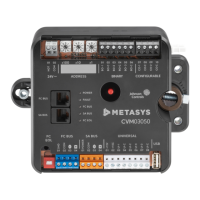
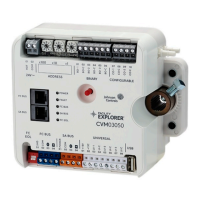
Johnson Controls CVM03050
24 pages
Print Icon
To Next Page IconTo Next Page
Loading...
M4-CV Series VAV Box Controllers Installation
Guide
Application
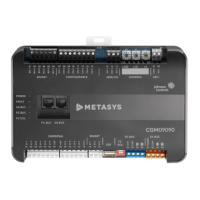
The CV series controllers are designed for variable air
volume (VAV) box applications.
CV series controllers feature 14 preloaded standard
applications to allow this controller to operate
standard VAV box equipment with a proven energy-
efficient sequence of operation, without the need for
programming. For information on configuring a CV series
controller to use a preloaded application, see Setting a
preloaded application. These controllers are also fully
programmable, using the Controller Configuration Tool
(CCT), providing the flexibility to create custom control
sequences.
CV series controllers feature an integral damper actuator,
a digital Differential Pressure Transmitter (DPT) sensor,
and a 32-bit microprocessor. The CVM03050-0P and
CVE03050-0P models feature an integral potentiometer
to sense actual VAV box damper position. For information
on configuring an application with integrated actuator
feedback, refer to the M4-CV Series Actuator Feedback
Application Note (LIT-12013631).
CV series controllers also include an integral real-time
clock, which enables the controllers to monitor and
control schedules, calendars, and trends, and operate
for extended periods of time as stand-alone controllers
when offline from the Metasys system network. These
controllers connect easily to the wired and wireless
network sensors for zone and discharge air temperature
sensing. Their small package size facilitates quick
field installation and efficient use of space without
compromising control performance.
Communications protocols
CV series controllers can communicate using multiple
communication protocols depending on model and
configuration. The CVE controllers communicate using
the BACnet/IP communication protocol. CVM controllers
communicate using the BACnet MS/TP, N2, or wireless
Zigbee
®
communications protocols, with the addition
of ZFR183x Pro Wireless Field Bus Routers. Equipment
Controllers in BACnet/IP or BACnet/MSTP communication
mode are BACnet network-compliant devices. The
BACnet protocol is a standard for ANSI, ASHRAE, and the
International Standards Organization (ISO) for building
controls.
Controllers running in N2 mode can be used to maintain
or modernize sites with installed legacy Johnson Controls
®
controllers. For installation and commissioning support,
and tips for efficient and safe replacement, refer
to the Modernization Guide for Legacy N2 Controllers
(LIT-12012005) and the controller-specific documentation.
For information about mapping N2 Objects in controllers
with switchable communications protocols, refer to the
N2 Compatibility Options chapter of the Controller Tool Help
(LIT-12011147).
To configure CVM controllers to communicate using
the N2 communications protocol, see Configuring N2
communications (CVM models only).
To configure CVM controllers to communicate using
the wireless communications protocol, see Configuring
wireless communications (CVM models only).
North American Emissions Compliance
United States
This equipment has been tested and found to comply
with the limits for a Class A digital device pursuant to
Part 15 of the FCC Rules. These limits are designed
to provide reasonable protection against harmful
interference when this equipment is operated in a
commercial environment. This equipment generates,
uses, and can radiate radio frequency energy and, if not
installed and used in accordance with the instruction
manual, may cause harmful interference to radio
communications. Operation of this equipment in a
residential area may cause harmful interference, in which
case the users will be required to correct the interference
at their own expense.
Canada
This Class (A) digital apparatus meets all the
requirements of the Canadian Interference-Causing
Equipment Regulations.
Cet appareil numérique de la Classe (A) respecte toutes
les exigences du Règlement sur le matériel brouilleur du
Canada.
Installation
Observe the following guidelines when installing the
controller:
To minimize vibration and shock damage to the
controller, transport the controller in the original
container.
Verify that all parts shipped with the controller.
Do not drop the controller or subject it to physical
shock.
Parts included
One CVM/CVE controller with removable terminal
blocks (Input/Output, Power, FC, and SA terminal blocks
bus are removable)
Note: The FC terminal block is only available with
the CVM model
One installation instructions sheet
One self-drilling No. 10 x 25 mm (1 in.) screw
*241014301590D*
Part No. 24-10143-01590 Rev. D
11.0
2022-02-07
(barcode for factory use only)
M4-CVM03050-0x, M4-CVE03050-0P


Questions and Answers

Johnson Controls CVM03050 Specifications

General IconGeneral
ModelCVM03050
Communication ProtocolBACnet MS/TP
TypeController
Supply Voltage24 VAC
Input TypeAnalog/Digital
Output TypeAnalog/Digital

Summary

Application and Installation

CV Series Controller Purpose

Details the CV series controllers for VAV box applications and their key features.

Supported Communications Protocols

Explains the various communication protocols used by CVM and CVE controllers for networking.

Installation Guidelines and Precautions

Provides directives and precautions for installing the controller unit safely.

Physical Features, Mounting, and Components

Controller Hardware Identification

Identifies physical features, ports, and components of the CVM/CVE controllers.

Controller Mounting Guidance

Offers essential guidance for securely and correctly mounting the controller unit.

Controller Mounting Orientations

Preferred and Acceptable Positions

Illustrates and describes preferred and acceptable mounting positions for the controller.

Wiring and Terminal Block Identification

Terminal Block and Bus Port Overview

Identifies terminal blocks and bus ports crucial for controller wiring and connectivity.

Input;Output Terminal Block Details

Explains the removable input/output terminal blocks and their specific locations.

Communication Bus and Network Topology

BACnet;IP Ethernet Network Topology

Describes network topologies for CVE controllers using BACnet/IP Ethernet communication.

FC Bus and SA Bus Wiring

Details wiring configurations for FC Bus and SA Bus terminal blocks on CVM controllers.

Port and Power Terminal Details

SA Bus Port and FC Bus Port Configuration

Explains SA Bus port and FC Bus port on CVM models for connecting devices.

24 VAC Supply Power Wiring

Details the 24 VAC supply power terminal block and its necessary wiring.

Wiring Guidelines and Requirements

Input and Output Wiring Guidelines

Provides guidelines for wiring controller inputs/outputs, including cable separation.

I;O Terminal Block Specifications

Universal Input and Output Terminal Details

Details functions, ratings, and requirements for Universal Input and Output terminals.

Cable Length and Wire Size Guidelines

Cable Length Guidelines for Wire Sizes

Provides guidelines on cable length based on wire size for low-voltage inputs/outputs.

Communication Bus and Supply Power Wiring

Communication Bus and Supply Power Terminal Details

Details terminal functions, ratings, and cable recommendations for communication and power.

Termination Diagrams and Bus Configurations

Termination Diagrams for Field Devices

Provides diagrams for wiring field devices to controller inputs/outputs.

SA Bus and 24 V~ Configuration Details

Details SA Bus and 24 VAC supply configurations and recommended cable types.

Detailed Termination Diagrams

Voltage Input and Output Termination Details

Shows termination diagrams for various voltage input and output configurations.

Advanced Termination Diagrams

Incremental Control and Binary Output Terminations

Illustrates termination for incremental control and binary output connections.

Network Stat SA Bus Termination

Details the termination diagram for Network Stats connected via SA Bus.

Setup, Adjustments, and Validation

Configuring Communication Protocols

Guides on configuring N2, switching to MS/TP, and setting up wireless communications.

Input;Output Wiring Validation

Steps to validate wiring connections using default applications and displays.

Device Addressing and Controller Numbering

Setting Device Address for CVM Models

Explains setting device addresses using rotary switches for CVM controllers.

Setting Controller Number for CVE Models

Guides setting controller numbers for CVE models using rotary switches.

Terminal Block Removal and EOL Switch

Removing a Terminal Block

Step-by-step instructions for safely removing a terminal block from the circuit board.

Setting the End-of-Line (EOL) Switch

Instructions for setting the EOL switch on CVM controllers for bus termination.

Controller Commissioning Procedures

Outlines the process and connection types for commissioning the controllers.

Firmware, Applications, and Troubleshooting

Firmware Package Files

Information on required firmware package files for CCT configuration and commissioning.

Setting a Preloaded Application

Describes how to configure a controller with one of the 14 preloaded applications.

Troubleshooting Equipment Controllers

Introduces troubleshooting information, including LED status and common issues.

LED Status Indicators

Status LED Descriptions

Explains the meaning of status LEDs for POWER, FAULT, FC BUS, SA BUS, and Ethernet ports.

General Troubleshooting

Controller Power and Output Issues

Addresses common problems like controller power loss or invalid configurable output modes.

CV Series Controller Accessories

Accessory Product Codes and Descriptions

Lists available accessories for CV series controllers with their product codes and descriptions.

Technical Specifications Overview

Power, Network, and Protocol Specs

Details power requirements, consumption, network types, and communication protocols.

Processor, Memory, and Clock Backup Specs

Provides specifications for the controller's processor, memory, and real-time clock backup.

Controller Capabilities and Compliance

Input;Output Capabilities and Accuracy

Details input/output capabilities, resolution, accuracy, and sensor ranges.

Mounting, Housing, and Compliance Standards

Covers mounting, housing, and compliance with US, Canada, Europe, and ANZ standards.

Contact and Patent Information

Patent Information

Provides information and links regarding patents related to the product.

Global Contact Information

Lists contact details for Johnson Controls' branch offices worldwide.

Related product manuals