EasyManua.ls Logo

Johnson Controls P77 Series - User Manual

Johnson Controls P77 Series
10 pages
Print Icon
To Next Page IconTo Next Page
Loading...
European Refrigeration Controls Catalogue
Catalog Section 6
Product Bulletin P77
Issue 13/05/2003
© 2003 Johnson Controls Inc Catalogue Section 6
Order No. PD-P77-E
PSC1302
Series P77
Single Pressure Controls for Refrigeration,
Air-conditioning and Heatpump Applications
Introduction
These pressure controls are designed for use in
a variety of applications involving refrigeration
high or low pressure. Models supplied have a
“whole range” design, enabling them to be
used with refrigerants R22, R134A, R404A and
all other non-corrosive refrigerants which are
within the operating range of the control. They
may also be used for other high or low pressure
applications such as air, water etc. Models
which can be used with ammonia as well as
controls tested, conforming to DIN 32733, and
approved by TÜV are included in the program.
DIN (HP) models are also tested and approved
according to PED 97/23EC Cat. IV.
Description
The P77 series pressure controls may be used
for control functions or limit functions, depending
on model number. All models are provided with
alarm contacts. All standard models have
phosphor bronze bellows and brass pressure
connections. Models for use with ammonia are
provided with stainless steel bellows and
connectors. Devices conforming to DIN 32733
have a double bellows on the high pressure
versions. Their IP54 classification means that
these pressure controls are suitable for almost
all applications.
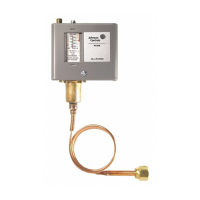
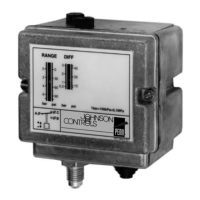
P77 Single Pressure Control
for Refrigeration
Feature and Benefits
Generous wiring space
Easy wiring and maintenance
Splash-proof enclosure (IP54)
Can be used for indoor/outdoor applications
SPDT contacts are provided as
standard on single pressure
controls.
Trip-free manual reset
Can be wired for alarm functions
Override is not possible in the control function
Question and Answer IconNeed help?

Do you have a question about the Johnson Controls P77 Series and is the answer not in the manual?

Johnson Controls P77 Series Specifications

General IconGeneral
BrandJohnson Controls
ModelP77 Series
CategoryController
LanguageEnglish

Summary

Series P77 Controls Overview

Introduction to P77 Controls

Details the intended applications, refrigerants, and standards compliance for Series P77 pressure controls.

P77 Control Description

Describes the functionality, construction materials, bellows, and IP54 classification of P77 pressure controls.

P77 Features and Benefits

Lists key features like generous wiring space, splash-proof enclosure, SPDT contacts, and trip-free manual reset.

P77 Product Selection and Operation

Type Number Matrix

Provides a matrix for selecting P77 control type numbers based on various specifications and features.

Contact Functions

Illustrates the contact configurations (A-C open/close) for pressure decrease and increase.

Mounting and Adjustment

Details mounting methods and procedures for adjusting range and differential screws.

Repair and Replacement

States that repair is not possible and advises contacting the supplier with the model number for replacement.

P77 Type Number Selection Table

P77 Connections and Accessories

Pressure Connections

Illustrates and describes different pressure connection types and their specifications.

Optional Accessories

Details optional accessories such as mounting brackets, compression couplings, and locking kits.

P77 Dimensions

Dimensional Drawings

Provides detailed dimensional drawings and labels for key components like mounting holes and cable grommet.

P77 Specifications

Technical Specifications

Lists technical specifications including pressure connections, operating ranges, ambient limits, electrical ratings, materials, and shipping weight.

P77 Installation and Operation

Installation Instructions

Provides instructions for installation, including notes on mounting, wiring, and electrical connections.

Check Out Procedure

Outlines the procedure to observe at least three operating cycles to confirm correct component function.

Related product manuals