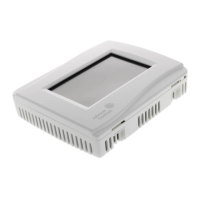
TEC3000 Series On/Off or Floating Fan Coil
Thermostats Quick Start Guide
North American emissions
compliance
United States
This equipment has been tested and found to comply with
the limits for a Class B digital device, pursuant to Part 15
of the FCC Rules. These limits are designed to provide
reasonable protection against harmful interference in
a residential installation. This equipment generates,
uses and can radiate radio frequency energy and, if not
installed and used in accordance with the instructions,
may cause harmful interference to radio communications.
However, there is no guarantee that interference will not
occur in a particular installation. If this equipment does
cause harmful interference to radio or television reception,
which can be determined by turning the equipment
off and on, the user is encouraged to try to correct the
interference by one or more of the following measures:
• Reorient or relocate the receiving antenna.
• Increase the separation between the equipment and
receiver.
• Connect the equipment into an outlet on a circuit
different from that to which the receiver is connected.
• Consult the dealer or an experienced radio/TV
technician for help.
Canada
This Class (B) digital apparatus meets all the requirements
of the Canadian Interference-Causing Equipment
Regulations.
Cet appareil numérique de la Classe (B) respecte toutes
les exigences du Règlement sur le matériel brouilleur du
Canada.
Parts included
• One TEC3000 Series Thermostat Controller with integral
mounting base
• One installation instructions sheet
Location considerations
For networked models, locate the TEC3000 Series
Thermostat Controller:
• On a partitioning wall, approximately 5 ft (1.5 m) above
the floor in a location of average temperature, to allow
for vertical air circulation to the TEC
• Away from direct sunlight, radiant heat, outside walls,
outside doors, air discharge grills, stairwells, and from
behind doors
• Away from steam or water pipes, warm air stacks,
unconditioned areas (not heated or cooled), or sources
of electrical interference
• In a clear path between the integrated passive infrared
(PIR) occupancy sensor, if equipped and the space it
monitors
For wireless models, also locate the thermostat controller:
• Outside of a recessed area, metal enclosure, or shelving
unit
• On the same building level as the other wireless devices
on the same personal area network (PAN)
• At least 2 in. (51 mm) away from any metal obstruction
• In the direct line of sight to other wireless devices on
the same PAN. Signal transmission is best if the path
between the TEC3000 and other wireless devices is
direct as possible. Line of sight is desirable but not
required. See Table 1 and Table 2 for the recommended
and maximum distances.
• Away from metal and large solid obstructions, that
includes equipment rooms and elevator shafts and
concrete or brick walls, between the TEC3000 and
the ZFR182x or ZFR183x Router/Repeater or ZFR Pro
Coordinator Radio
• Within range of two or more wireless devices on the
same PAN. Redundancy in the layout provides the best
reliability in wireless installations
• At least 20 ft (6 m) from a microwave oven
For integrated PIR models, make sure that the thermostat
controller is located centrally, where occupant movement
is frequent. Ensure that the unit is not blocked by a plastic
tamper resistant enclosure (such as the GRD10A-608). The
plastic enclosure blocks the occupancy sensing capability.
The use of insulating foam pads is necessary for
installations where wiring passes through the wall to the
thermostat.
For wireless models, the effective transmission range and
distance for indoor applications vary because of wireless
signal absorption and reflection due to metal obstructions,
walls or floors, and furniture that is found in building
interiors.
Table 1: Indoor line-of-sight transmission ranges
ZFR182x
Range type Transmission
distance
WNC Coordinator
Radio,ZFR Pro
Repeater
TEC3000 Wireless
Thermostat
Controller
Recommended 50 ft (15.2 m) 50 ft (15.2 m)
Line of sight,
maximum
250 ft (76.2 m) 100 ft (30 m)
*241135300001E*
Part No. 24-11353-00001 Rev. E
2020-07-06
(barcode for factory use only)
TEC3012-1x-xxx, TEC3013-1x-xxx, TEC3312-1x-xxx,
TEC3313-1x-xxx, TEC3612-1x-xxx, TEC3613-1x-xxx,
TEC311x-14-xxx



 To Next Page

 General