the pressure is lowered. If this foam reaches the oil pump suction, the bearing oil pressure will
fluctuate with possible temporary loss of lubrication, causing the oil pressure safety cutout to
actuate and stop the system. Refer to OptiView
™
Control Center – Operation Manual (160.76-O2).
Motor driveline
The compressor motor is an open-drip-proof, squirrel cage, induction type constructed to YORK
design specifications. 60 Hz motors operate at 3570 rpm. 50 Hz motors operate at 2975 rpm.
The open motor is provided with a D-flange, cast iron adapter mounted to the compressor and
supported by a motor support.
Motor drive shaft is directly connected to the compressor shaft with a flexible disc coupling. This
coupling has all metal construction with no wearing parts to ensure long life, and no lubrication
requirements to provide low maintenance.
For units utilizing remote electromechanical starters, a terminal box is provided for field connected
conduit. Motor terminals are brought through the motor casing into the terminal box. Jumpers
are furnished for three-lead type of starting. Motor terminal lugs are not furnished. Overload/over
current transformers are furnished with all units.
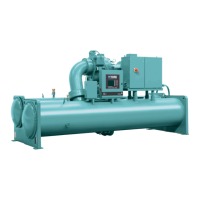
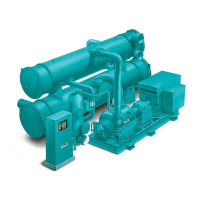
Heat exchangers
Evaporator and condenser shells are fabricated from rolled carbon steel plates with fusion welded
seams.
Heat exchanger tubes are internally enhanced type.
The evaporator is a shell and tube type with customer process fluid flowing inside the tubes and
refrigerant removing heat on the shell side via evaporation. The evaporator utilizes a hybrid
falling film design. It contains a balance of falling film technology to optimize efficiency, minimize
refrigerant charge, and maintain reliable control. A specifically designed spray distributor provides
uniform distribution of refrigerant over the entire length to yield optimum heat transfer. The hybrid
falling film evaporator design has suction baffles around the sides and above the falling film section
to prevent liquid refrigerant carryover into the compressor.
A 1 1/2 in. (38 mm) liquid level sight glass is conveniently located on the side of the shell to aid
in determining proper refrigerant charge. The evaporator shell contains a dual refrigerant relief
valve arrangement set at 235 psig (16.2 barg) on Q compressor models; or single-relief valve
arrangement, if the chiller is supplied with optional refrigerant isolation valves. A 1 in. (25.4 mm)
refrigerant charging valve is provided. The condenser is a shell and tube type, with a discharge gas
baffle to prevent direct high velocity impingement on the tubes. The baffle is also used to distribute
the refrigerant gas flow properly for most efficient heat transfer. An integral sub-cooler is located at
the bottom of the condenser shell providing highly effective liquid refrigerant subcooling to provide
the highest cycle efficiency. The condenser contains dual refrigerant relief valves set at 235 psig
(16.2 barg).
The removable waterboxes are fabricated of steel. The design working pressure is 150 psig (10.3
barg) and the boxes are tested at 225 psig (15.5 barg). Integral steel water baffles are located
and welded within the waterbox to provide the required pass arrangements. Stub- out water
nozzle connections with ANSI/AWWA C-606 grooves are welded to the waterboxes. These nozzle
connections are suitable for ANSI/AWWA C-606 couplings, welding or flanges, and are capped for
shipment. Plugged 3/4 in. (19 mm) drain and vent connections are provided in each waterbox.
Refrigerant flow control
Refrigerant flow to the evaporator is controlled by a variable orifice.
A level sensor senses the refrigerant level in the condenser and outputs an analog voltage to
the Microboard that represents this level (0% = empty; 100% = full). Under program control,
21Model YK (Style H), R-134a and R-513A



 To Next Page
 Loading...