
 Need help?
Do you have a question about the Johnson Controls York YVAG and is the answer not in the manual?
Explains the warning and informational symbols used throughout the document.
Safety notes and requirements for controller installation.
Advises on safe practices during operation and cleaning.
Explains how the controller connects to the unit with a diagram.
Lists optimal operating conditions and environmental standards.
Lists electrical specifications, including power and interfaces.
Explains the function and use of the dip switch on the controller.
Details the location and connection points of power and communication ports.
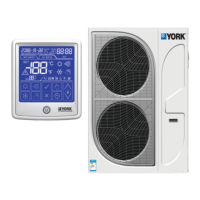
Shows a visual representation of the controller's appearance.
Illustrates the wiring connections between the controller and the unit.
Provides a legend for the icons used on the controller display.
Steps for turning the controller on and initial connection process.
Explains the procedure to reset the controller to its default configuration.
Describes the information shown in different display areas during normal operation.
Explains screen saver behavior and backlight states.
Guides on how to access and view fault codes and statuses.
Details how to use the touch-sensitive keys on the controller.
Describes buzzer sound signals and backlight states.
Instructions for turning the unit on and off using the mechanical key.
Steps to select and confirm cooling or heating operating modes.
How to use up/down keys to adjust and confirm temperature settings.
Step-by-step guide to set the date, time, and day of the week.
Guides on setting timers for once, daily, or weekly operation.
How to enter and navigate the parameter setting screen.
Describes various system parameters available for configuration.
Lists and describes various module-specific parameters.
How to access and view fault codes, numbers, and times.
Specifies where fault information is displayed on the screen.
Identifies key elements on the display related to fault information.
A table listing common fault codes and their descriptions.
How to enter and navigate the running status query display.
Identifies elements on the display for running status information.
Lists running status numbers and their descriptions.
Procedures for resetting faults and enabling/disabling key lock.
How to operate pump cycle and low sound modes.
How to enable/disable night mode for reduced noise during specific hours.
Steps to enter and configure the manual defrost setting.
 General
| Model | YVAG |
|---|---|
| Category | Chiller |
| Type | Air-Cooled Screw Chiller |
| Refrigerant | R-134a |
| Manufacturer | Johnson Controls |
| Capacity Range (Tons) | 150 - 450 |
| Compressor Type | Screw |
| Sound Power Level (dBA) | 85-95 dBA |
| Voltage Options | 380V, 460V, 50/60Hz |
| Operating Ambient Temperature Range (°C) | -20 to 52 |



 To Next Page