
 Need help?
Do you have a question about the Johnson Controls YORK YVAM and is the answer not in the manual?
Explains symbols used in the document to alert readers to specific situations.
Warns about external wiring connections and their potential impact on warranty and damage.
Warns about handling pressurized refrigerant and qualified technician requirements.
States that document information is subject to change without notice.
Defines system and compressor nomenclature through figures and descriptions.
Outlines Johnson Controls' warranty terms for YVAM chillers, including limitations and conditions.
Lists certifications and labels applicable to YVAM chillers.
Details standards and codes compliance for product design, testing, and certification.
Addresses fluorinated greenhouse gases and venting regulations.
Defines primary responsibilities for safe operation and maintenance of machinery.
Clarifies the manual's content as guidance and states Johnson Controls' rights.
Warns about potential hazards and necessary precautions for safe operation and maintenance.
Specifies the intended use of the unit and consequences of misuse or non-compliance.
Emphasizes the need for proper structural support to prevent injury or damage.
Details the unit's design limitations regarding external loads and mounted components.
Highlights hazard areas and the importance of restricted access to qualified personnel.
Addresses hazards associated with pressurized refrigerant and the need for trained personnel.
Outlines essential electrical safety precautions for installation and maintenance.
Advises on safety measures related to rotating components like fans and guards.
Warns about sharp edges on components like condenser coils and frame rails.
Provides safety guidelines for handling refrigerants and selecting correct glycol concentrations.
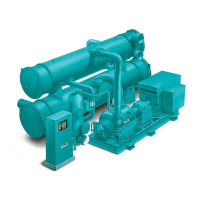
Lists the main components of the YORK Model YVAM Centrifugal Liquid Chiller.
Describes the compressor's single-stage centrifugal type, motor, and impeller design.
Details the compressor motor's hermetic design, high-speed capabilities, and bearing system.
Describes the fabrication and internal enhancement of the evaporator heat exchanger tubes.
Details the evaporator's shell and tube design, refrigerant distribution, and safety features.
Explains the condenser's microchannel design, fan speed control, and subcooling process.
Describes the construction and features of the removable compact waterboxes.
Explains how refrigerant flow is controlled by the condenser drain valve and subcooling setpoint.
Describes the HYP model variable speed drive's function in controlling compressor speed for capacity.
Explains the UPS power panel's function in providing backup power for essential loads during outages.
Details the purpose and usage of optional service isolation valves for refrigerant isolation.
Describes read-only parameters displayed on the chiller operation screens.
Explains that values can be changed by users after logging in with appropriate access levels.
Details the three access levels (View, Operator, Service) and their permissions.
Describes how to modify setpoints when the access level is operator or higher.
Provides a step-by-step procedure for programming setpoints on the OptiView Control Center.
Mentions buttons for manual control of compressor speed or valve actuators, often restricted to service technicians.
Explains the use of a soft key to enable cursor buttons for highlighting setpoint fields.
Explains how navigation buttons are used to move between screens and access information.
States that screens can be displayed in various languages, selected on the User screen.
Details valid display ranges for analog input values in English and Metric formats.
Describes the home screen display, showing a visual representation of the chiller and animated liquid flow.
Lists run messages, such as VSD high input current limit and input pulldown limit.
Details messages displayed during system startup, like waiting for flow or MBC levitation.
Lists messages indicating start inhibit conditions like line frequency or voltage not set.
Details features of the HYP compressor drive, including ground fault detection and direct liquid cooling.
Describes the Smart Sensor System for detecting rapidly rising temperatures and localized overheating.
Explains how low ambient temperatures inhibit chiller starting and the role of heaters.
Details components and power flow for the 0490B amp drive.
Explains benefits of the HYP model drive's harmonic current filter for power factor and waveform.
Explains the need for additional heating in the HYP0730C drive for low ambient start-up.
Describes the electronic signature board as an enhancement over smart sensors for problem detection.
Outlines daily, weekly, monthly, and yearly maintenance requirements for YVAM chillers.
Details steps for safely isolating electrical power and plant fluid flow before maintenance.
Directs users to Solution Navigator for required renewal parts.
Provides a guide for weekly, monthly, and semi-annual inspections of chiller components.
Lists annual checks for the evaporator, condenser, and compressor drive motor.
Explains leak testing procedures for the refrigerant side of the system.
Details leak testing methods, acceptable limits, and repair procedures for refrigerant systems.
Shows connection locations for system service, evacuation, and charging.
Outlines the procedure for performing a system pressure test using refrigerant and dry nitrogen.
Details steps for monitoring system pressure over time and conducting a gas pressure hold test.
Provides instructions for conducting a soap visual gas leak test to detect leaks.
Explains how to perform a trace gas leak test using R-134a or R-1234ze.
Details the process of evacuating the system, emphasizing power removal from VSD.
Outlines a method for evacuating and dehydrating the system to remove moisture effectively.
Step-by-step guide for conducting dehydration, including vacuum hold tests.
Describes final evacuation steps after pressure testing and vessel dehydration.
Explains charging the system with refrigerant, ensuring vapor quality and preventing liquid freezing.
Details how to verify and adjust refrigerant charge based on operational parameters and design values.
Covers maintenance checks for compressor drive motor, including winding resistance and electrical tests.
Specifies electrical tests for motor winding resistance performed by a qualified service technician.
Emphasizes maintaining evaporator shell cleanliness and water side of tubes.
Advises on water treatment to prevent scale, corrosion, and prolong evaporator tube life.
Discusses determining causes of performance issues and how fouled tubes affect capacity.
Explains types of tube fouling deposits like rust, sludge, and scale.
Outlines main methods for cleaning tubes, including brush and acid cleaning.
Details the brush cleaning process for tubes fouled with dirt and sludge.
Describes acid cleaning for tubes fouled with hard scale deposits, emphasizing expert execution.
Mentions specialized services for acid cleaning evaporators from commercial organizations.
Discusses detection and prevention of refrigerant leaks into water circuits or vice versa.
Provides steps to determine the exact location of evaporator tube leaks.
Highlights importance of maintaining condenser microchannel coils for heat transfer and warranty.
Outlines cleaning guidelines for MCHX to prevent damage and maintain performance.
Details the cleaning procedure for Standard and Environment Guard microchannel coils.
Describes the cleaning procedure for Environment Guard Premium microchannel coils.
Instructions for using touch-up paint on finned coil surfaces.
Guide for applying urethane mastic touch-ups to end tubes or headers.
Recommends annual checks for tight electrical connections and secure connectors.
Explains how to verify operation of various heaters protecting against low ambient temperatures.
Details the procedure for testing evaporator waterbox heaters.
Details the procedure for testing evaporator shell heaters.
Outlines testing procedures for drive coolant heat trace elements HT1 and HT2.
Describes how to test the VGD actuator heater mat by measuring current.
Details testing procedures for the MBC heater mat.
Explains how to test the drive's internal heater by measuring current and adjusting temperature.
Describes testing the OptiView Control Panel heater by measuring current and adjusting thermostat.
Explains how to test the OptiView panel cooler by adjusting its thermostat knob.
States UPS panel heating relies on chiller coolant and testing involves manual pump operation.
Details performing a battery health test via the Power Panel screen to monitor battery voltage under load.
Lists acceptable printers and guidelines for using unlisted printers with RS-232 serial interface.
Details how to connect printers to the Control Center Microboard, specifying cable and connector requirements.
Outlines printer configuration steps, including DIP switch settings for OKI Data OKIPOS 441.
Provides specifications for Brecknell CP130 printers and their connection details.
Covers chiller ID assignment and printer setup configuration via the Comms screen.
Sets the printer type to Weigh-Tronix using the Printer screen.
Configures automatic status reports printing at specified intervals and start times.
Configures automatic status reports printing at specified intervals and start times.
Provides instructions for establishing communication between the Control Panel and a laptop for downloading reports.
Explains how data values are transmitted serially at defined intervals for logging.
Describes automatic data capture initiated by the installed SD card for viewing and analysis.
Explains how to convert temperature values between Fahrenheit and Celsius.
 General
| Brand | Johnson Controls |
|---|---|
| Model | YORK YVAM |
| Category | Chiller |
| Language | English |



 To Next Page
