Need help?
Do you have a question about the Juniper SRX4600 and is the answer not in the manual?
Procedures for mounting the SRX4600 Firewall in a 19-inch four-post rack configuration, including grounding strap attachment.
Steps for connecting the SRX4600 Firewall to ground using an ESD strap and grounding cable.
Instructions for connecting AC or DC power to the SRX4600 Firewall.
Configure essential console or management host parameters like Baud Rate, Flow Control, and Data bits.
Connect via console and perform initial configuration steps, including setting passwords and hostnames.
Recommendations for further actions after initial configuration, such as CLI configuration and software upgrades.
Links to comprehensive SRX4600 documentation and release notes for staying updated.
Resources for learning Juniper technologies through videos, including installation and configuration guides.
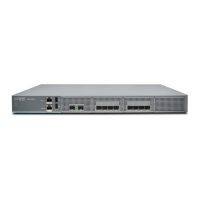
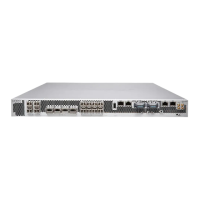
The Juniper Networks SRX4600 Firewall is a robust network security device designed for deployment in a 19-inch four-post rack configuration. It serves as a critical component for safeguarding network infrastructure, offering comprehensive firewall capabilities to protect against various cyber threats. The device is engineered for simplicity in both its installation and ongoing management, aiming to provide a straightforward experience for network administrators.
The primary function of the SRX4600 Firewall is to provide advanced network security. It acts as a barrier between trusted internal networks and untrusted external networks, inspecting incoming and outgoing network traffic to enforce security policies. This includes filtering traffic based on predefined rules, preventing unauthorized access, and mitigating various forms of network attacks. The firewall is capable of handling high-performance network environments, making it suitable for data centers, enterprise networks, and service provider deployments where security and throughput are paramount.
The SRX4600 supports both AC and DC power configurations, offering flexibility to integrate into different power infrastructures. Its design emphasizes reliability and continuous operation, crucial for maintaining network availability and security posture. The device's core functionality revolves around its ability to process and secure network traffic efficiently, ensuring that legitimate data flows unimpeded while malicious traffic is blocked.
Beyond basic packet filtering, the SRX4600 incorporates advanced security features. While specific features are configured through the Junos OS Evolved CLI, the device is built to support a wide range of security services. These services typically include intrusion prevention systems (IPS), unified threat management (UTM) capabilities, VPN services for secure remote access and site-to-site connectivity, and application visibility and control. The firewall's architecture is designed to scale with evolving network demands and threat landscapes, providing a future-proof security solution.
The initial configuration process highlights the device's reliance on the Junos OS Evolved CLI, a powerful command-line interface that provides granular control over all aspects of the firewall's operation. This allows administrators to define intricate security policies, configure network interfaces, set up routing options, and manage user access. The CLI-driven approach ensures precision and consistency in configuration, which is essential for maintaining a secure and stable network environment.
The SRX4600 is designed for ease of use from the moment of installation through its daily operation. The mounting process, while requiring two persons due to the device's weight (approximately 38 lb for AC and 40 lb for DC models), is clearly outlined with steps for attaching mounting brackets and securing the chassis to a standard 19-inch rack. This ensures a stable and compliant physical installation. The inclusion of a four-post rack-mounting kit simplifies the physical setup, although some screws for securing the chassis to the rack are not provided, requiring administrators to source these separately.
Connecting the device to ground is a critical safety and operational step, and the manual provides explicit instructions for attaching an ESD grounding strap and connecting a grounding cable to a proper earth ground. This attention to detail in the setup process underscores the importance of proper installation for the device's longevity and the safety of personnel.
Power connection procedures are also detailed, distinguishing between AC and DC power configurations. For AC-powered units, the process involves inserting power cords and verifying the OK/FAIL LED status. For DC-powered units, a more cautious approach is emphasized, requiring verification of zero voltage across cable leads and proper labeling before connection. This highlights the device's adaptability to different power environments while prioritizing safety during electrical connections.
The initial configuration of the SRX4600 is performed through a console port, typically connected to a laptop or PC. This direct connection allows for the fundamental setup of the device, including setting the root authentication password, configuring an administrator account, defining the device's hostname, and setting up network interfaces and default routes. The CLI commands provided are straightforward, guiding the administrator through the essential steps to bring the firewall online and establish basic network connectivity and security. The ability to check configuration validity (commit check) before committing changes is a valuable feature, preventing potential errors and ensuring a smooth deployment.
The device's operational status is indicated by LEDs, such as the OK/FAIL LED, which provides immediate visual feedback on the power supply status. This simple yet effective diagnostic tool helps administrators quickly ascertain the health of the power system.
Maintenance of the SRX4600 is integrated into its design and operational procedures, focusing on ease of access and clear instructions for routine tasks. The physical installation guidelines, such as allowing adequate clearance for airflow and maintenance, are crucial for the device's long-term performance and for facilitating future servicing. Proper airflow prevents overheating, which is vital for the reliability and lifespan of network hardware.
The modular nature of network devices often implies ease of component replacement, and while not explicitly detailed in the provided text, the rack-mountable design inherently supports accessibility for maintenance. The instructions for securing mounting blades and attaching grounding cables are not only for initial setup but also ensure that the device remains securely in place, simplifying access for any future hardware inspections or replacements.
Software maintenance is primarily managed through the Junos OS Evolved CLI. The initial configuration steps lay the groundwork for ongoing management, including user access and authentication. The ability to configure administrator accounts with specific privileges is a fundamental security maintenance feature, ensuring that only authorized personnel can make changes to the firewall's configuration.
The documentation also points to resources for installing and upgrading Junos OS Evolved software, activating licenses, and configuring various interfaces. These resources are essential for keeping the firewall's software up-to-date, applying security patches, and expanding its capabilities as network requirements evolve. Regular software updates are a cornerstone of effective security maintenance, addressing new vulnerabilities and improving performance.
Troubleshooting is supported through the CLI, allowing administrators to diagnose issues with interfaces, routing, and other network functions. The commit check command, for instance, is a proactive maintenance feature that helps identify configuration errors before they can impact network operations.
The availability of comprehensive documentation, including the SRX4600 Documentation in the Juniper Networks TechLibrary, Junos OS Release Notes, and various user guides, is a significant maintenance feature. These resources provide detailed information on all aspects of the device, from installation and configuration to advanced features and troubleshooting. Additionally, Juniper Networks offers learning resources such as videos and training portals, which empower administrators to continuously expand their knowledge and skills in managing the SRX4600 and other Juniper devices. This commitment to educational resources helps ensure that administrators can effectively maintain and optimize their security infrastructure.

 To Next Page

 General