Need help?
Do you have a question about the Juniper SRX380 and is the answer not in the manual?
Register product serial numbers on the Juniper Networks website to update installation base data.
Instructions for properly grounding the SRX380 Services Gateway using an ESD strap and grounding cable.
Detailed steps on how to connect the AC power cord, including using the retainer clip.
Steps to connect the SRX380 to a management device via an Ethernet cable for initial configuration.
Information required and the initial step to launch the J-Web Setup wizard.
Steps to select and configure the SRX380 in Standard Mode via the J-Web wizard.
Setting time, time zone, and DNS server IP address in the J-Web wizard.
Configuring the management port IP address and static route within the J-Web wizard.
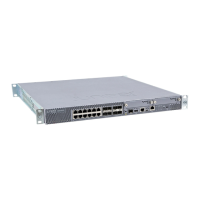
The SRX380 Services Gateway is a versatile networking platform designed to consolidate security, routing, and switching functionalities. This all-in-one device is suitable for both enterprise deployments, including large branch offices, small campuses, and SD-WAN setups, as well as service provider environments for managed WAN CPE and SD-WAN. Its design emphasizes ease of use and quick deployment, offering a plug-and-play experience with factory-default settings that allow for immediate operation upon connection to LAN and WAN networks.
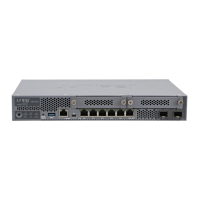
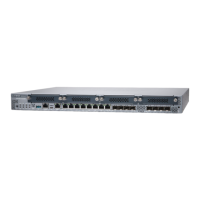
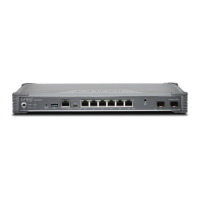
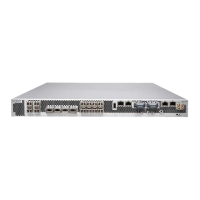
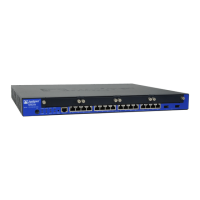
The SRX380 is equipped with a comprehensive set of features to facilitate its operation and management. The front panel includes various LEDs for status indication, a Reset Config button for system resets, and multiple connectivity options. These include a Mini-USB console port, Mini-PIM slots for expansion, and a combination of 1-Gigabit Ethernet and 10-Gigabit Ethernet SFP/SFP+ ports, as well as additional 1-Gigabit Ethernet ports. For management, it features a dedicated management port, a USB port, and an RJ-45 console port. A power button is also conveniently located on the front panel.
The device supports various interface configurations by default. For instance, ports 0/0 and 0/19 are configured as untrust interfaces, acting as clients with unassigned IP addresses, suitable for WAN connections. Ports 0/1 to 0/18 are part of a VLAN Interface (irb.0) within the trust security zone, configured as a server with an IP address of 192.168.2.1/24, ideal for LAN connections. The management interface (fxp0) is also configured as a server with an IP address of 192.168.1.1/24. For LTE connectivity, if an LTE Mini-PIM is present, the cl-1/0/0 interface is set to N/A, while the dI0 (logical) interface is in the untrust zone with an ISP assigned IP.
Security is a core aspect of the SRX380. By default, it includes security policies that permit traffic between trust zones and from trust to untrust zones. NAT rules are also pre-configured to perform Source NAT to the untrust zone interface for traffic originating from the trust zone. Essential services and protocols are enabled by default, including SSH, HTTPS, and NETCONF over SSH, with RSTP enabled on all interfaces for switching operations. A basic set of screens is configured on the untrust zone to provide secure traffic.
The device offers flexible configuration options through its J-Web interface. Users can easily modify settings such as hostname, root authentication password, IP addresses for NTP and DNS servers, and the management interface. The J-Web Setup Wizard guides users through the configuration process, allowing them to choose between Standard, Cluster (HA) Mode, or Passive Mode. This wizard simplifies the initial setup, enabling users to define network parameters, configure zones, and set up security policies. The plug-and-play functionality, combined with the J-Web wizard, ensures that the SRX380 can be quickly integrated into an existing network and customized to specific requirements.
The SRX380 is designed with maintenance and reliability in mind. The rear panel includes a grounding point for electrical safety, multiple fans for efficient cooling, a power supply input, and an SSD slot for storage.
Installation in a four-post rack is straightforward, with a rack mounting kit provided with the device. The process involves securing front-mounting brackets to side-mounting rails, then attaching these rails to the SRX380, and finally positioning the device in the rack. This modular approach simplifies physical installation and ensures secure placement.
Connecting to ground is a critical safety step, involving wrapping an ESD grounding strap around the wrist, connecting a grounding cable lug to the grounding point on the device, and securing it with washers and screws. Proper dressing of the grounding cable is emphasized to prevent interference with other components and to avoid tripping hazards.
Power connection is also designed for security and ease. A power cord retainer strip is used to secure the power cord, preventing accidental disconnections. The strip snaps into place above the power cord inlet, and a small tab allows for loosening and tightening the loop around the power cord coupler. Once the power cord is firmly inserted, the loop is slid toward the power supply for a snug fit. The device starts automatically upon power-up, and the PWR LED indicates normal operation, turning solid green when the power supply is functioning correctly. A note advises users to ignore any error indicators during the initial 60 seconds after power-on, as the system initializes.
For ongoing management, the SRX380 functions as a DHCP server, automatically assigning an IP address to a connected management device, such as a laptop, on the 192.168.1.0/24 network. This simplifies the initial connection for configuration. If the laptop fails to acquire an IP address automatically, manual configuration is possible. The J-Web interface provides a user-friendly graphical environment for managing the device, allowing for easy access to settings and monitoring. The system also offers resources like Junos OS User Guides and a Getting Started Knowledge Base Article for further assistance with configuring advanced features. Regular updates to the installation base and product serial number registration are also recommended to ensure eligibility for hardware replacement service-level agreements.
 General
| Firewall Throughput | 20 Gbps |
|---|---|
| IPSec VPN Throughput | 4 Gbps |
| Memory | 8 GB |
| MTBF | 200, 000 hours |
| Form Factor | 1U |
| Concurrent Sessions | 1, 000, 000 |
| Interfaces | 16 x 1GbE, 4 x 10GbE |
| Power Supply | Dual redundant AC or DC |
| Operating Temperature | 32° to 104° F (0° to 40° C) |
| Storage Temperature | -4° to 158° F (-20° to 70° C) |
| Humidity | 5% to 90% non-condensing |

 To Next Page